
At its core, a vacuum furnace is about achieving ultimate process control. It creates an extremely pure, actively controlled environment for heat treatment by removing virtually all atmospheric gases. This fundamental change prevents unwanted surface reactions like oxidation and decarburization, resulting in cleaner, stronger, and more dimensionally stable components with superior mechanical properties and a bright, scale-free finish.
By removing the atmosphere rather than trying to control it, a vacuum furnace shifts the paradigm of heat treatment. It moves from merely protecting a part's surface to actively purifying and enhancing the material itself, delivering a level of quality and repeatability that is difficult to achieve with traditional methods.
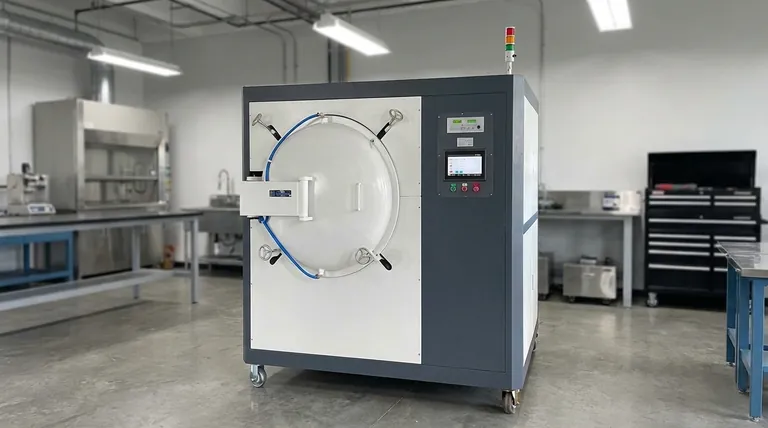
The Foundation: How a Vacuum Transforms Heat Treatment
The primary advantages of a vacuum furnace all stem from one core principle: removing the reactive elements that surround a workpiece during heating.
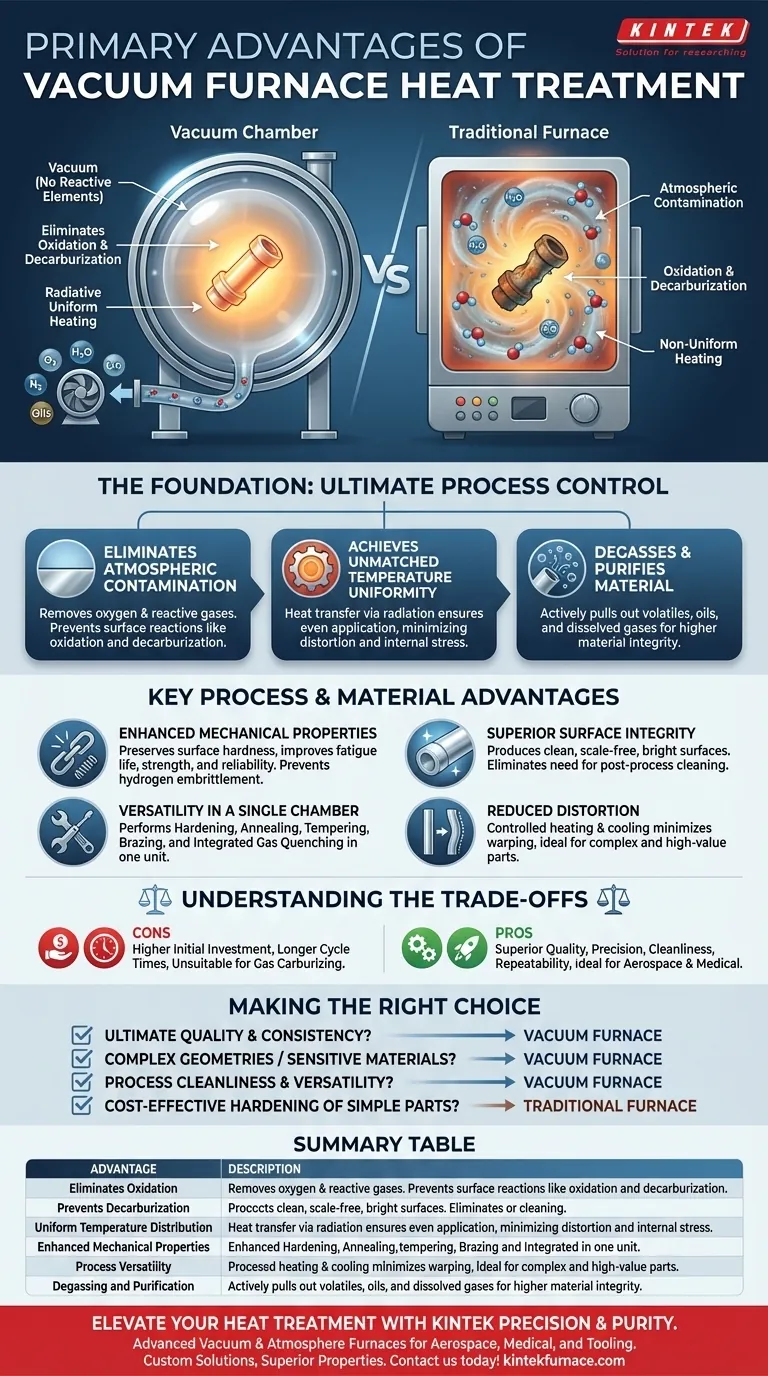
Eliminating Atmospheric Contamination
In a traditional furnace, the ambient air—composed of oxygen, nitrogen, water vapor, and other elements—reacts with the hot metal surface. A vacuum furnace physically removes these molecules using a pumping system.
This creates a sub-atmospheric environment where these reactions cannot occur, providing a level of purity that is unmatched by simply flooding a chamber with a protective gas.
The Impact on Surface Integrity
Without oxygen, oxidation (scaling or discoloration) is completely eliminated. Parts emerge from the furnace with a clean, bright surface, removing the need for post-process cleaning like sandblasting or chemical pickling.
Similarly, removing carbon-reactive gases prevents decarburization, a process where carbon leaches from the surface of steel, leaving a soft, weak outer layer. This ensures the material's surface hardness and fatigue properties are preserved.
Achieving Unmatched Temperature Uniformity
In a vacuum, heat transfer occurs primarily through thermal radiation. This method allows heat to be applied evenly across the entire surface of the part, regardless of its shape.
This exceptional uniformity minimizes thermal gradients, which are a primary cause of internal stress and distortion. The result is a more dimensionally stable part with significantly less risk of warping.
Key Process and Material Advantages
The controlled vacuum environment directly translates into tangible improvements in the final product and the manufacturing process itself.
Enhanced Mechanical Properties
Because a vacuum furnace prevents the formation of surface imperfections like oxide layers and decarburization, the finished part retains its designed engineering properties.
This clean processing environment also prevents issues like hydrogen embrittlement, as any residual hydrogen can be pulled out of the material during the cycle. The result is a component with improved fatigue life, strength, and overall reliability.
Versatility in a Single Chamber
Modern vacuum furnaces are highly versatile "all-in-one" systems. A single unit can perform multiple processes, such as hardening, annealing, tempering, and brazing.
Most systems include integrated high-pressure gas quenching (HPGQ) using inert gases like nitrogen or argon. This allows for rapid, controlled cooling within the same sealed chamber, further enhancing process control and efficiency.
Degassing and Surface Purification
The vacuum actively pulls volatile substances out of the workpiece. This includes residual oils from manufacturing, binding agents in metal injection molded (MIM) parts, and dissolved gases within the metal itself.
This degassing function acts as a final purification step, leading to a higher quality material with improved internal integrity, which is especially critical for brazing and medical implant applications.
Understanding the Trade-offs
While powerful, a vacuum furnace is not the universal solution. Objectivity requires acknowledging its specific limitations.
Higher Initial Investment
Vacuum furnaces represent a significant capital investment. The complex pumping systems, robust chamber construction, and sophisticated computer controls make them more expensive upfront than most conventional atmosphere furnaces.
Process Cycle Considerations
The time required to pump the chamber down to the desired vacuum level adds to the total cycle time. For some high-volume, low-margin parts, this additional time may not be economically viable compared to faster, continuous atmosphere furnace operations.
Unsuitability for Certain Processes
Traditional thermochemical processes that rely on adding elements to a material's surface, such as gas carburizing or nitrocarburizing, are fundamentally incompatible with a high vacuum. While vacuum-specific versions of these processes exist (e.g., low-pressure vacuum carburizing), they are distinct and specialized.
Making the Right Choice for Your Application
Selecting the right heat treatment method depends entirely on your final goal for the component.
- If your primary focus is ultimate part quality and consistency: A vacuum furnace is the superior choice for its ability to eliminate surface defects and ensure perfectly repeatable results, which is essential for aerospace, medical, and high-performance tooling.
- If your primary focus is processing complex geometries or sensitive materials: The uniform heating and controlled cooling of a vacuum furnace minimize distortion and thermal stress, making it the safest option for intricate or high-value parts.
- If your primary focus is process cleanliness and versatility: A vacuum furnace allows for multiple, distinct processes in a single chamber without cross-contamination, simplifying workflow and improving the work environment.
- If your primary focus is cost-effective hardening of simple, high-volume parts: A traditional atmosphere furnace may be a more economical solution, provided that minor surface oxidation or decarburization is acceptable for the application.
By understanding these core principles, you can confidently determine if the precision and purity of vacuum heat treatment align with your engineering and production goals.
Summary Table:
| Advantage | Description |
|---|---|
| Eliminates Oxidation | Prevents surface scaling and discoloration for a bright, clean finish without post-cleaning. |
| Prevents Decarburization | Maintains surface hardness and fatigue properties by avoiding carbon loss in steel. |
| Uniform Temperature Distribution | Uses radiation for even heating, reducing distortion and internal stress in complex parts. |
| Enhanced Mechanical Properties | Improves fatigue life, strength, and reliability by preventing defects like hydrogen embrittlement. |
| Process Versatility | Supports hardening, annealing, tempering, and brazing in one chamber with integrated gas quenching. |
| Degassing and Purification | Removes volatile substances for higher material integrity, ideal for brazing and medical implants. |
Ready to elevate your heat treatment processes with precision and purity? KINTEK specializes in advanced high-temperature furnace solutions, including Vacuum & Atmosphere Furnaces, designed to meet the unique needs of industries like aerospace, medical, and tooling. Leveraging our exceptional R&D and in-house manufacturing, we offer deep customization to ensure your components achieve superior mechanical properties, dimensional stability, and a scale-free finish. Contact us today to discuss how our vacuum furnaces can enhance your lab's efficiency and deliver unmatched quality for your critical applications!
Visual Guide
Related Products
- Vacuum Hot Press Furnace Machine Heated Vacuum Press Tube Furnace
- Vacuum Hot Press Furnace Machine Heated Vacuum Press
- 600T Vacuum Induction Hot Press Vacuum Heat Treat and Sintering Furnace
- 2200 ℃ Tungsten Vacuum Heat Treat and Sintering Furnace
- Vacuum Heat Treat Sintering Furnace with Pressure for Vacuum Sintering
People Also Ask
- Why use Vacuum Hot Press (VHP) for ZnS Ceramics? Achieve Superior IR Transparency and Mechanical Strength
- What safety features are incorporated in vacuum hot press furnaces? Ensure Operator and Equipment Protection
- What are the benefits of the vacuum environment system in a vacuum hot press furnace? Unlock High-Density Sintering
- What is the primary function of the vacuum environment in a vacuum hot press furnace during titanium alloy processing? Prevent Embrittlement for Superior Ductility
- How have vacuum hot press furnaces transformed material processing? Achieve Superior Density and Purity



















