
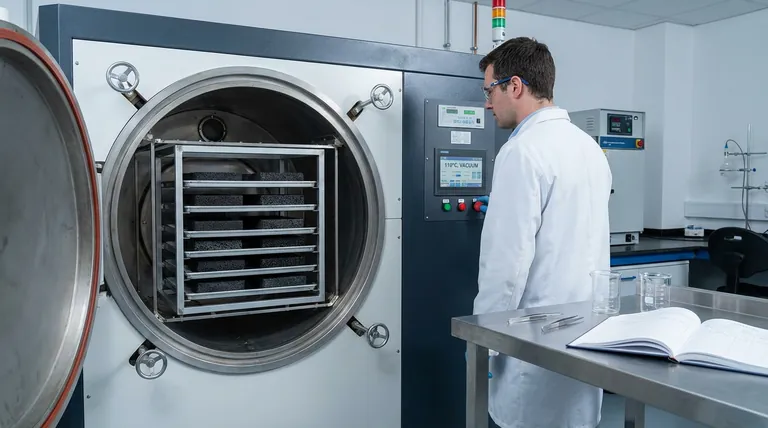
The critical role of the vacuum drying oven at 110°C is to facilitate the complete removal of residual deionized water while creating a protective environment for the selenium components. This process prevents the oxidation of selenium during the heating phase, ensuring the active material remains in its elemental form. Simultaneously, the thermal treatment under vacuum strengthens the bond between the selenium and the Polyphenylene Sulfide (PPS) substrate, which is vital for the material's structural integrity.
The vacuum environment is not merely for drying; it is a protective measure that preserves the chemical integrity of elemental selenium by preventing oxidation. This step is essential for firmly anchoring the active components to the fabric, ensuring the material can withstand the high-velocity flow of industrial flue gases.
Preserving Chemical Integrity
Prevention of Selenium Oxidation
The most significant risk during the 110°C treatment is the chemical alteration of the selenium. Heating selenium in the presence of oxygen can lead to unwanted oxidation, which degrades the material's functional properties. The vacuum oven eliminates atmospheric oxygen, ensuring the selenium remains chemically stable throughout the thermal process.
Maintaining Elemental Form
For the composite to function correctly, the active components must remain as elemental selenium. Any shift in oxidation state could render the functionalization ineffective. The vacuum environment acts as a shield, locking in the elemental state of the selenium while the heat is applied.
Structural Enhancement and Bonding
Strengthening the Se-PPS Interface
The 110°C treatment is not just about drying; it is an annealing process that enhances adhesion. The heat promotes a stronger interaction between the selenium and the PPS fabric. By conducting this under vacuum, the process ensures that no air pockets or oxide layers interfere with this bonding interface.
Improving Mechanical Durability
A weak bond between the coating and the substrate leads to failure in practical applications. The enhanced bonding achieved in the vacuum oven anchors the selenium firmly to the PPS fiber. This ensures the composite is durable enough to resist detachment caused by the high-velocity flow of industrial flue gases.
The Mechanism of Solvent Removal
Deep Pore Drying
Porous composite materials can trap liquids deep within their microstructure. While 110°C is sufficient to boil water at standard pressure, the vacuum environment significantly accelerates this process. It lowers the boiling point of the residual deionized water, allowing it to evaporate rapidly and completely from the deepest pores without requiring excessive temperatures that could damage the PPS substrate.
Understanding the Trade-offs
Process Complexity vs. Material Quality
Using a vacuum oven introduces more complexity and equipment cost compared to a standard air-drying oven. However, this is a necessary trade-off. A standard oven would dry the material but would likely result in oxidized, poorly adhered selenium that fails under industrial stress.
Thermal Balance
While the vacuum allows for lower-temperature evaporation, the specific set point of 110°C is deliberate. It is high enough to cure the bond between the materials but, thanks to the vacuum, safe enough to prevent thermal degradation or oxidation.
Making the Right Choice for Your Goal
To ensure the success of your Se/PPS composite preparation, apply the following principles:
- If your primary focus is Chemical Purity: Prioritize the vacuum seal integrity to ensure absolute prevention of oxidation, preserving the elemental selenium.
- If your primary focus is Mechanical Longevity: Ensure the full 110°C temperature is reached and maintained to maximize the anchoring of selenium to the PPS fabric against flue gas erosion.
By strictly controlling both the temperature and the atmospheric pressure, you transform a sensitive chemical mixture into a robust, industrially viable filter material.
Summary Table:
| Process Objective | Mechanism in Vacuum Oven | Key Benefit |
|---|---|---|
| Oxidation Prevention | Removal of atmospheric oxygen | Preserves elemental selenium state |
| Structural Integrity | Thermal annealing at 110°C | Strengthens Se-PPS interface bonding |
| Solvent Removal | Reduced pressure evaporation | Deep pore drying of residual water |
| Mechanical Durability | High-temperature anchoring | Resists high-velocity industrial gas flow |
Elevate Your Material Research with KINTEK Precision
Unlock the full potential of your composite materials with KINTEK’s advanced thermal solutions. Backed by expert R&D and manufacturing, KINTEK offers high-performance Vacuum, Muffle, Tube, and CVD systems—all fully customizable to meet the rigorous demands of Se/PPS functionalization and other sensitive lab processes.
Ensure your research achieves maximum chemical integrity and mechanical durability. Contact KINTEK today to find the perfect high-temperature furnace for your unique needs.
References
- Hailong Li, Jianping Yang. Biomimetic mercury immobilization by selenium functionalized polyphenylene sulfide fabric. DOI: 10.1038/s41467-024-45486-7
This article is also based on technical information from Kintek Furnace Knowledge Base .
Related Products
- Vacuum Heat Treat Sintering and Brazing Furnace
- Vacuum Heat Treat Sintering Furnace Molybdenum Wire Vacuum Sintering Furnace
- Dental Porcelain Zirconia Sintering Ceramic Vacuum Press Furnace
- Molybdenum Vacuum Heat Treat Furnace
- Vacuum Hot Press Furnace Machine Heated Vacuum Press
People Also Ask
- What are the benefits of using vacuum heat treating furnaces for metal alloys? Achieve Superior Metal Properties and Performance
- What is one of the most important uses of vacuum heat treating furnaces in aerospace? Achieve Superior Strength in Aircraft Alloys
- How does vacuum heat treating affect the grain structure of metal alloys? Achieve Precise Microstructure Control
- What is the temperature of a vacuum furnace brazing? Optimize Your Joint Strength and Cleanliness
- What are the steps involved in a typical vacuum brazing treatment? Master the Process for Strong, Clean Joints












