
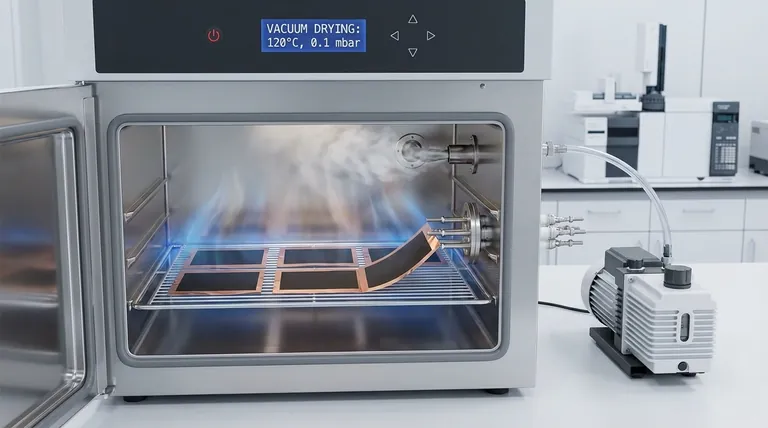
A vacuum drying oven is indispensable for the preparation of carbon-based electrodes because it enables deep dehydration and solvent removal without chemically degrading the sample. By operating under a vacuum at 120°C, the equipment ensures the complete volatilization of the N-methylpyrrolidone (NMP) solvent while simultaneously preventing atmospheric oxygen from oxidizing the carbon surface. This process is essential for creating the stable electrical contact required to accurately evaluate Edge Nitrogen-enriched Lignin-derived Carbon Nanosheet Frameworks (EN-LCNF).
The vacuum drying process resolves the critical conflict between the high temperatures needed to evaporate stubborn solvents and the sensitivity of carbon nanomaterials to oxidation, ensuring the electrode’s chemical structure remains intact for testing.
The Mechanics of Solvent and Moisture Removal
Volatilization of NMP
The preparation of electrode slurries relies heavily on N-methylpyrrolidone (NMP) as a solvent.
However, NMP must be completely removed to form a functional solid electrode.
The vacuum drying oven facilitates the thorough volatilization of NMP at 120°C, a temperature sufficient to drive off the solvent but controlled enough to maintain material stability.
Achieving Deep Dehydration
Beyond solvent removal, the electrode must be free of trace moisture.
Water molecules trapped within the electrode microstructure can cause detrimental side reactions inside a battery cell.
The low-pressure environment of the vacuum oven extracts this residual moisture from the deep pores of the coated slurry, ensuring the material is strictly anhydrous.
Preserving Material Integrity
Preventing Surface Oxidation
Carbon materials, such as EN-LCNF, are highly susceptible to oxidation when exposed to high temperatures in the presence of air.
Standard thermal drying would risk altering the surface functional groups of the carbon nanosheets, fundamentally changing the material you intend to test.
By removing atmospheric oxygen, the vacuum oven allows for high-temperature drying while preserving the original chemical composition of the active material.
Establishing Electrical Continuity
The ultimate goal of drying is to solidify the relationship between the active material, the conductive carbon black, and the PVDF binder.
Thorough drying ensures these components form a cohesive network on the copper foil current collector.
This creates the stable electrical contact necessary to measure impedance and capacity accurately, without interference from remaining liquid agents.
Common Pitfalls to Avoid
The Risk of Incomplete Drying
If the vacuum process is rushed or the pressure is not sufficiently low, trace NMP or moisture may remain.
This leads to poor adhesion between the active material and the current collector, causing the electrode to delaminate during testing.
Furthermore, residual moisture will trigger electrochemical side reactions, producing "phantom" data that does not reflect the true performance of the EN-LCNF material.
The Danger of Thermal Oxidation
Attempting to dry these electrodes in a standard convection oven is a critical error.
Without the vacuum to remove oxygen, the heat required to evaporate the solvent will inevitably oxidize the carbon surface.
This degradation modifies the active sites of the material, rendering the subsequent electrochemical performance assessment invalid.
Making the Right Choice for Your Experiment
To ensure the reliability of your EN-LCNF evaluation, consider your specific analytical goals when setting drying parameters:
- If your primary focus is Chemical Stability: Prioritize a high-vacuum environment to eliminate oxygen entirely, preserving the specific surface functional groups of the carbon nanosheets.
- If your primary focus is Electrochemical Accuracy: Ensure the drying duration is sufficient to remove 100% of the NMP solvent, as any residue will interfere with conductivity and binder adhesion.
Precise control of the drying environment is the only way to transform a raw slurry into a reliable, testable electrode.
Summary Table:
| Feature | Impact on EN-LCNF Electrodes | Benefit |
|---|---|---|
| Vacuum Environment | Eliminates atmospheric oxygen | Prevents surface oxidation of carbon nanosheets |
| 120°C Thermal Control | Facilitates NMP solvent volatilization | Ensures deep dehydration and solid electrode formation |
| Low-Pressure Extraction | Removes trapped pore moisture | Prevents detrimental electrochemical side reactions |
| Structural Preservation | Maintains binder-active material bond | Ensures stable electrical contact and capacity accuracy |
Elevate Your Materials Research with KINTEK Precision
Don't let residual moisture or oxidation compromise your EN-LCNF evaluation. Backed by expert R&D and manufacturing, KINTEK offers high-performance Vacuum, Muffle, Tube, Rotary, and CVD systems designed to meet the rigorous demands of battery and carbon research. Our lab high-temp furnaces are fully customizable to your unique drying and sintering needs, ensuring your electrodes maintain perfect chemical integrity.
Ready to optimize your drying process? Contact us today to consult with our experts on the perfect high-temperature solution for your laboratory.
References
- Caiwei Wang, Zhili Li. Engineering of edge nitrogen dopant in carbon nanosheet framework for fast and stable potassium-ion storage. DOI: 10.1007/s44246-024-00101-8
This article is also based on technical information from Kintek Furnace Knowledge Base .
Related Products
- Vacuum Heat Treat Sintering and Brazing Furnace
- Vacuum Heat Treat Sintering Furnace Molybdenum Wire Vacuum Sintering Furnace
- Dental Porcelain Zirconia Sintering Ceramic Vacuum Press Furnace
- Molybdenum Vacuum Heat Treat Furnace
- Vacuum Hot Press Furnace Machine Heated Vacuum Press
People Also Ask
- How does vacuum heat treating affect the grain structure of metal alloys? Achieve Precise Microstructure Control
- What is one of the most important uses of vacuum heat treating furnaces in aerospace? Achieve Superior Strength in Aircraft Alloys
- What are the benefits of using vacuum heat treating furnaces for metal alloys? Achieve Superior Metal Properties and Performance
- What is the temperature of a vacuum furnace brazing? Optimize Your Joint Strength and Cleanliness
- What are the steps involved in a typical vacuum brazing treatment? Master the Process for Strong, Clean Joints












