The precision of the vacuum environment is the deciding factor in the efficiency of ion delivery during plasma nitriding. An automated pressure control system enables the maintenance of extremely low pressures, specifically around 10^-3 mbar, which is an order of magnitude lower than traditional Direct Current (DC) plasma nitriding. This distinct low-pressure regime minimizes particle collisions, ensuring that ions strike the workpiece with maximum kinetic energy.
The core value of an automated pressure control system is its ability to maintain a vacuum where the mean free path is maximized. By reducing the number of gas molecules in the chamber, the system ensures ions retain energy close to the bias voltage, leading to deeper diffusion and superior surface quality.
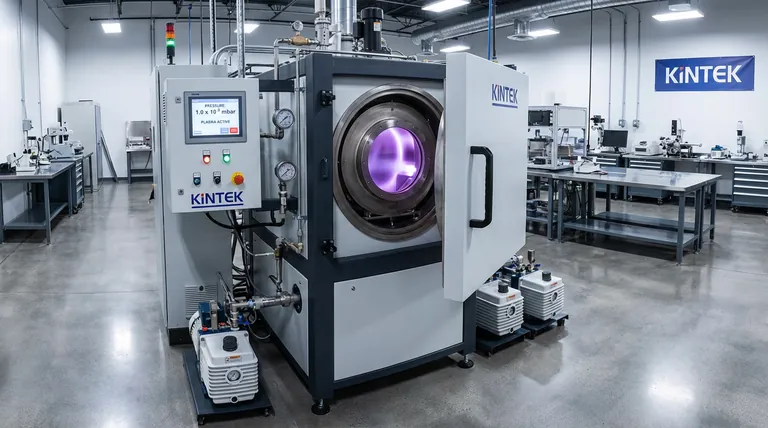
The Physics of Low-Pressure Efficiency
Reducing Energy Loss
In a plasma nitriding chamber, ions must travel through a "sheath" to reach the workpiece.
At higher pressures, this path is crowded with gas molecules. Ions collide with these molecules, losing significant energy before they ever reach the surface.
An automated system maintains pressure at 10^-3 mbar. This low density drastically reduces the probability of these collisions, preserving the ions' momentum.
Maximizing Kinetic Energy
Because the ions encounter fewer obstacles, they are injected into the workpiece surface with energy close to the bias voltage.
This high-energy bombardment is critical. It drives nitrogen atoms effectively into the material lattice, rather than just coating the surface.
The result is a more robust interaction between the plasma and the workpiece, directly translating to improved process efficiency.
Superiority Over Traditional Methods
Beyond Traditional DC Nitriding
Traditional DC plasma nitriding typically operates at higher pressures. While functional, these systems suffer from the energy loss described above.
Automated pressure control pushes the vacuum an order of magnitude lower. This shift changes the fundamental dynamics of ion implantation.
Enhanced Layer Quality
The specific environment created by automated control facilitates a stable plasma glow discharge.
This stability ensures that the bombardment of the workpiece is uniform across the entire geometry.
Consequently, the nitrided layer formed is consistent, and the diffusion efficiency of nitrogen atoms is significantly improved compared to manual or higher-pressure systems.
Operational Considerations and Trade-offs
Process Stability Sensitivity
While lower pressure yields higher ion energy, it requires rigorous control.
If the vacuum system fails to maintain the specific setpoint (e.g., drifting above 10^-3 mbar), the mean free path decreases, and the benefits of high-energy impact are lost immediately.
Glow Discharge Maintenance
A vacuum system must be balanced to sustain the glow discharge.
If the pressure drops too low without automatic compensation, the plasma discharge can become unstable or extinguish. The automated system is not just about reaching a low number; it is about stabilizing that number dynamically to keep the plasma active.
Making the Right Choice for Your Goal
To maximize the benefits of an automated pressure control system, align your settings with your specific metallurgical objectives:
- If your primary focus is Diffusion Depth: Prioritize maintaining the lowest stable pressure (10^-3 mbar) to maximize the kinetic energy of the impacting ions.
- If your primary focus is Process Consistency: Ensure the automation logic prioritizes stability over absolute vacuum depth to maintain a continuous, uniform glow discharge.
Automated pressure control transforms the vacuum chamber from a simple container into a precision tool for maximizing ion energy.
Summary Table:
| Feature | Traditional DC Nitriding | Automated Low-Pressure System |
|---|---|---|
| Operating Pressure | High (mbar range) | Low (10^-3 mbar) |
| Mean Free Path | Short (Frequent collisions) | Long (Minimal collisions) |
| Ion Kinetic Energy | Low (Energy loss via collisions) | High (Close to bias voltage) |
| Nitrogen Diffusion | Surface-level/Variable | Deep and Robust |
| Process Stability | Manual adjustment needed | Dynamic Auto-Stabilization |
Elevate Your Heat Treatment Precision with KINTEK
Don’t let pressure fluctuations compromise your material integrity. KINTEK provides industry-leading vacuum technology backed by expert R&D and manufacturing. Our comprehensive range of Muffle, Tube, Rotary, Vacuum, and CVD systems are fully customizable to meet the rigorous demands of plasma nitriding and high-temperature lab processes.
Ready to maximize your diffusion efficiency and surface quality? Contact us today to discuss your unique needs and see how our advanced furnace solutions can transform your production outcomes.
Visual Guide
References
- Arutiun P. Ehiasarian, P.Eh. Hovsepian. Novel high-efficiency plasma nitriding process utilizing a high power impulse magnetron sputtering discharge. DOI: 10.1116/6.0003277
This article is also based on technical information from Kintek Furnace Knowledge Base .
Related Products
- Split Chamber CVD Tube Furnace with Vacuum Station CVD Machine
- Vacuum Dental Porcelain Sintering Furnace for Dental Laboratories
- Vacuum Hot Press Furnace Machine Heated Vacuum Press
- Vacuum Hot Press Furnace Machine for Lamination and Heating
- Stainless Steel Quick Release Vacuum Chain Three Section Clamp
People Also Ask
- What role does a Tube Furnace play in the CVD growth of carbon nanotubes? Achieve High-Purity CNT Synthesis
- What are the advantages of using a CVD tube furnace for preparing gate dielectrics? Achieve High-Quality Thin Films for Transistors
- How does a CVD tube furnace achieve high purity in gate media preparation? Master Precision Control for Flawless Films
- What are the operational and maintenance requirements for a CVD tube furnace? Ensure Precision for Thin Film Deposition
- What improvements can be made to the bonding force of gate dielectric films using a CVD tube furnace? Enhance Adhesion for Reliable Devices