
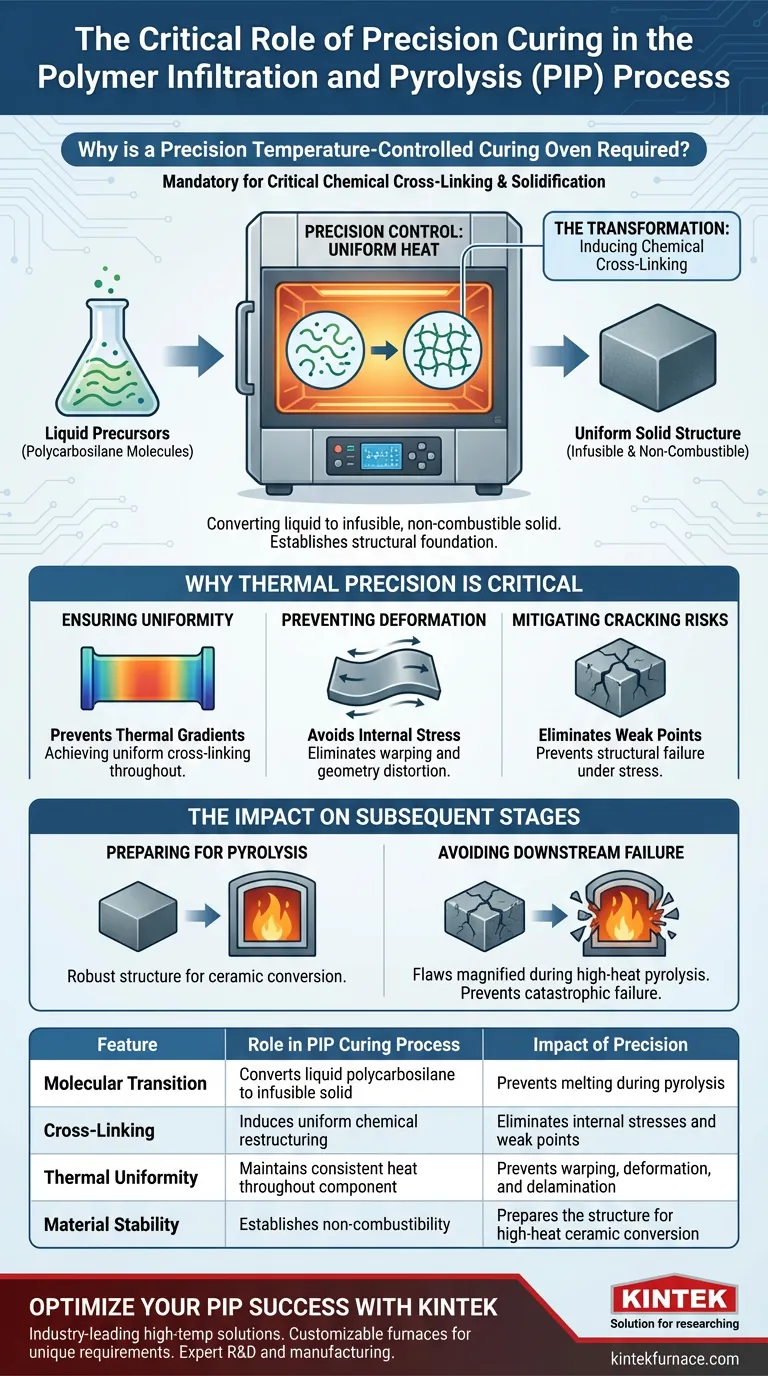
A precision temperature-controlled curing oven is mandatory because it drives the critical chemical cross-linking reactions required to transform liquid precursors into a solid state. This equipment creates a specific thermal environment that converts polycarbosilane molecules from a liquid into an infusible, non-combustible solid, establishing the structural foundation for the material.
Core Takeaway: The primary objective of precision curing is to achieve a uniform degree of cross-linking throughout the material. Without strict thermal control, uneven heating creates internal stresses that inevitably lead to cracking or deformation during the subsequent high-temperature pyrolysis stage.
The Transformation from Liquid to Solid
Inducing Chemical Cross-Linking
The fundamental role of the curing oven is to initiate and sustain a chemical reaction among polycarbosilane molecules. This process is not merely drying; it is a molecular restructuring.
Creating an Infusible State
Through this thermal treatment, the precursor transitions from a manageable liquid into a solid that is infusible. This means the material will no longer melt or flow, even when subjected to intense heat later in the process.
Establishing Non-Combustibility
Simultaneously, the curing process alters the chemical properties to render the solid non-combustible. This stability is a prerequisite for the extreme environments the material will face during pyrolysis.
Why Thermal Precision is Critical
Ensuring Uniformity
The "precision" aspect of the equipment is vital to ensure a uniform degree of cross-linking throughout the entire component. If temperature gradients exist within the oven, different sections of the part will cure at different rates.
Preventing Structural Deformation
Uneven curing results in internal physical stress. If the heating is not precise, the material is prone to deformation, warping the geometry of the final part before the process is even complete.
Mitigating Cracking Risks
Perhaps the most significant risk of poor temperature control is cracking. Variations in the curing level create weak points that will fracture under stress, compromising the integrity of the composite.
The Impact on Subsequent Stages
Preparing for Pyrolysis
The curing stage is effectively a preparation for high-temperature pyrolysis. The solid structure formed here must be robust enough to survive the conversion to ceramic.
Avoiding Downstream Failure
If the cross-linking is not uniform, the flaws will be magnified during pyrolysis. Defects introduced by uneven heating in the curing oven often result in catastrophic failure when the temperature is ramped up in the next processing step.
Understanding the Risks of Imprecision
The Danger of Thermal Gradients
Using standard heating equipment without precision controls often leads to thermal gradients. Even minor fluctuations can result in a part where the surface is cured but the core remains reactive, leading to delamination.
The Cost of "Good Enough"
Compromising on thermal precision is a common pitfall. While less precise ovens are cheaper, they result in inconsistent material properties that render the final PIP product unusable for high-performance applications.
Making the Right Choice for Your Process
Precision in the curing phase is the single biggest determinant of your material's final structural yield.
- If your primary focus is material integrity: Ensure your oven is calibrated to eliminate thermal gradients, guaranteeing a uniform cross-link density across complex geometries.
- If your primary focus is process yield: Prioritize temperature control to prevent the cracking and deformation that are the leading causes of part rejection during pyrolysis.
The success of the entire PIP process relies on the uniformity of the initial cross-linked structure established in this specific thermal environment.
Summary Table:
| Feature | Role in PIP Curing Process | Impact of Precision |
|---|---|---|
| Molecular Transition | Converts liquid polycarbosilane to infusible solid | Prevents melting during pyrolysis |
| Cross-Linking | Induces uniform chemical restructuring | Eliminates internal stresses and weak points |
| Thermal Uniformity | Maintains consistent heat throughout component | Prevents warping, deformation, and delamination |
| Material Stability | Establishes non-combustibility | Prepares the structure for high-heat ceramic conversion |
Optimize Your PIP Success with KINTEK
Don't let thermal gradients compromise your material yields. KINTEK provides industry-leading high-temperature solutions specifically engineered for the rigorous demands of advanced material processing.
Backed by expert R&D and manufacturing, KINTEK offers Muffle, Tube, Rotary, Vacuum, CVD systems, and other lab high-temp furnaces, all customizable for your unique PIP requirements. Whether you need absolute thermal uniformity for delicate cross-linking or robust systems for high-temperature pyrolysis, our specialized equipment ensures your materials achieve peak structural integrity.
Ready to elevate your lab's precision? Contact us today to discuss your custom furnace needs!
Visual Guide
References
- Surface Processing and Characterization of Stoichiometry-Varied BaZrS<sub>3</sub> Thin Films. DOI: 10.1021/acsaem.5c01766
This article is also based on technical information from Kintek Furnace Knowledge Base .
Related Products
- 1400℃ Muffle Oven Furnace for Laboratory
- Multi Heating Zones CVD Tube Furnace Machine for Chemical Vapor Deposition Equipment
- 1700℃ High Temperature Muffle Oven Furnace for Laboratory
- High Temperature Muffle Oven Furnace for Laboratory Debinding and Pre Sintering
- 1800℃ High Temperature Muffle Oven Furnace for Laboratory
People Also Ask
- How does a high-temperature laboratory muffle furnace affect material properties? Transform Anodic Oxide Films Fast
- What is the primary function of a high-temperature laboratory muffle furnace in chemical synthesis? Achieve Precision.
- How does a laboratory high-temperature muffle furnace facilitate the homogenization of borosilicate glass samples? Expert Insights
- How does a muffle furnace facilitate Ag/ATP catalyst preparation? Optimize Calcination for Superior Performance
- How does a laboratory high-temperature muffle furnace contribute to the final formation of Bismuth Oxide nanosheets?












