Precise gas control is the fundamental requirement for synthesizing high-quality Gallium Nitride (GaN) thin films. By strictly regulating the intake of carrier gases like pure nitrogen, a mass flow controller (MFC) stabilizes the reaction chamber's pressure and precursor concentration to ensure consistent crystal growth.
Core Takeaway: The nitrogen flow rate acts as the throttle for your reaction; it directly dictates the precursor concentration gradient. Minor fluctuations in flow disrupt the Gallium Nitride to Gallium ratio, causing immediate defects in film thickness and uniformity.
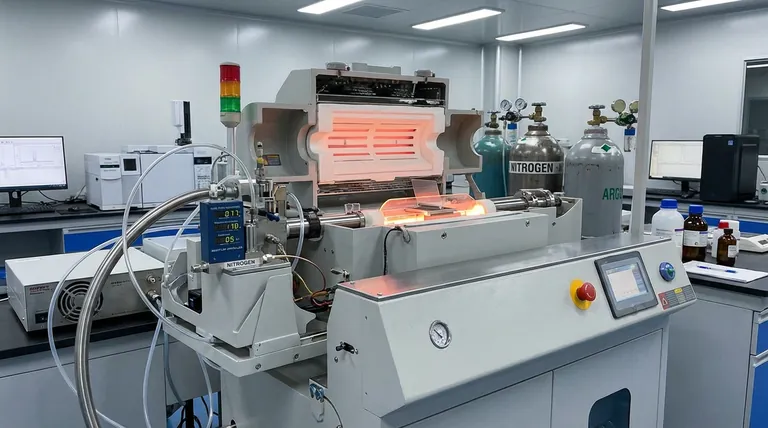
The Role of Flow in Crystal Stoichiometry
To grow a high-performance semiconductor, you must control the chemical composition at a microscopic level. The MFC is the primary tool for achieving this balance.
Stabilizing Precursor Concentration
In GaN synthesis, carrier gases (typically pure nitrogen) transport the reactive ingredients to the substrate. The flow rate directly influences the precursor concentration gradient across the reaction chamber.
If the flow is inconsistent, the delivery of reactants becomes unstable. This instability prevents the formation of a homogeneous film structure.
Tuning the GaN to Gallium Ratio
The quality of the final film depends heavily on the ratio between Gallium Nitride and elemental Gallium.
A precision MFC allows you to finely adjust the nitrogen intake. This adjustment is vital for optimizing the chemical reaction to achieve the correct stoichiometric ratio, minimizing crystal defects.
Achieving Physical Uniformity
Beyond chemical composition, the physical dimensions of the thin film must be exact across the entire wafer.
Controlling Film Thickness
The growth rate of the thin film is a function of how much reactant reaches the surface over time.
By maintaining strict regulation of the gas flow, the MFC ensures a constant growth rate. This results in uniform thickness across the substrate, which is critical for the subsequent fabrication of electronic devices.
Maintaining Pressure Stability
Gas flow and chamber pressure are intrinsically linked.
A high-precision controller compensates for upstream pressure changes to maintain a stable pressure environment within the chamber. This stability is required to keep the thermodynamics of the growth process constant.
Creating a Stable Inert Atmosphere
While the primary reference emphasizes nitrogen carrier gas, supplementary data highlights the importance of inert gases like argon.
An MFC accurately regulates these gases to create a protective atmosphere. This prevents secondary oxidation of metal components at high temperatures and ensures reduction reactions occur strictly according to your parameters.
Understanding the Trade-offs
While precision MFCs are essential, relying on them involves specific considerations regarding system complexity and maintenance.
Calibration Sensitivity
High-precision instruments are extremely sensitive to calibration drift.
If the specific gas type or mixture changes even slightly, the MFC reading may become inaccurate. You must ensure the device is calibrated specifically for the carrier gas (Nitrogen) or inert gas (Argon) you are using.
Response Time vs. Stability
There is often a balance between how fast an MFC reacts to a setpoint change and how stable it remains.
An overly aggressive response tune can cause flow oscillation (ringing), while a sluggish response leads to inconsistent gradients during process ramping. You must select a controller tuned for the specific dynamics of your reaction chamber.
Making the Right Choice for Your Goal
Selecting the right flow control strategy depends on which aspect of the film quality is your current bottleneck.
- If your primary focus is Crystal Purity: Prioritize an MFC with high repeatability to lock in the exact GaN to Gallium ratio needed to minimize defects.
- If your primary focus is Device Consistency: Focus on an MFC with exceptional long-term stability to ensure uniform thickness across large batches.
- If your primary focus is Preventing Contamination: Ensure your setup includes dedicated precision controllers for inert gases to stop secondary oxidation during high-temperature cycles.
Mastering the flow rate is the first step toward mastering the material properties of Gallium Nitride.
Summary Table:
| Key Function | Impact on GaN Quality | Benefit for Synthesis |
|---|---|---|
| Flow Stability | Uniform Precursor Gradient | Consistent film thickness across substrate |
| Stoichiometry Control | Optimal GaN to Ga Ratio | Minimized crystal defects and high purity |
| Pressure Regulation | Thermodynamic Stability | Predictable and repeatable growth rates |
| Inert Shielding | Prevention of Oxidation | Protects metal components at high temperatures |
Optimize Your Thin Film Synthesis with KINTEK
Precise gas control is the difference between a defective wafer and a high-performance semiconductor. Backed by expert R&D and manufacturing, KINTEK offers high-precision Muffle, Tube, Rotary, Vacuum, and CVD systems, all customizable for your unique GaN research needs. Whether you are tuning precursor concentration or stabilizing inert atmospheres, our laboratory high-temperature solutions provide the reliability you demand.
Ready to elevate your material properties? Contact KINTEK today to discuss your custom furnace and flow control requirements.
References
- Olzat Toktarbaiuly, Г. Сугурбекова. ENHANCEMENT OF POWER CONVERSION EFFICIENCY OF DYE-SENSITIZED SOLAR CELLS VIA INCORPORATION OF GAN SEMICONDUCTOR MATERIAL SYNTHESIZED IN HOT-WALL CHEMICAL VAPOR DEPOSITION FURNACE. DOI: 10.31489/2024no4/131-139
This article is also based on technical information from Kintek Furnace Knowledge Base .
Related Products
- Multi Heating Zones CVD Tube Furnace Machine for Chemical Vapor Deposition Equipment
- Inclined Rotary Plasma Enhanced Chemical Deposition PECVD Tube Furnace Machine
- Custom Made Versatile CVD Tube Furnace Chemical Vapor Deposition CVD Equipment Machine
- 1200℃ Controlled Inert Nitrogen Atmosphere Furnace
- Slide PECVD Tube Furnace with Liquid Gasifier PECVD Machine
People Also Ask
- What is the function of a multi-zone tube furnace in CVD synthesis? Master 2D In2Se3 Nanosheet Precision
- What role do multi zone tube furnaces play in new energy research? Unlock Precise Thermal Control for Innovation
- Why are multi zone tube furnaces particularly useful for nanomaterial research? Unlock Precise Thermal Control for Advanced Synthesis
- What temperature-related capabilities make multi zone tube furnaces valuable for research? Unlock Precision Thermal Control
- What environmental protection applications utilize multi zone tube furnaces? Unlock Precision in Waste Treatment and Green Tech