
The non-consumable vacuum arc melting furnace is the preferred tool for preparing AlCrTiVNbx high-entropy alloys because it uniquely solves the dual challenge of melting refractory metals while preserving chemical purity. This equipment uses high-temperature arcs to melt components with extremely high melting points—specifically Niobium (Nb), Titanium (Ti), and Vanadium (V)—under a high vacuum or inert gas atmosphere. By utilizing a non-consumable electrode, the process ensures that the electrode material itself does not melt into and contaminate the alloy, guaranteeing the high purity required for accurate performance research.
The core value of this furnace lies in its ability to force the fusion of elements with vastly different melting points into a uniform solid solution without oxidation or external contamination.
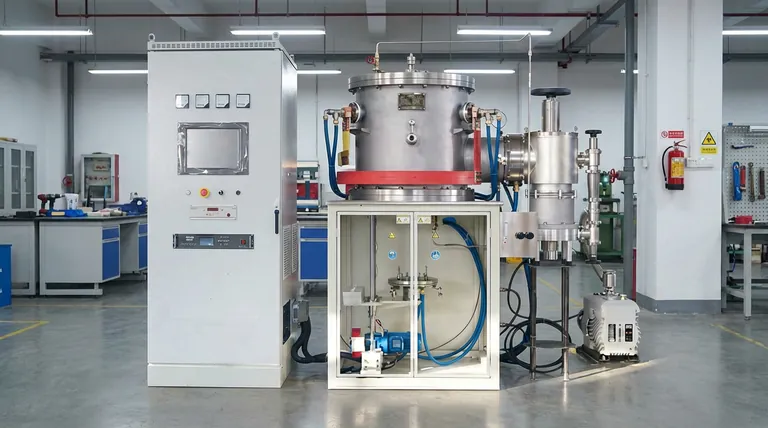
Overcoming Thermal and Chemical Barriers
To create a viable AlCrTiVNbx alloy, you must overcome significant physical property differences between the constituent elements.
Handling Refractory Elements
The specific composition of this alloy includes Niobium, Titanium, and Vanadium. These are "refractory" metals, meaning they possess exceptionally high melting points.
Standard heating methods often struggle to reach the temperatures required to fully liquefy these components simultaneously. The electric arc generated by this furnace provides the extreme, localized heat intensity necessary to rapidly melt these high-melting-point elements.
Protecting Reactive Elements
High-entropy alloys often contain active elements that react aggressively with oxygen. In this specific alloy system, Aluminum (Al) and Titanium (Ti) are particularly susceptible to oxidative loss.
If melted in air, these elements would burn off or form brittle oxides, ruining the alloy's stoichiometry. The furnace operates under a high vacuum or a controlled high-purity argon atmosphere, effectively shielding these active elements from oxidation.
Ensuring Compositional Integrity
Beyond simply melting the metal, the furnace design is critical for ensuring the final ingot matches the intended chemical formula.
Zero Electrode Contamination
The term "non-consumable" is vital here. In this design, the electrode (typically tungsten) generates the arc but does not melt.
This prevents the electrode material from entering the melt pool. Consequently, the resulting alloy consists strictly of the raw materials you introduced, maintaining a pure chemical baseline for research.
Achieving Homogeneity via Remelting
A common issue in multi-component alloys is segregation, where heavier elements sink and lighter ones float.
To counter this, the standard protocol involves melting the ingot, flipping it (inversion), and remelting it multiple times. This process, facilitated by the furnace design, ensures a highly uniform elemental distribution, which is the defining characteristic of a successful high-entropy alloy.
Rapid Solidification
These furnaces typically utilize a water-cooled copper crucible. This allows for rapid cooling of the melt.
Rapid solidification helps lock in the uniform distribution of elements achieved during the melt, preventing them from separating again as the metal cools.
Understanding the Trade-offs
While this furnace is the standard for preparation, it is important to recognize the inherent limitations of the process to ensure realistic expectations.
Localized Heating Limitations
The electric arc provides intense heat, but it is highly localized. Unlike induction melting, which heats the entire volume simultaneously, arc melting creates a localized melt pool.
This is why the flipping and remelting cycles are non-negotiable. Without them, the alloy will likely suffer from significant chemical inhomogeneity.
Volume Restrictions
Non-consumable vacuum arc melting is primarily a batch process suited for smaller scale "buttons" or ingots.
It is excellent for research and development of new alloy compositions like AlCrTiVNbx but is generally not suitable for large-scale industrial mass production without significant modification.
Making the Right Choice for Your Goal
When selecting a preparation method for complex alloys, align your equipment choice with your specific research objectives.
- If your primary focus is material purity: Rely on the non-consumable electrode design to eliminate foreign contaminants and maintain strict stoichiometric control.
- If your primary focus is microstructural uniformity: Mandate a protocol of multiple melting cycles (inversion) to overcome the segregation of heavy refractory elements like Niobium.
Success in preparing AlCrTiVNbx lies in leveraging the arc's intensity to conquer high melting points while strictly managing the vacuum environment to protect reactive components.
Summary Table:
| Feature | Benefit for AlCrTiVNbx Alloy Preparation |
|---|---|
| Non-Consumable Electrode | Prevents tungsten/electrode contamination, ensuring chemical purity. |
| High-Intensity Arc | Reaches extreme temperatures needed to melt refractory Nb, Ti, and V. |
| Vacuum/Inert Atmosphere | Protects reactive Aluminum (Al) and Titanium (Ti) from oxidation. |
| Water-Cooled Crucible | Enables rapid solidification to lock in uniform elemental distribution. |
| Remelting Capability | Facilitates multiple inversion cycles to eliminate elemental segregation. |
Elevate Your Alloy Research with KINTEK
Precise stoichiometry and zero contamination are non-negotiable for high-entropy alloy development. Backed by expert R&D and world-class manufacturing, KINTEK provides advanced Vacuum Arc Melting, Muffle, Tube, Rotary, and CVD systems tailored for the most demanding laboratory requirements. Whether you are melting refractory metals or require customizable high-temperature furnaces, our solutions ensure your materials meet the highest standards of purity and homogeneity.
Ready to optimize your thermal processing? Contact KINTEK today to discuss your unique research needs with our technical experts.
Visual Guide

References
- Baowei Li, Zhen Peng. Microstructure and Friction Properties of AlCrTiVNbx High-Entropy Alloys via Annealing Manufactured by Vacuum Arc Melting. DOI: 10.3390/ma17040812
This article is also based on technical information from Kintek Furnace Knowledge Base .
Related Products
- Vacuum Induction Melting Furnace
- Vacuum Heat Treat Sintering Furnace Molybdenum Wire Vacuum Sintering Furnace
- Vacuum Heat Treat Sintering Furnace with Pressure for Vacuum Sintering
- Vacuum Heat Treat Sintering and Brazing Furnace
- Small Vacuum Heat Treat and Tungsten Wire Sintering Furnace
People Also Ask
- What are the core functions of the High Vacuum Induction Melting (VIM) furnace? Optimize DD5 Superalloy Purification
- What role does a Vacuum Induction Melting furnace play in the production of high-aluminum nickel-based superalloys?
- What are the technical advantages of using a Vacuum Induction Melting furnace in the development of advanced packaging steel?
- What is the role of VIM and directional solidification in aero-engine blade substrates? Engineering Extreme Durability
- Why is a Vacuum Induction Melting furnace (VIM) used for Cu-Zn-Al-Sn alloys? Achieve Precision Composition Control



















