Knowledge Why is a MgO crucible preferred for VCD? Achieve 3ppm Purity in High-Temperature Metallurgy
Author avatar

Tech Team · Kintek Furnace

Updated 1 day ago

Why is a MgO crucible preferred for VCD? Achieve 3ppm Purity in High-Temperature Metallurgy


Magnesium oxide (MgO) crucibles are the definitive choice for Vacuum Carbon Deoxidation (VCD) processes due to their superior thermodynamic stability and chemical inertness. By exhibiting minimal reactivity with high-activity molten steel, MgO crucibles prevent the container itself from decomposing and releasing oxygen back into the purified metal.

Core Takeaway The success of VCD relies on eliminating oxygen, and standard refractory materials often decompose under vacuum, re-contaminating the melt. MgO is preferred because it remains stable in these harsh conditions, enabling total oxygen reduction to ultra-low levels (as low as 3 ppm) while promoting a favorable, uniform microstructure.
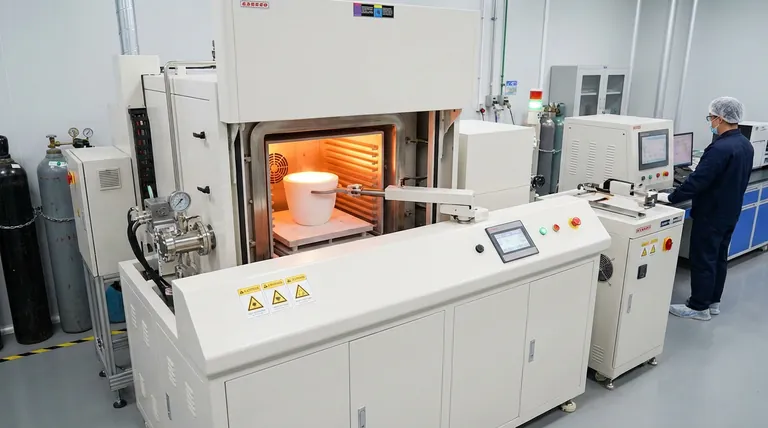
Why is a MgO crucible preferred for VCD? Achieve 3ppm Purity in High-Temperature Metallurgy

The Critical Role of Thermodynamic Stability

Preventing Secondary Oxygen Supply

In high-temperature metallurgy, the crucible is not just a container; it is a potential chemical participant.

If a crucible material lacks thermodynamic stability, the high-activity molten steel will cause the refractory lining to decompose.

MgO is preferred because it resists this decomposition, effectively blocking the "secondary supply" of oxygen that would otherwise contaminate the steel during processing.

Maintaining Chemical Inertness

The vacuum environment in VCD lowers partial pressures, which can accelerate the breakdown of less stable oxides.

MgO exhibits exceptional chemical inertness under these specific conditions.

This ensures that the reduction of oxygen is driven solely by the carbon deoxidation process, rather than being hindered by oxygen leaching from the crucible walls.

Impact on Steel Purity and Microstructure

Achieving Ultra-Low Oxygen Content

The ultimate goal of VCD is high purity.

Because the MgO crucible does not re-introduce oxygen, the process can push the total oxygen content to extremely low limits.

Primary data indicates that using MgO enables the reduction of total oxygen in steel to levels as low as 3 ppm.

Controlling Inclusion Morphology

While MgO is inert regarding oxygen release, it does interact favorably with the melt's microstructure.

The use of MgO aids in the formation of specific magnesium-based inclusions.

Unlike the large, irregular clusters often found with other refractories, these magnesium-based inclusions tend to be smaller and more uniformly distributed throughout the steel matrix.

Understanding the Material Interactions

Reactivity is Minimal, Not Non-Existent

It is important to understand that "inert" does not mean completely passive in all respects.

The primary reference notes that MgO exhibits "minimal reactivity," which implies a very slight, controlled interaction.

This interaction is actually beneficial in this context, as it facilitates the modification of inclusions described above.

Specificity of Application

The superiority of MgO is context-dependent.

While supplementary data shows MgO is also effective for resisting corrosion in lower-temperature applications (such as lead oxide at 450°C), its selection for VCD is specifically tied to high-temperature stability under vacuum.

Substituting materials with lower thermodynamic stability would immediately compromise the oxygen removal efficiency.

Making the Right Choice for Your Goal

To maximize the quality of your metallurgical output, consider your specific refining targets:

  • If your primary focus is Extreme Purity: Select MgO to prevent crucible decomposition and achieve total oxygen levels as low as 3 ppm.
  • If your primary focus is Microstructural Integrity: Rely on MgO to promote the formation of fine, uniformly distributed magnesium-based inclusions rather than large defects.

By choosing Magnesium Oxide, you ensure the crucible acts as a stable vessel rather than a chemical contaminant.

Summary Table:

Feature Advantage of MgO in VCD
Thermodynamic Stability Prevents crucible decomposition and secondary oxygen supply
Chemical Inertness Minimizes reactivity with high-activity molten steel under vacuum
Purity Level Enables total oxygen reduction to as low as 3 ppm
Inclusion Control Promotes fine, uniformly distributed magnesium-based inclusions

Elevate Your Metallurgical Purity with KINTEK

Don't let crucible contamination compromise your high-performance alloys. Backed by expert R&D and manufacturing, KINTEK offers high-purity MgO crucibles, Muffle, Tube, and Vacuum systems tailored for the most demanding high-temperature environments. Whether you need CVD systems or custom laboratory furnaces, our solutions are designed to help you achieve ultra-low oxygen levels and superior microstructural integrity.

Ready to optimize your VCD process? Contact us today for a custom consultation!

References

  1. Yuheng Dai, Xicheng Wei. The Inclusion Characteristics and Mechanical Properties of M2 High-Speed Steel Treated with a Vacuum Carbon Deoxidation Process. DOI: 10.3390/met14101146

This article is also based on technical information from Kintek Furnace Knowledge Base .

Related Products

People Also Ask

Related Products

Magnesium Extraction and Purification Condensing Tube Furnace

Magnesium Extraction and Purification Condensing Tube Furnace

Magnesium purification tube furnace for high-purity metal production. Achieve ≤10Pa vacuum, dual-zone heating. Ideal for aerospace, electronics, and lab research.

High Temperature Muffle Oven Furnace for Laboratory Debinding and Pre Sintering

High Temperature Muffle Oven Furnace for Laboratory Debinding and Pre Sintering

KT-MD Debinding & Pre-Sintering Furnace for ceramics - precise temperature control, energy-efficient design, customizable sizes. Boost your lab efficiency today!

1200℃ Split Tube Furnace Laboratory Quartz Tube Furnace with Quartz Tube

1200℃ Split Tube Furnace Laboratory Quartz Tube Furnace with Quartz Tube

Discover KINTEK's 1200℃ Split Tube Furnace with quartz tube for precise high-temperature lab applications. Customizable, durable, and efficient. Get yours now!

1400℃ Muffle Oven Furnace for Laboratory

1400℃ Muffle Oven Furnace for Laboratory

KT-14M Muffle Furnace: Precision 1400°C heating with SiC elements, PID control, and energy-efficient design. Ideal for labs.

1200℃ Muffle Oven Furnace for Laboratory

1200℃ Muffle Oven Furnace for Laboratory

KINTEK KT-12M Muffle Furnace: Precision 1200°C heating with PID control. Ideal for labs needing rapid, uniform heat. Explore models & customization options.

1400℃ High Temperature Laboratory Tube Furnace with Quartz and Alumina Tube

1400℃ High Temperature Laboratory Tube Furnace with Quartz and Alumina Tube

KINTEK's Tube Furnace with Alumina Tube: Precision high-temperature processing up to 2000°C for labs. Ideal for material synthesis, CVD, and sintering. Customizable options available.

1700℃ High Temperature Muffle Oven Furnace for Laboratory

1700℃ High Temperature Muffle Oven Furnace for Laboratory

KT-17M Muffle Furnace: High-precision 1700°C lab furnace with PID control, energy efficiency, and customizable sizes for industrial & research applications.

Laboratory Muffle Oven Furnace with Bottom Lifting

Laboratory Muffle Oven Furnace with Bottom Lifting

Boost lab efficiency with KT-BL Bottom Lifting Furnace: precise 1600℃ control, superior uniformity, and enhanced productivity for material science and R&D.

1800℃ High Temperature Muffle Oven Furnace for Laboratory

1800℃ High Temperature Muffle Oven Furnace for Laboratory

KINTEK Muffle Furnaces: Precision 1800°C heating for labs. Energy-efficient, customizable, with PID control. Ideal for sintering, annealing, and research.

1700℃ Controlled Inert Nitrogen Atmosphere Furnace

1700℃ Controlled Inert Nitrogen Atmosphere Furnace

KT-17A Controlled Atmosphere Furnace: Precise 1700°C heating with vacuum & gas control. Ideal for sintering, research & material processing. Explore now!

1200℃ Controlled Inert Nitrogen Atmosphere Furnace

1200℃ Controlled Inert Nitrogen Atmosphere Furnace

KINTEK 1200℃ Controlled Atmosphere Furnace: Precision heating with gas control for labs. Ideal for sintering, annealing, and material research. Customizable sizes available.

1400℃ Controlled Inert Nitrogen Atmosphere Furnace

1400℃ Controlled Inert Nitrogen Atmosphere Furnace

KT-14A Controlled Atmosphere Furnace for labs & industry. 1400°C max temp, vacuum sealing, inert gas control. Customizable solutions available.

Molybdenum Disilicide MoSi2 Thermal Heating Elements for Electric Furnace

Molybdenum Disilicide MoSi2 Thermal Heating Elements for Electric Furnace

High-performance MoSi2 heating elements for labs, reaching 1800°C with superior oxidation resistance. Customizable, durable, and reliable for high-temperature applications.

Silicon Carbide SiC Thermal Heating Elements for Electric Furnace

Silicon Carbide SiC Thermal Heating Elements for Electric Furnace

High-performance SiC heating elements for labs, offering 600-1600°C precision, energy efficiency, and long lifespan. Customizable solutions available.

Multi Zone Laboratory Quartz Tube Furnace Tubular Furnace

Multi Zone Laboratory Quartz Tube Furnace Tubular Furnace

KINTEK Multi-Zone Tube Furnace: Precise 1700℃ heating with 1-10 zones for advanced material research. Customizable, vacuum-ready, and safety-certified.

Vacuum Hot Press Furnace Machine Heated Vacuum Press Tube Furnace

Vacuum Hot Press Furnace Machine Heated Vacuum Press Tube Furnace

Discover KINTEK's advanced Vacuum Tube Hot Press Furnace for precise high-temperature sintering, hot pressing, and material bonding. Customizable solutions for labs.

CF KF Flange Vacuum Electrode Feedthrough Lead Sealing Assembly for Vacuum Systems

CF KF Flange Vacuum Electrode Feedthrough Lead Sealing Assembly for Vacuum Systems

Reliable CF/KF flange vacuum electrode feedthrough for high-performance vacuum systems. Ensures superior sealing, conductivity & durability. Customizable options available.

Split Chamber CVD Tube Furnace with Vacuum Station CVD Machine

Split Chamber CVD Tube Furnace with Vacuum Station CVD Machine

Split Chamber CVD Tube Furnace with Vacuum Station - High precision 1200°C lab furnace for advanced materials research. Customizable solutions available.

915MHz MPCVD Diamond Machine Microwave Plasma Chemical Vapor Deposition System Reactor

915MHz MPCVD Diamond Machine Microwave Plasma Chemical Vapor Deposition System Reactor

KINTEK MPCVD Diamond Machine: High-quality diamond synthesis with advanced MPCVD technology. Faster growth, superior purity, customizable options. Boost production now!

Multi Heating Zones CVD Tube Furnace Machine for Chemical Vapor Deposition Equipment

Multi Heating Zones CVD Tube Furnace Machine for Chemical Vapor Deposition Equipment

KINTEK's Multi-Zone CVD Tube Furnaces offer precision temperature control for advanced thin film deposition. Ideal for research and production, customizable for your lab needs.


Leave Your Message
