
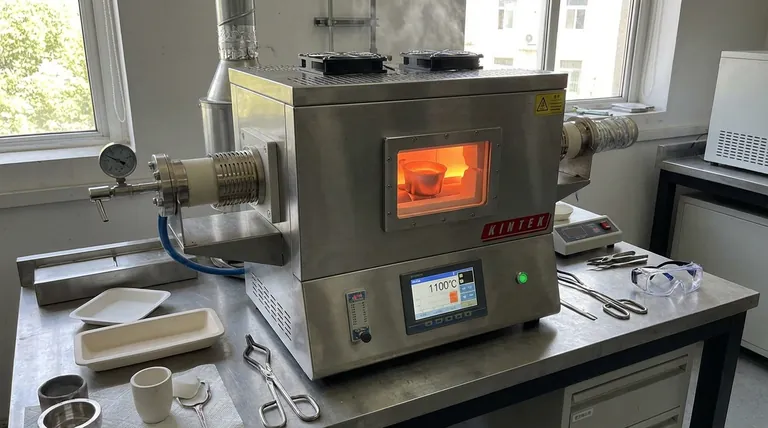
A laboratory resistance furnace is the preferred instrument for preparing Al-5Er-Ti master alloys because it provides a stable, high-temperature environment capable of reaching over 1100°C. This precise thermal control is critical for processing alloys containing high-melting-point elements like Titanium (Ti). It ensures that every component within the master alloy melts completely, resulting in a chemically uniform composition.
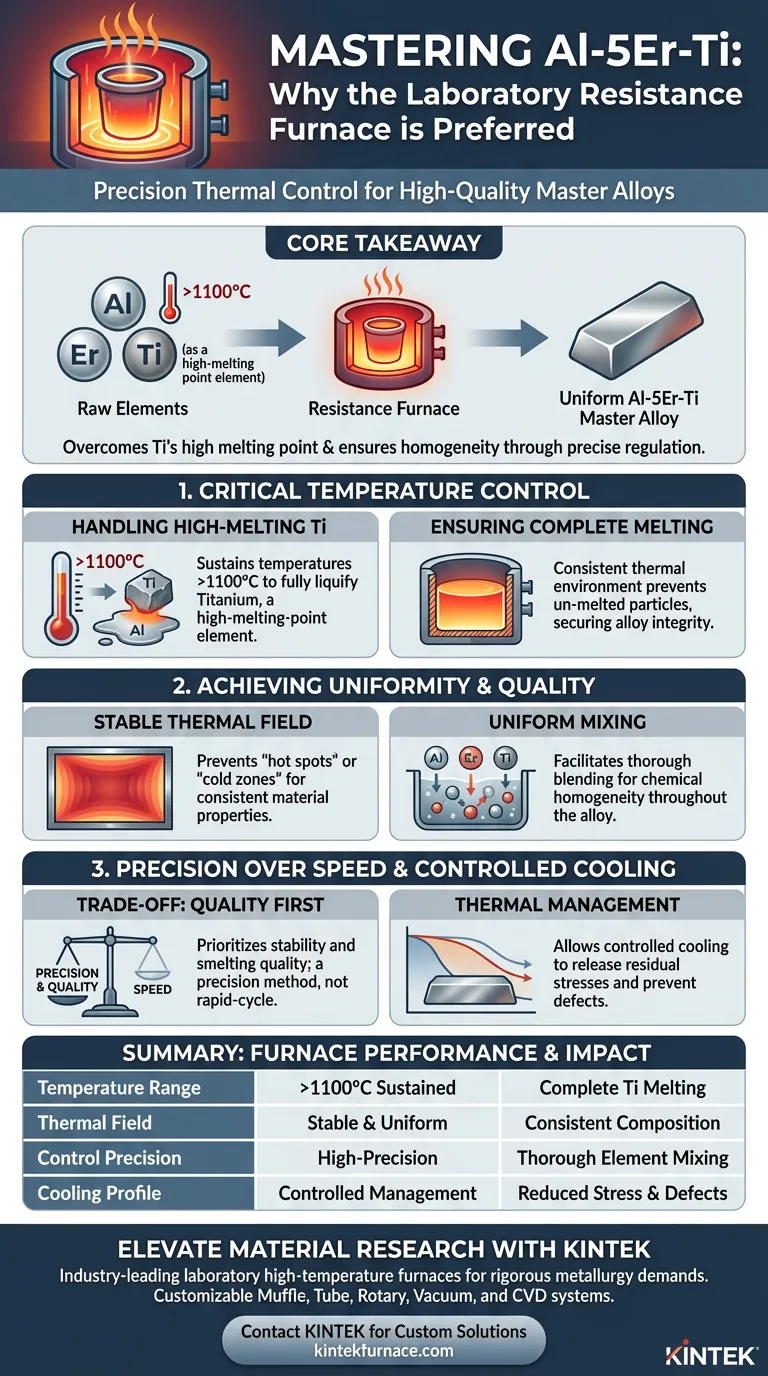
Core Takeaway: The preparation of Al-5Er-Ti alloys hinges on overcoming the high melting point of Titanium while maintaining homogeneity. The laboratory resistance furnace offers the precise temperature regulation and stable thermal field necessary to ensure a complete melt and a uniform chemical structure.
The Critical Role of Temperature Control
Handling High-Melting-Point Elements
The primary challenge in creating Al-5Er-Ti master alloys is the inclusion of Titanium (Ti).
Titanium is a high-melting-point element that resists liquification at standard aluminum processing temperatures. A resistance furnace is specifically chosen because it can sustain temperatures exceeding 1100°C.
Ensuring Complete Melting
Reaching the target temperature is only half the battle; sustaining it is equally important.
The resistance furnace provides a consistent thermal environment that ensures the Titanium is not just heated, but fully melted into the aluminum matrix. Without this sustained high heat, un-melted particles could remain, compromising the alloy's integrity.
Achieving Alloy Quality and Consistency
Creating a Stable Thermal Field
Beyond simple heat generation, the quality of the alloy depends on how that heat is distributed.
As seen in similar metallurgical processes, such as with aluminum-lithium alloys, a resistance furnace excels at providing a stable thermal field distribution. This prevents "hot spots" or "cold zones" within the crucible that could lead to inconsistent material properties.
Uniform Mixing and Homogeneity
The ultimate goal of the preparation process is chemical uniformity.
The controlled environment allows the Aluminum, Erbium, and Titanium to mix thoroughly. This ensures that the final master alloy has a consistent composition throughout, which is essential for its performance in subsequent casting or molding applications.
Understanding the Trade-offs
Precision vs. Speed
While the laboratory resistance furnace is superior for quality, it prioritizes stability over speed.
The process requires time to reach the high temperatures needed for Titanium and to stabilize the thermal field for uniform mixing. This is not a rapid-cycle method; it is a precision method designed to maximize smelting quality and ensure the proper integration of complex elements.
The Necessity of Controlled Cooling
The resistance furnace also allows for controlled thermal management, which can be critical for stress relief.
Just as with high-entropy alloy coatings, the ability to hold samples at constant temperatures helps release residual stresses. In the context of master alloys, this control prevents the formation of defects that might occur during rapid, uncontrolled cooling.
Making the Right Choice for Your Project
To ensure the success of your Al-5Er-Ti alloy preparation, align your equipment choice with your specific metallurgical goals.
- If your primary focus is complete melting of Titanium: Ensure your resistance furnace is calibrated to reliably sustain temperatures above 1100°C.
- If your primary focus is alloy homogeneity: Prioritize a furnace design that guarantees a stable thermal field to promote uniform mixing of the Aluminum matrix and additives.
By leveraging the precise thermal environment of a resistance furnace, you ensure a foundational casting process that yields a high-quality, uniform master alloy.
Summary Table:
| Feature | Resistance Furnace Performance | Impact on Al-5Er-Ti Master Alloy |
|---|---|---|
| Temperature Range | Sustained levels >1100°C | Ensures complete melting of high-melting-point Titanium (Ti). |
| Thermal Field | Stable and uniform distribution | Prevents hot/cold spots for consistent chemical composition. |
| Control Precision | High-precision thermal regulation | Facilitates thorough mixing of Al, Er, and Ti elements. |
| Cooling Profile | Controlled thermal management | Reduces residual stress and prevents structural defects. |
Elevate Your Material Research with KINTEK
Precision in master alloy preparation begins with superior thermal control. KINTEK provides industry-leading laboratory high-temperature furnaces—including Muffle, Tube, Rotary, Vacuum, and CVD systems—specifically designed to handle the rigorous demands of high-melting-point metallurgy. Backed by expert R&D and manufacturing, our systems are fully customizable to meet your unique Al-5Er-Ti or specialty alloy requirements.
Ready to ensure complete melting and chemical uniformity in your next project?
Contact KINTEK Today to Discuss Your Custom Solution
Visual Guide
References
- Al-5Er-Ti Master Alloy with Both Grain Refinement and Microalloying Effects. DOI: 10.3390/met15010043
This article is also based on technical information from Kintek Furnace Knowledge Base .
Related Products
- 1200℃ Muffle Oven Furnace for Laboratory
- 1400℃ Muffle Oven Furnace for Laboratory
- Laboratory Muffle Oven Furnace with Bottom Lifting
- Vertical Laboratory Quartz Tube Furnace Tubular Furnace
- 1400℃ High Temperature Laboratory Tube Furnace with Alumina Tube
People Also Ask
- What is the primary function of a high-temperature laboratory muffle furnace in chemical synthesis? Achieve Precision.
- How does a high-temperature laboratory muffle furnace affect material properties? Transform Anodic Oxide Films Fast
- How is a laboratory muffle furnace used in 3D-printed PP-CF cross-linking? Achieve Thermal Stability at 150 °C
- Why is a laboratory high-temperature muffle furnace used for BaTiO3? Achieve Optimal Tetragonal Crystalline Phases
- Why is a laboratory high-temperature muffle furnace required for LaNixFe1-xO3 catalysts? Optimize Two-Stage Synthesis



















