
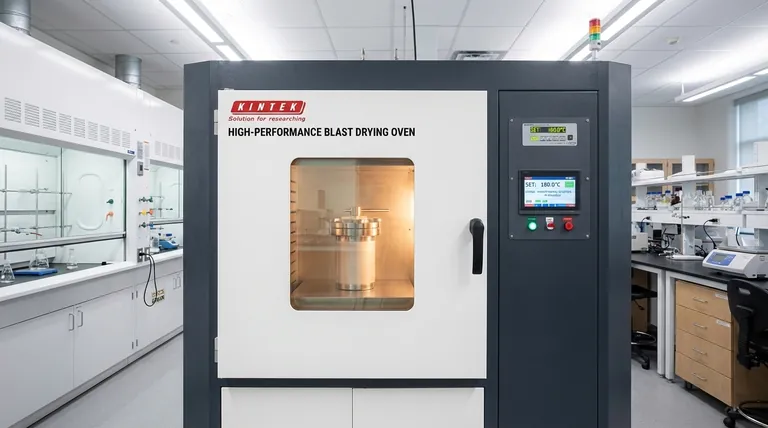
In the synthesis of CoO/CoSe composite nanoparticles, the high-performance blast drying oven serves as the critical thermal regulator during the hydrothermal reaction stage.
Its primary function is to provide a precise and continuous thermal environment, typically maintaining a specific temperature of 180°C. By utilizing forced air circulation, the oven ensures that the hydrothermal reaction vessel receives completely uniform heating, which is essential for initiating and sustaining the chemical transformation.
Core Takeaway: The blast drying oven is not merely a heat source; it is a mechanism for process control. Its ability to create a stable, uniform high-temperature and high-pressure environment is the deciding factor in whether cobalt precursors successfully anchor to the carbon substrate or fail to adhere.
The Mechanics of the Hydrothermal Stage
Establishing Precise Thermal Conditions
To synthesize these specific nanoparticles, the reaction environment must be held at a steady 180°C.
The high-performance oven maintains this temperature with minimal fluctuation. This consistency is vital because even minor thermal deviations can alter the reaction kinetics, leading to inconsistent material properties.
The Role of Forced Circulation
The defining feature of a "blast" drying oven is its forced circulation of heated air.
Static ovens can develop hot and cold spots, but forced circulation ensures the heat is distributed evenly around the reaction vessel. This guarantees that the solvent inside reaches the necessary high-temperature and high-pressure state uniformly, preventing localized reaction failures.
Impact on Nanoparticle Formation
Driving the Chemical Reaction
The uniform heat provided by the oven facilitates the full reaction between cobalt sources and urea within the solvent.
Without this sustained thermal energy, the chemical precursors would not break down and interact efficiently. The high-performance nature of the oven ensures the reaction proceeds to completion rather than stalling halfway.
Controlling Structural Growth
The ultimate goal of this stage is to grow cobalt-based precursor nanoparticles.
The stable environment allows these nanoparticles to grow uniformly and anchor firmly onto the three-dimensional carbon paper fiber skeleton. This structural anchoring is critical for the composite's final stability and performance.
The Risks of Inconsistent Heating
Non-Uniform Particle Growth
If the oven fails to provide uniform heating (a common issue with low-performance equipment), the nucleation of nanoparticles becomes erratic.
This results in particles of varying sizes and densities. In the context of CoO/CoSe composites, this lack of uniformity compromises the material's electrochemical properties.
Weak Substrate Adhesion
The "anchoring" effect described in your process relies on sustained, high-pressure conditions.
If the temperature fluctuates, the pressure inside the vessel drops. This prevents the precursors from bonding securely to the carbon paper skeleton, potentially causing the active material to detach during use.
Making the Right Choice for Your Goal
To ensure the successful synthesis of CoO/CoSe composite nanoparticles, you must prioritize the stability of your thermal equipment.
- If your primary focus is Structural Integrity: Ensure your oven’s air circulation acts continuously to maintain the high pressure required for the nanoparticles to anchor firmly to the carbon paper.
- If your primary focus is Chemical Purity: Verify the oven can hold precisely 180°C without fluctuation to guarantee the full reaction of cobalt and urea.
The blast drying oven is the foundational tool that translates chemical potential into structural reality.
Summary Table:
| Feature | Role in Hydrothermal Synthesis | Impact on CoO/CoSe Nanoparticles |
|---|---|---|
| Precise Temperature Control | Maintains steady 180°C environment | Ensures consistent reaction kinetics and chemical purity |
| Forced Air Circulation | Eliminates hot/cold spots around vessel | Guarantees uniform nanoparticle nucleation and growth |
| High-Pressure Stability | Sustains constant thermal energy | Drives precursors to anchor firmly to carbon paper fiber |
| Process Uniformity | Prevents localized reaction failure | Ensures structural integrity and electrochemical stability |
Elevate Your Material Synthesis with KINTEK Precision
High-performance hydrothermal reactions demand absolute thermal stability. KINTEK provides the cutting-edge laboratory equipment needed to ensure your precursors anchor perfectly every time.
Backed by expert R&D and world-class manufacturing, KINTEK offers a comprehensive range of Muffle, Tube, Rotary, Vacuum, and CVD systems, alongside specialized high-temp furnaces—all fully customizable to meet your unique nanoparticle research requirements. Don't let thermal fluctuations compromise your structural growth.
Contact KINTEK Experts Today to Optimize Your Lab Results
Visual Guide

References
- Shasha Song, Xingqun Zhu. Synthesis and Lithium Storage Performance of CoO/CoSe Composite Nanoparticles Supported on Carbon Paper. DOI: 10.54691/k2djhp47
This article is also based on technical information from Kintek Furnace Knowledge Base .
Related Products
- High Temperature Muffle Oven Furnace for Laboratory Debinding and Pre Sintering
- Laboratory Muffle Oven Furnace with Bottom Lifting
People Also Ask
- What thermal phenomena occur during polymer binder burnout in ceramic green bodies? Lab Furnace Guide
- What role does a high-temperature muffle furnace play in STFO synthesis? Achieve Pure Perovskite Results
- Why is controlled heat treatment in a muffle furnace necessary for calcined clay? Achieve Optimal Pozzolanic Activity
- How does a high-temperature muffle furnace facilitate the formation of LaNbxAl1−xO3+δ perovskite structures? Key Roles
- What role does a high-temperature muffle furnace play in the formation of biochar catalysts? Master Catalyst Synthesis

