
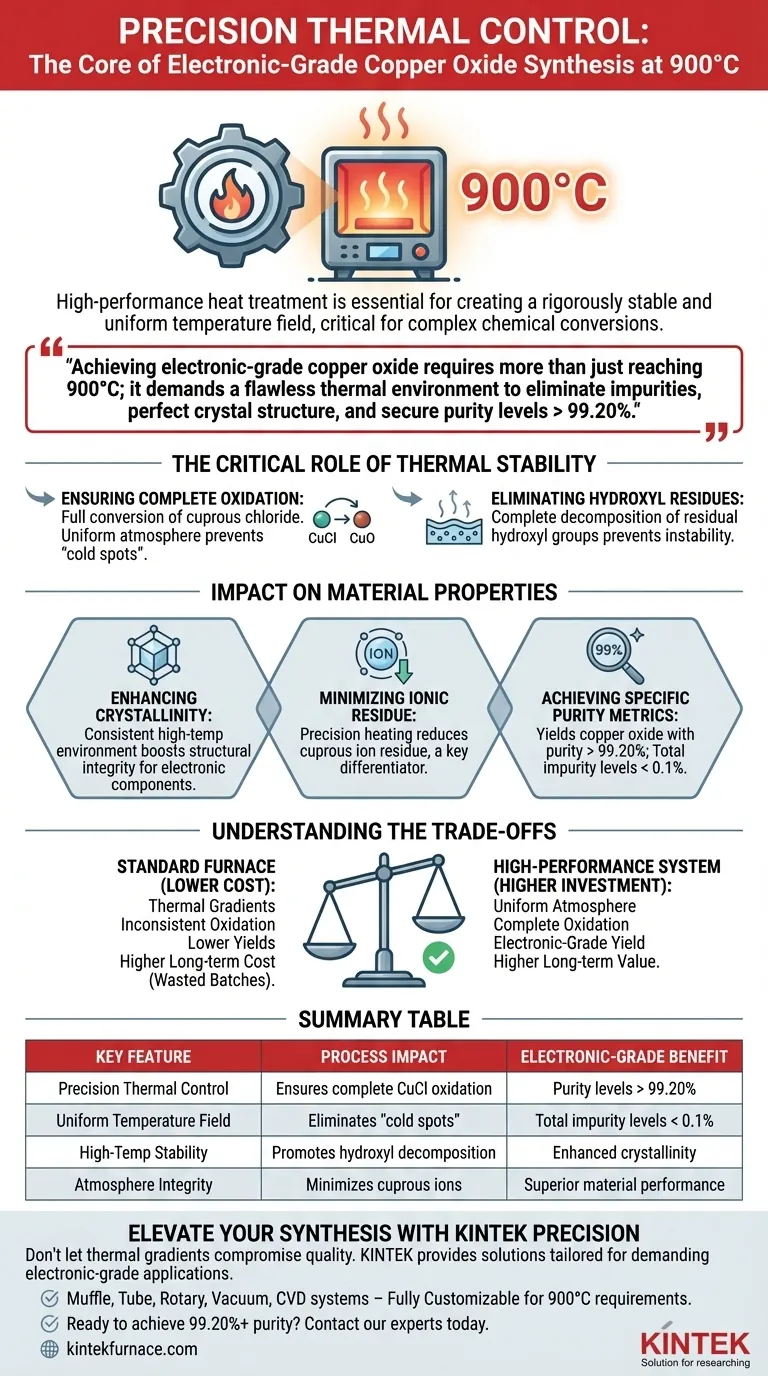
Precision thermal control is the cornerstone of synthesizing electronic-grade materials. High-performance heat treatment equipment is essential for 900°C calcination because it creates the rigorously stable and uniform temperature field required for complex chemical conversions. Without this precision, it is impossible to ensure the complete oxidation and decomposition processes necessary to achieve the high purity standards of electronic-grade copper oxide.
Achieving electronic-grade copper oxide requires more than just reaching 900°C; it demands a flawless thermal environment. High-performance equipment guarantees the uniformity necessary to eliminate impurities, perfect the crystal structure, and secure purity levels exceeding 99.20%.
The Critical Role of Thermal Stability
Ensuring Complete Oxidation
The primary chemical objective at 900°C is the full conversion of precursors into copper oxide.
High-performance equipment ensures that cuprous chloride is fully oxidized. A uniform atmosphere prevents "cold spots" that would otherwise leave unreacted material in the batch.
Eliminating Hydroxyl Residues
Beyond oxidation, the process must strip away volatile impurities.
The equipment promotes the complete decomposition of residual hydroxyl groups. This is critical for preventing chemical instability in the final application.
Impact on Material Properties
Enhancing Crystallinity
The stability of the temperature field directly influences the physical structure of the material.
A consistent high-temperature environment significantly enhances product crystallinity. This structural integrity is vital for the performance of copper oxide in electronic components.
Minimizing Ionic Residue
Precision heating allows for the strict control of ionic impurities.
The process specifically reduces cuprous ion residue. This reduction is the key differentiator between standard industrial copper and electronic-grade material.
Achieving Specific Purity Metrics
The ultimate output of using high-performance equipment is quantifiable quality.
This process yields copper oxide with a purity exceeding 99.20%. Furthermore, it ensures total impurity levels are kept below 0.1%, meeting stringent electronic standards.
Understanding the Trade-offs
Equipment Cost vs. Product Value
High-performance heat treatment systems represent a significant capital investment compared to standard industrial furnaces.
However, relying on lower-grade equipment introduces thermal gradients. This leads to inconsistent oxidation and lower yields of electronic-grade material, which can be more costly in the long run due to wasted batches.
Making the Right Choice for Your Goal
To select the correct processing strategy, align your equipment capabilities with your specific purity requirements:
- If your primary focus is maximizing purity: Ensure your equipment provides a uniform atmosphere to guarantee cuprous chloride is fully oxidized and impurity levels remain below 0.1%.
- If your primary focus is structural integrity: Prioritize thermal stability at 900°C to drive the decomposition of hydroxyl groups and maximize product crystallinity.
Precision heat treatment is not merely a manufacturing step; it is the defining factor that elevates copper oxide from a raw commodity to a high-value electronic component.
Summary Table:
| Key Feature | Process Impact | Electronic-Grade Benefit |
|---|---|---|
| Precision Thermal Control | Ensures complete cuprous chloride oxidation | Purity levels exceeding 99.20% |
| Uniform Temperature Field | Eliminates "cold spots" and unreacted material | Total impurity levels < 0.1% |
| High-Temp Stability | Promotes full decomposition of hydroxyl groups | Enhanced product crystallinity |
| Atmosphere Integrity | Minimizes residual cuprous ions | Superior material performance |
Elevate Your Material Synthesis with KINTEK Precision
Don't let thermal gradients compromise your product quality. At KINTEK, we specialize in providing high-performance heat treatment solutions tailored for the most demanding electronic-grade applications. Backed by expert R&D and world-class manufacturing, we offer a comprehensive range of Muffle, Tube, Rotary, Vacuum, and CVD systems, all fully customizable to meet your unique 900°C calcination requirements.
Ready to achieve 99.20%+ purity consistently? Contact our technical experts today to design a thermal environment that guarantees stability, uniformity, and excellence for your laboratory or production line.
Visual Guide
References
- Dengliang He, Shishan Xue. Integrated Alkali Gradient pH Control Purification of Acidic Copper-Containing Etching Waste Solution and Cu2(OH)3Cl Conversion-Calcination Process for High-Purity CuO. DOI: 10.3390/pr13092807
This article is also based on technical information from Kintek Furnace Knowledge Base .
Related Products
- Electric Rotary Kiln Pyrolysis Furnace Plant Machine Small Rotary Kiln Calciner
- Custom Made Versatile CVD Tube Furnace Chemical Vapor Deposition CVD Equipment Machine
- Multi Heating Zones CVD Tube Furnace Machine for Chemical Vapor Deposition Equipment
- Vertical Laboratory Quartz Tube Furnace Tubular Furnace
- Vacuum Heat Treat Sintering Furnace with Pressure for Vacuum Sintering
People Also Ask
- What are the advantages of electric rotary kilns compared to fuel-fired ones? Boost Precision and Efficiency in Your Process
- What advantages do electric rotary kilns offer over fuel-based kilns? Boost Efficiency and Purity in Your Process
- What materials can be processed in an electric rotary kiln? Versatile Solutions for Advanced Materials
- What are the main applications of a rotary kiln electric furnace? Achieve Uniform Heat Treatment for Powders
- What are the key components of a rotary kiln electric furnace? Unlock Efficient Thermal Processing



















