
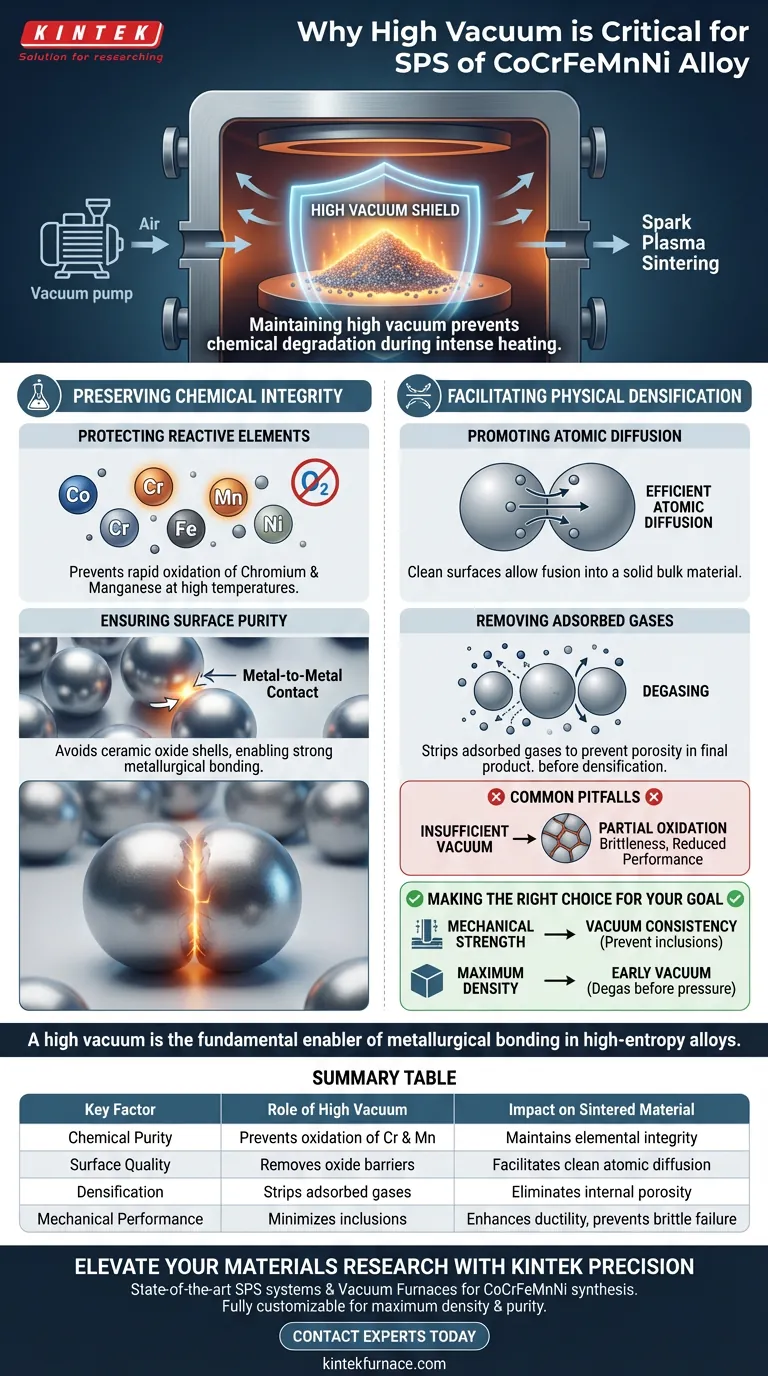
Maintaining a high vacuum is critical to prevent the chemical degradation of CoCrFeMnNi alloy powders during the intense heating of Spark Plasma Sintering (SPS). It specifically prevents the oxidation of reactive elements like chromium and manganese, ensuring the powder particles remain pure. This environment is a prerequisite for creating the clean surfaces necessary for effective atomic diffusion and high material density.
The vacuum acts as a critical shield for the alloy's purity, preventing the formation of oxide layers that inhibit particle bonding. Without this isolation, the high reactivity of the alloy's components at sintering temperatures would compromise both the structural integrity and the density of the material.
Preserving Chemical Integrity
Protecting Reactive Elements
The CoCrFeMnNi alloy contains elements that are chemically active and highly sensitive to oxygen. Chromium and manganese, in particular, are prone to rapid oxidation when exposed to high temperatures in non-vacuum environments. A high vacuum effectively excludes active gases from the chamber, neutralizing the risk of these elements degrading into oxides.
Ensuring Surface Purity
Oxidation creates a ceramic-like shell around metal powder particles. This shell acts as a barrier, preventing the metal-to-metal contact required for a strong metallurgical bond. By maintaining a high vacuum, you ensure the particle surfaces remain metallic and clean throughout the heating process.
Facilitating Physical Densification
Promoting Atomic Diffusion
SPS relies on atomic diffusion to fuse powder particles into a solid bulk material. This diffusion occurs most efficiently when particle surfaces are free of contaminants and oxides. The vacuum environment facilitates this atomic diffusion contact, allowing the material to achieve a homogenous structure.
Removing Adsorbed Gases
Powder particles often have gases adsorbed onto their surfaces or trapped within the gaps between them. If these gases are not removed prior to densification, they can become trapped inside the final product, leading to porosity. The vacuum assists in stripping these adsorbed gases, significantly enhancing the density of the sintered body.
Common Pitfalls to Avoid
While the necessity of a vacuum is clear, the quality of that vacuum is equally important. Insufficient vacuum levels (poor pressure) can lead to "partial oxidation," where micro-scale oxide inclusions form at grain boundaries. This results in a material that may look dense but suffers from brittleness and reduced mechanical performance. Furthermore, failing to maintain the vacuum during the cooling phase can result in surface oxidation of the newly formed bulk material.
Making the Right Choice for Your Goal
To maximize the quality of your CoCrFeMnNi alloy, apply the vacuum protocols based on your specific sintering objectives:
- If your primary focus is Mechanical Strength: Prioritize vacuum consistency to prevent oxide formation on Manganese and Chromium, as oxide inclusions will act as crack initiation sites.
- If your primary focus is Maximum Density: Ensure the vacuum is applied early in the cycle to fully degas the powder gaps and remove adsorbed layers before high pressure seals the pores.
A high vacuum is not merely a process variable; it is the fundamental enabler of metallurgical bonding in high-entropy alloys.
Summary Table:
| Key Factor | Role of High Vacuum | Impact on Sintered Material |
|---|---|---|
| Chemical Purity | Prevents oxidation of Cr & Mn | Maintains elemental integrity & metallic surfaces |
| Surface Quality | Removes oxide barriers | Facilitates clean metal-to-metal atomic diffusion |
| Densification | Strips adsorbed gases | Eliminates internal porosity for maximum density |
| Mechanical Performance | Minimizes grain boundary inclusions | Enhances ductility and prevents brittle failure |
Elevate Your Materials Research with KINTEK Precision
Don't let oxidation compromise your High-Entropy Alloy research. KINTEK provides state-of-the-art Spark Plasma Sintering (SPS) systems and specialized Vacuum Furnaces engineered for the rigorous demands of CoCrFeMnNi synthesis.
Backed by expert R&D and manufacturing, our systems—including Muffle, Tube, Rotary, and CVD options—are fully customizable to ensure your laboratory achieves maximum material density and chemical purity.
Ready to optimize your sintering process? Contact our technical experts today to find the perfect high-temp solution for your unique research needs.
Visual Guide
References
- Anna Kopeć-Surzyn, M. Madej. Influence of Tooling on the Properties of the Surface Layer in HEA Alloy Sinters Produced by the SPS Method. DOI: 10.3390/coatings14020186
This article is also based on technical information from Kintek Furnace Knowledge Base .
Related Products
- Spark Plasma Sintering SPS Furnace
- Controlled Inert Nitrogen Hydrogen Atmosphere Furnace
- Small Vacuum Heat Treat and Tungsten Wire Sintering Furnace
- Chairside Dental Porcelain Zirconia Sintering Furnace with Transformer for Ceramic Restorations
- Mesh Belt Controlled Atmosphere Furnace Inert Nitrogen Atmosphere Furnace
People Also Ask
- Why is it necessary to maintain a high vacuum environment during the SPS of SiC? Key to High-Density Ceramics
- How does the heating mechanism of Spark Plasma Sintering (SPS) function? Enhance TiC/SiC Composite Fabrication
- What are the technical advantages of using an SPS sintering furnace? Elevate Al2O3-TiC Material Performance
- What are the steps in the discharge plasma sintering process? Master Fast, High-Density Material Consolidation
- What are the advantages of spark plasma sintering (SPS) over traditional forging? Precision Microstructural Control



















