
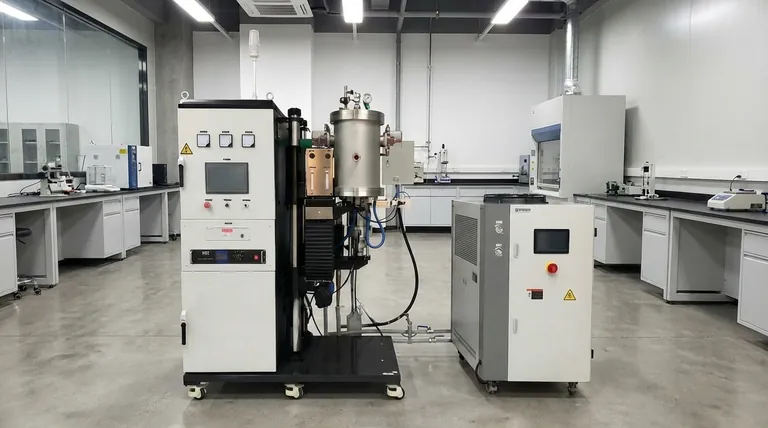
A high vacuum sintering furnace serves as a specialized reaction chamber designed to facilitate solid-state sintering while strictly controlling the chemical environment. By maintaining an extreme vacuum (approximately $10^{-5}$ mbar) at temperatures around 1200 °C, it drives the atomic diffusion necessary to bond titanium particles while simultaneously preventing the chemical degradation associated with reactive alloys.
The core function of this equipment is to enable "neck growth" between particles without oxidation; it creates a neutral atmosphere that preserves ductility and ensures the porous Ti6Al4V skeleton achieves the necessary mechanical strength and electrical conductivity.
Overcoming Chemical Reactivity
The primary challenge in processing Ti6Al4V is its high affinity for atmospheric gases. The furnace addresses this by creating an environment where chemical reactions are minimized.
The Sensitivity of Titanium
Titanium and its alloys are highly chemically active, particularly at elevated temperatures. They readily absorb gaseous elements such as oxygen and nitrogen if exposed to a standard atmosphere.
Preventing Material Embrittlement
The absorption of oxygen and nitrogen is detrimental to the alloy's performance. It leads to embrittlement, which significantly reduces the durability and fatigue life of the porous structure.
Ensuring a Neutral Atmosphere
A high vacuum furnace reduces residual gases to extremely low levels. This creates an atmosphere that is essentially neutral, preventing the alloy from reacting with its surroundings during the heat treatment.
The Mechanism of Densification
Once the environment is secured, the furnace utilizes thermal energy to physically transform the material through solid-state sintering.
Promoting Atomic Diffusion
At the processing temperature of 1200 °C, the furnace provides the energy required for atoms to move across particle boundaries. This process is known as solid-state sintering.
Facilitating Neck Growth
The heat triggers the formation and expansion of "necks" at the contact points between titanium particles. This is the physical mechanism that bonds the particles together.
Establishing Mechanical Strength
As neck growth progresses, the formerly loose structure transforms into a cohesive, porous skeleton. This consolidation is what provides the final component with its mechanical strength.
Removing Impurities
The vacuum environment does more than prevent new oxidation; it actively aids in the removal of impurity gases. This ensures the chemical purity and stability of the phase composition in the final sintered alloy.
Understanding the Trade-offs
While high vacuum sintering is effective, it introduces specific process constraints that must be managed to ensure quality.
The "All or Nothing" Vacuum Requirement
For Ti6Al4V, a partial vacuum is often insufficient. The process specifically requires an extreme vacuum ($10^{-5}$ mbar) to prevent the formation of oxide films that negatively impact electrical conductivity.
Sensitivity to Residual Gases
Even minor fluctuations in vacuum pressure can introduce residual gases. This can lead to unexpected oxidation, compromising the electrical conductivity and phase stability of the entire batch.
Making the Right Choice for Your Goal
When utilizing high vacuum sintering for porous Ti6Al4V, your specific objectives should dictate your process parameters.
- If your primary focus is Mechanical Strength: Ensure your cycle allows sufficient time at 1200 °C to maximize neck growth and diffusion between particles.
- If your primary focus is Electrical Conductivity: Prioritize maintaining the vacuum at $10^{-5}$ mbar or better to absolutely prevent the formation of insulating oxide films.
- If your primary focus is Material Purity: Monitor the degassing phase closely to ensure all trapped impurity gases are evacuated before peak temperature is reached.
By rigorously controlling the vacuum level, you transform a potentially brittle, reactive metal into a robust and conductive structural component.
Summary Table:
| Process Feature | Specification/Mechanism | Impact on Ti6Al4V |
|---|---|---|
| Vacuum Level | $10^{-5}$ mbar | Prevents oxidation and maintains electrical conductivity |
| Sintering Temperature | Approx. 1200 °C | Provides thermal energy for atomic diffusion |
| Bonding Mechanism | Solid-state neck growth | Establishes mechanical strength and skeletal integrity |
| Atmosphere Control | High-purity neutral | Eliminates gas absorption (Oxygen/Nitrogen) to prevent embrittlement |
Elevate Your Titanium Processing Precision
Don't let oxidation compromise your Ti6Al4V components. KINTEK provides industry-leading high-temperature vacuum systems designed to maintain the extreme $10^{-5}$ mbar environments required for perfect sintering.
Backed by expert R&D and manufacturing, KINTEK offers Muffle, Tube, Rotary, Vacuum, and CVD systems—all fully customizable to your lab’s unique densification needs. Our technology ensures your porous structures achieve maximum mechanical strength and chemical purity.
Ready to optimize your sintering workflow? Contact KINTEK today for a custom solution.
References
- Juan Villemur, E. Gordo. Fabrication and Coating of Porous Ti6Al4V Structures for Application in PEM Fuel Cell and Electrolyzer Technologies. DOI: 10.3390/ma17246253
This article is also based on technical information from Kintek Furnace Knowledge Base .
Related Products
- 9MPa Air Pressure Vacuum Heat Treat and Sintering Furnace
- 2200 ℃ Tungsten Vacuum Heat Treat and Sintering Furnace
- 2200 ℃ Graphite Vacuum Heat Treat Furnace
- Vacuum Heat Treat Sintering Furnace Molybdenum Wire Vacuum Sintering Furnace
- 600T Vacuum Induction Hot Press Vacuum Heat Treat and Sintering Furnace
People Also Ask
- What are the key features of vacuum pressure sintering furnaces? Unlock High-Purity, Dense Materials
- What materials can be processed using vacuum pressure sintering furnaces? Unlock High-Performance Material Densification
- What are the key components of a vacuum pressure sintering furnace? Essential Systems for High-Performance Materials
- What safety features are integrated into vacuum pressure sintering furnaces? Ensure Operator and Equipment Protection
- What are the main technical parameters of vacuum pressure sintering furnaces? Key Specs for Advanced Materials



















