
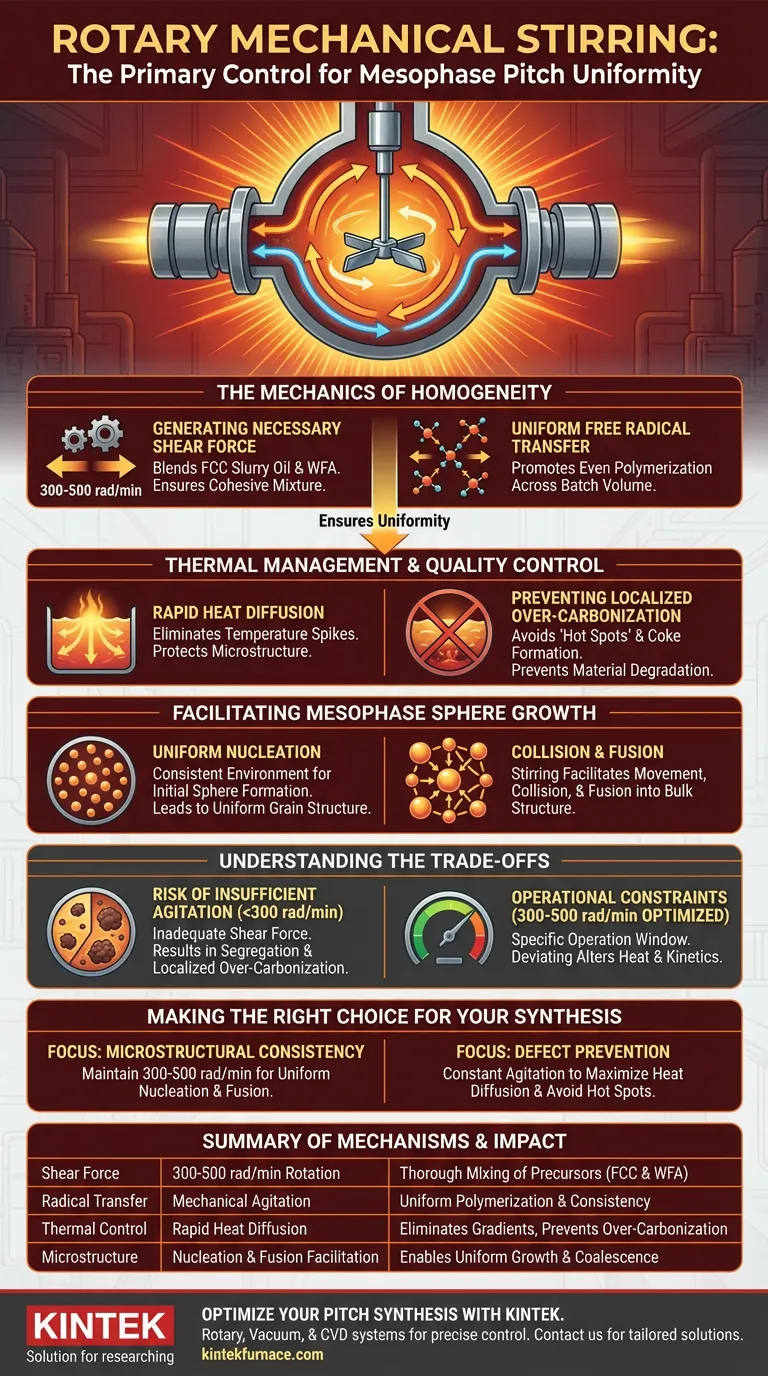
Rotary mechanical stirring acts as the primary control mechanism for uniformity during the high-temperature synthesis of mesophase pitch. By operating at speeds between 300 and 500 rad/min, these devices generate necessary shear force to thoroughly mix heavy precursors like Fluid Catalytic Cracking (FCC) slurry oil and Waste Fluid Asphalt (WFA).
High-temperature synthesis is volatile; without precise agitation, precursors degrade rather than transform. Mechanical stirring provides the shear force required to equalize heat and chemical reaction rates, ensuring mesophase spheres grow and fuse uniformly rather than hardening into localized coke.
The Mechanics of Homogeneity
Generating Necessary Shear Force
To combine viscous precursors effectively, the system requires significant mechanical energy.
Rotary devices operating between 300 and 500 rad/min provide the shear force needed to blend FCC slurry oil and WFA. This ensures the raw materials interact as a cohesive mixture rather than separate phases.
Uniform Free Radical Transfer
The chemical transformation of pitch relies on the activity of free radicals.
Mechanical agitation promotes the uniform transfer of these free radicals throughout the mixture. This consistency is vital for ensuring that the polymerization reactions occur evenly across the entire batch volume.
Thermal Management and Quality Control
Rapid Heat Diffusion
High-temperature synthesis creates a risk of thermal gradients.
Stirring drives rapid heat diffusion, constantly moving material from the heat source to the bulk fluid. This eliminates temperature spikes that could damage the developing microstructure.
Preventing Localized Over-Carbonization
Static or poorly mixed fluids are prone to "hot spots."
By preventing these localized high-temperature zones, stirring prevents localized over-carbonization. This ensures the material remains a synthesizable pitch rather than degrading into unwanted solid carbon or coke.
Facilitating Mesophase Sphere Growth
Uniform Nucleation
The quality of the final product depends on how the mesophase spheres initially form.
Consistent agitation creates an environment where mesophase spheres can nucleate uniformly. This leads to a consistent grain structure throughout the final pitch product.
Collision and Fusion
Mesophase spheres must interact to build larger liquid crystalline domains.
The movement generated by the stirrer facilitates the free movement, collision, and fusion of these spheres. This dynamic environment is essential for the spheres to coalesce into a bulk mesophase structure.
Understanding the Trade-offs
The Risk of Insufficient Agitation
Failing to maintain the designated speed range undermines the process.
If stirring falls below the 300 rad/min threshold, shear force may be insufficient to prevent segregation. This often results in localized over-carbonization, ruining the batch homogeneity.
Operational Constraints
The system relies on a specific window of operation.
The process is optimized strictly for the 300 to 500 rad/min range. Deviating from this parameter risks altering the heat diffusion rates and radical transfer kinetics that define the material's success.
Making the Right Choice for Your Synthesis
Achieving high-quality mesophase pitch requires adhering to strict mechanical parameters to manage thermal and chemical dynamics.
- If your primary focus is microstructural consistency: Maintain rotation speeds between 300 and 500 rad/min to ensure uniform nucleation and sphere fusion.
- If your primary focus is defect prevention: Rely on constant mechanical agitation to maximize heat diffusion and prevent localized over-carbonization.
Precise control of mechanical shear force is the difference between a high-quality mesophase pitch and a degraded, carbonized byproduct.
Summary Table:
| Function | Mechanism | Impact on Quality |
|---|---|---|
| Shear Force | 300 - 500 rad/min rotation | Ensures thorough mixing of viscous precursors (FCC & WFA) |
| Radical Transfer | Mechanical agitation | Promotes uniform polymerization and chemical consistency |
| Thermal Control | Rapid heat diffusion | Eliminates thermal gradients and prevents localized over-carbonization |
| Microstructure | Nucleation & Fusion facilitation | Enables uniform growth and coalescence of mesophase spheres |
Optimize Your Pitch Synthesis with KINTEK
Achieving the perfect mesophase structure requires absolute precision in thermal and mechanical control. KINTEK provides the cutting-edge laboratory high-temp furnaces—including Rotary, Vacuum, and CVD systems—needed to manage complex synthesis reactions. Backed by expert R&D and manufacturing, our systems are fully customizable to meet your unique speed and temperature requirements.
Ready to elevate your material research? Contact our engineering team today to discover how our tailored solutions can ensure microstructural consistency and defect-free production.
Visual Guide
References
- Mingzhi Wang, Xiaolong Zhou. The Neglected Role of Asphaltene in the Synthesis of Mesophase Pitch. DOI: 10.3390/molecules29071500
This article is also based on technical information from Kintek Furnace Knowledge Base .
Related Products
- Electric Rotary Kiln Pyrolysis Furnace Plant Machine Small Rotary Kiln Calciner
- Electric Rotary Kiln Continuous Working Small Rotary Furnace Kiln for Pyrolysis Plant Heating
- Vacuum Heat Treat Sintering Furnace Molybdenum Wire Vacuum Sintering Furnace
- High Temperature Muffle Oven Furnace for Laboratory Debinding and Pre Sintering
- Electric Rotary Kiln Small Rotary Furnace for Activated Carbon Regeneration
People Also Ask
- What are the advantages of electric rotary kilns compared to fuel-fired ones? Boost Precision and Efficiency in Your Process
- What advantages do electric rotary kilns offer over fuel-based kilns? Boost Efficiency and Purity in Your Process
- What materials can be processed in an electric rotary kiln? Versatile Solutions for Advanced Materials
- What is the significance of the refractory lining in a rotary kiln electric furnace? Unlock Efficiency and Longevity
- What are the main applications of a rotary kiln electric furnace? Achieve Uniform Heat Treatment for Powders














