
The diffusion bonding process for ODS steel and nickel-based alloys requires a dedicated vacuum furnace to create a contaminant-free environment that prevents high-temperature oxidation. Without this vacuum, oxygen reacts with the metal surfaces to form oxide films, which act as physical barriers that block the atomic diffusion necessary for creating a solid, permanent bond.
By eliminating oxygen and residual gases, the vacuum environment ensures that nothing stands between the mating surfaces. This allows for unobstructed atomic movement across the interface, resulting in a pore-free, solid-phase bond that maintains the material's full mechanical properties.
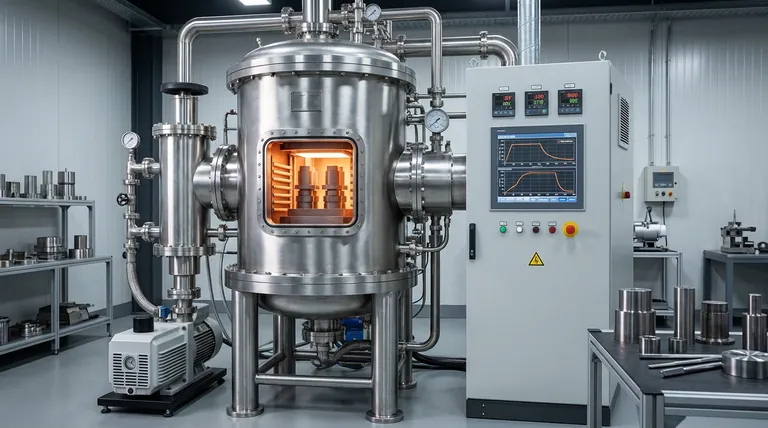
The Critical Role of the Vacuum Environment
Preventing Oxide Film Formation
At the elevated temperatures required for diffusion bonding, ODS steel and nickel-based alloys are highly susceptible to oxidation.
If oxygen is present, it reacts instantly with the metal surface to create a stable oxide film.
A dedicated vacuum furnace effectively removes oxygen, preventing these films from forming and keeping the metal surfaces chemically active for bonding.
Removing Residual Gases
Even if the external environment is clean, gases can be trapped within the microscopic gaps between the mating surfaces.
The vacuum environment actively evacuates these residual gases from the interface gaps.
This evacuation is crucial because trapped gases would otherwise expand or react at high temperatures, creating voids and preventing surface contact.
The Mechanics of a Sound Bond
Enabling Atomic Diffusion
Diffusion bonding relies entirely on the movement of atoms across the interface to merge two pieces of material into one.
Oxide films and impurities act as a "wall" that stops this atomic migration.
By ensuring a pure, oxide-free interface, the vacuum allows atoms to diffuse freely, creating a seamless metallurgical bridge between the components.
Eliminating Pores and Impurities
A sound solid-phase bond is defined by the absence of pores, voids, and inclusions.
Impurities at the interface often lead to weak spots or brittle zones within the final assembly.
The high-vacuum environment ensures the bonded interface remains free of these defects, resulting in a component that acts as a single, continuous piece of metal.
Understanding the Risks of Process Deviation
The Consequence of Poor Vacuum Levels
If the vacuum level is insufficient, partial oxidation will occur.
This leads to "weak links" in the bond where atomic diffusion was blocked by microscopic oxide patches.
The result is a joint with unpredictable mechanical properties that may fail under stress.
The Danger of Brittle Compounds
While the primary focus is preventing simple oxides, the presence of nitrogen or other atmospheric gases can also be detrimental.
Similar to how titanium reacts to form brittle compounds in air, nickel alloys can suffer from contamination that compromises ductility.
A dedicated vacuum furnace mitigates this risk by isolating the workpiece from all reactive elements, not just oxygen.
Ensuring Bond Integrity in Your Process
To achieve reliable results with ODS steel and nickel-based alloys, you must align your equipment capabilities with your material requirements.
- If your primary focus is mechanical strength: Ensure your furnace can maintain a high vacuum throughout the entire heating cycle to prevent oxide films that reduce bond strength.
- If your primary focus is microstructural purity: Prioritize vacuum systems capable of deep evacuation to remove all residual gases from interface gaps, eliminating porosity.
A pristine vacuum environment is the non-negotiable foundation for achieving high-performance solid-phase bonds in advanced alloy systems.
Summary Table:
| Factor | Vacuum Environment | Non-Vacuum/Poor Vacuum |
|---|---|---|
| Oxide Formation | Prevented; surfaces stay active | Oxide films form, blocking bonding |
| Atomic Diffusion | Unobstructed across interface | Blocked by physical barriers |
| Joint Integrity | Pore-free, solid-phase bond | Voids, pores, and weak spots |
| Mechanical Properties | Full material strength retained | Brittle zones and unpredictable failure |
| Contamination | Gas evacuation from gaps | Trapped gases cause inclusions |
Elevate Your Advanced Alloy Bonding with KINTEK
Don't compromise the integrity of your ODS steel and nickel-based alloy joints with substandard equipment. KINTEK provides industry-leading Vacuum Diffusion Bonding systems, specifically engineered to eliminate oxidation and facilitate flawless atomic migration.
Backed by expert R&D and manufacturing, we offer customizable Muffle, Tube, Rotary, Vacuum, and CVD systems tailored for high-temperature research and industrial production. Whether you need to ensure microstructural purity or maximize mechanical strength, our high-performance furnaces are the non-negotiable foundation for your success.
Ready to optimize your bonding process? Contact KINTEK today for a customized solution.
References
- José Rodolpho de Oliveira Leo, Michael E. Fitzpatrick. Development of a Diffusion Bonding Route for Joining Oxide-Dispersion-Strengthened (ODS) Steels for Nuclear Applications. DOI: 10.1007/s11661-023-07288-2
This article is also based on technical information from Kintek Furnace Knowledge Base .
Related Products
- Vacuum Hot Press Furnace Machine for Lamination and Heating
- Vacuum Induction Melting Furnace
- Split Chamber CVD Tube Furnace with Vacuum Station CVD Machine
- Vacuum Heat Treat Sintering and Brazing Furnace
- Vacuum Heat Treat Sintering Furnace with Pressure for Vacuum Sintering
People Also Ask
- What are the primary components of a vacuum hot press furnace? Master the Core Systems for Precise Material Processing
- What safety features are incorporated in vacuum hot press furnaces? Ensure Operator and Equipment Protection
- What are the benefits of the vacuum environment system in a vacuum hot press furnace? Unlock High-Density Sintering
- What industries benefit from the use of vacuum hot press furnaces? Unlock High-Performance Materials for Your Industry
- What is a vacuum hot press furnace? Unlock Superior Material Performance



















