
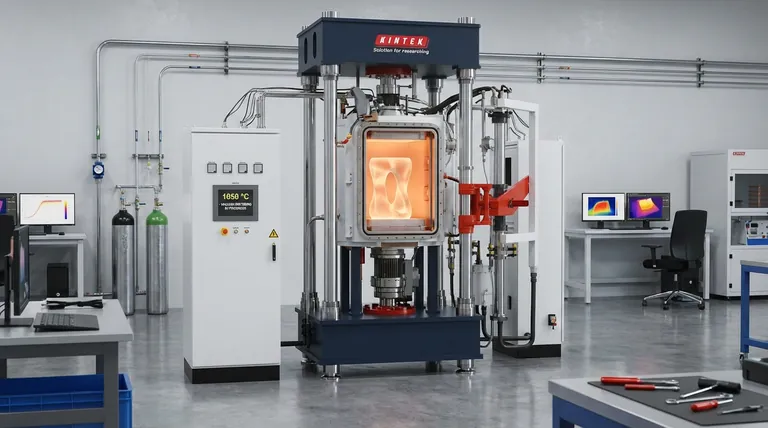
Vacuum sintering is the critical transformation phase that converts a fragile, 3D-printed silica "green body" into functional glass. By operating at temperatures around 1050 °C within a controlled vacuum, the furnace drives particle rearrangement and purges impurities to achieve full densification.
Core Takeaway The vacuum sintering furnace acts as both a purification and densification chamber. It simultaneously removes residual carbon by-products and facilitates the physical agglomeration of silica nanoparticles, transforming an opaque, porous print into a defect-free, optically transparent fused silica glass.
The Mechanics of Densification
The Role of the Vacuum Environment
The primary function of the vacuum is to create a pristine environment free of atmospheric gases. By evacuating the chamber, the furnace ensures that the silica does not react with air, which could alter its material properties.
Furthermore, the vacuum is essential for impurity removal. It facilitates the extraction of residual carbon by-products and binders used during the printing process, preventing them from becoming trapped defects in the final glass.
Thermal Processing at 1050 °C
The furnace raises the temperature to a specific set point, typically 1050 °C for fused silica. At this thermal plateau, silica nanoparticles gain the energy required to move and interact.
This heat triggers rearrangement and agglomeration. The particles shift to fill voids and bond together, effectively collapsing the porous structure of the green body into a solid mass.
Transition from Opaque to Transparent
Before sintering, the 3D-printed part is an opaque "green body" due to the scattering of light by pores and boundaries between particles.
As the furnace eliminates these pores through densification and removes residual carbon, the material's optical properties change drastically. The result is fully dense fused silica glass that is optically transparent and free of internal defects.
Critical Process Controls
Elimination of By-Products
The process involves more than just melting; it is a chemical and physical purification. The vacuum aids in "debinding," where organic matter and polymer matrices from the printing phase are decomposed and evacuated.
If these by-products are not fully removed before the pores close, the glass will retain black carbon specs or bubbles. The vacuum ensures these volatile elements are drawn out of the material structure.
Atomic Diffusion
While the primary mechanism for glass is often viscous flow, the vacuum environment facilitates atomic diffusion at particle boundaries.
This diffusion promotes the formation of a solid, high-density product by encouraging the particles to merge at a molecular level, rather than just mechanically adhering to one another.
Understanding the Trade-offs
Temperature Precision vs. Deformation
While 1050 °C is the target for densification, strict thermal control is required. If the temperature is too low, the glass remains porous and opaque; if it is too high or uneven, the part may suffer from unwanted deformation or slumping.
Cycle Time Implications
Vacuum sintering is rarely a rapid process. To ensure the complete removal of binders and gradual densification without cracking, the heating and cooling profiles must be carefully controlled. This often requires longer cycle times compared to simple air-firing.
Making the Right Choice for Your Goal
To maximize the quality of your 3D-printed glass, align your furnace parameters with your specific material requirements.
- If your primary focus is Optical Clarity: Ensure your vacuum levels are high enough to completely evacuate carbon by-products before the pores seal at peak temperature.
- If your primary focus is Geometric Fidelity: Closely monitor the 1050 °C hold time to achieve density without allowing the glass to flow or slump excessively.
Success relies on balancing the evacuation of impurities with the precise thermal energy needed to fuse nanoparticles into a unified solid.
Summary Table:
| Feature | Function in Densification | Impact on Final Product |
|---|---|---|
| Vacuum Environment | Removes residual carbon and binders | Ensures optical clarity and zero bubbles |
| 1050 °C Thermal Plateau | Triggers nanoparticle agglomeration | Collapses porous structures into solid mass |
| Pore Elimination | Facilitates atomic diffusion/viscous flow | Converts opaque green body to transparent glass |
| Process Control | Balances heat vs. hold time | Prevents deformation while ensuring high density |
Elevate Your Glass Manufacturing with KINTEK
Achieving perfect optical clarity and structural integrity in 3D-printed fused silica requires uncompromising thermal precision. KINTEK provides industry-leading vacuum sintering solutions backed by expert R&D and world-class manufacturing.
Our versatile range of Muffle, Tube, Rotary, and Vacuum furnaces—including advanced CVD systems—are fully customizable to meet your unique material specifications. Whether you are scaling production or conducting high-precision lab research, KINTEK ensures your silica components achieve maximum densification without deformation.
Ready to optimize your sintering profile? Contact our technical experts today to find the perfect high-temperature furnace for your 3D-printing workflow.
References
- Ziyong Li, Xiewen Wen. One-photon three-dimensional printed fused silica glass with sub-micron features. DOI: 10.1038/s41467-024-46929-x
This article is also based on technical information from Kintek Furnace Knowledge Base .
Related Products
- Vacuum Heat Treat Sintering Furnace Molybdenum Wire Vacuum Sintering Furnace
- Vacuum Heat Treat Sintering Furnace with Pressure for Vacuum Sintering
- 9MPa Air Pressure Vacuum Heat Treat and Sintering Furnace
- Small Vacuum Heat Treat and Tungsten Wire Sintering Furnace
- 600T Vacuum Induction Hot Press Vacuum Heat Treat and Sintering Furnace
People Also Ask
- What are the main structural components of a vacuum sintering furnace? Unlock Precision in High-Temperature Processing
- How does vacuum sintering improve dimensional tolerances? Achieve Uniform Shrinkage and Precision
- What is the purpose of setting a mid-temperature dwell stage? Eliminate Defects in Vacuum Sintering
- What are the key components of a vacuum sintering furnace? Essential Parts for Precision Material Processing
- How does vacuum sintering contribute to cost reduction in material processing? Lower Expenses with Superior Parts



















