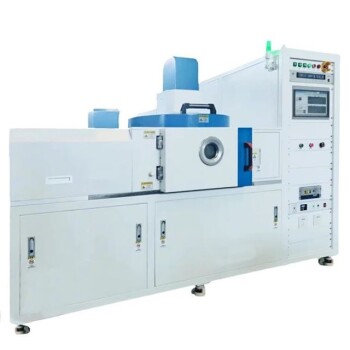
The primary advantage of a Rapid Thermal Treatment (RTT) system is its ability to decouple heating temperature from exposure time. While a traditional vacuum annealing furnace requires a heating cycle of at least 30 minutes, an RTT system utilizes high-energy quartz halogen lamps to complete reactions in as little as 7 seconds. This massive reduction in processing time enables precise control over material properties that is simply impossible with slower heating methods.
Core Takeaway RTT replaces the broad thermal soaking of traditional furnaces with precise, high-speed kinetic control. By reducing reaction times to mere seconds, RTT stabilizes desired nickel-silicon phases (NiSi) while physically preventing the microscopic degradation—such as grain growth and agglomeration—that occurs during prolonged heating.
The Mechanics of Rapid Heating
The Power Source Difference
Traditional vacuum annealing relies on conventional heating elements that heat the entire environment slowly. In contrast, RTT systems employ high-energy quartz halogen lamps.
This technology allows the system to ramp up temperature almost instantaneously. The direct application of high-intensity light acts as an immediate heat source, eliminating the thermal lag inherent in furnace designs.
Drastic Reduction in Cycle Time
The difference in processing speed is orders of magnitude apart. A standard furnace process demands a minimum of 30 minutes to heat, soak, and cool.
An RTT system can execute the same chemical reaction in 7 seconds. This speed is not just about manufacturing throughput; it is the fundamental mechanism that preserves the integrity of the materials being processed.
Controlling Microstructure at the Sub-Micron Level
Regulating Phase Transformations
Creating nickel-silicon compounds is a complex, multi-step chemical reaction. The material transitions from pure Nickel (Ni) to Dinickel Silicide (Ni2Si), and finally to the desired Nickel Monosilicide (NiSi).
RTT provides the temporal precision necessary to "lock in" the correct phase. Because the heating is so brief, the process can be stopped exactly when the optimal phase is reached, preventing over-processing or unwanted phase mixtures.
Inhibiting Excessive Grain Growth
In metallurgy, time is often the enemy of fine structure. Prolonged exposure to heat allows individual crystal grains to merge and grow larger.
The ultra-short duration of the RTT process denies the material the time needed for excessive grain growth. This results in a finer, superior sub-micron microstructure that is critical for modern, miniaturized device performance.
Preventing Thin Film Agglomeration
One of the most significant risks in preparing thin films is agglomeration—where a smooth film breaks apart into isolated islands or clumps.
This defect is thermally driven and time-dependent. By slashing the thermal budget from minutes to seconds, RTT effectively inhibits agglomeration, ensuring the thin film remains continuous and uniform.
The Risks of Traditional Annealing
The Cost of Thermal Inertia
While traditional vacuum annealing is a well-understood process, its inherent slowness creates a specific set of liabilities for advanced materials.
The extended 30-minute cycle creates a wide window for thermodynamic degradation. During this time, the material seeks equilibrium, which often leads to the microstructural coarsening described above.
If your application requires sub-micron precision, the "thermal soaking" effect of a traditional furnace acts as a detriment, degrading the film quality regardless of how precise the temperature setpoint is.
Making the Right Choice for Your Goal
To determine which thermal processing method suits your specific fabrication needs, consider the following technical priorities:
- If your primary focus is microstructure quality: Choose RTT to minimize grain size and prevent the agglomeration of thin films through strictly limited thermal exposure.
- If your primary focus is process speed: Choose RTT to leverage quartz halogen lamps for reaction times as short as 7 seconds, vastly outpacing the 30-minute cycles of vacuum furnaces.
- If your primary focus is phase purity: Choose RTT to gain tight control over the transition path from Ni to Ni2Si to NiSi, stopping the reaction at the precise moment required.
By leveraging the speed of quartz halogen lamps, RTT transforms thermal processing from a passive soaking step into a precise tool for microstructural engineering.
Summary Table:
| Feature | Traditional Vacuum Annealing | Rapid Thermal Treatment (RTT) |
|---|---|---|
| Heating Source | Conventional elements (Slow) | High-energy quartz halogen lamps |
| Processing Time | ≥ 30 minutes | As little as 7 seconds |
| Thermal Budget | High (leads to grain growth) | Ultra-low (preserves microstructure) |
| Thin Film Integrity | Risk of agglomeration/clumping | Inhibits agglomeration; ensures uniformity |
| Phase Control | Broad thermal soaking | Precise kinetic "lock-in" of NiSi phase |
Elevate Your Material Precision with KINTEK
Don't let traditional thermal lag compromise your sub-micron material integrity. KINTEK provides industry-leading thermal solutions designed for the most demanding research and production environments.
Why partner with KINTEK?
- Expert R&D: Our systems are backed by deep manufacturing expertise to ensure optimal phase purity.
- Versatile Systems: From Muffle and Tube furnaces to advanced Vacuum, Rotary, and CVD systems.
- Customizable Solutions: We tailor our lab high-temp furnaces to meet your unique chemical and metallurgical requirements.
Ready to transition from broad thermal soaking to precise kinetic control? Contact our technical experts today to find the perfect system for your application.
References
- V. A. Lapitskaya, Maksim Douhal. Microstructure and Properties of Thin-Film Submicrostructures Obtained by Rapid Thermal Treatment of Nickel Films on Silicon. DOI: 10.3390/surfaces7020013
This article is also based on technical information from Kintek Furnace Knowledge Base .
Related Products
- Laboratory Quartz Tube Furnace RTP Heating Tubular Furnace
- RF PECVD System Radio Frequency Plasma Enhanced Chemical Vapor Deposition
- Vacuum Heat Treat Furnace with Ceramic Fiber Liner
- Split Multi Heating Zone Rotary Tube Furnace Rotating Tube Furnace
- Vacuum Heat Treat Sintering and Brazing Furnace
People Also Ask
- What physical conditions does a laboratory Tube Furnace provide for SOEC? Precision Heat for Solid Oxide Characterization
- What are the main features and functions of a laboratory tube furnace? Unlock Precise High-Temp Control for Your Lab
- What conditions do tube furnaces provide for Au-Seeded TiO2 nanowires? Master Precision Thermal Synthesis
- What parameters must be controlled when calcining freeze-dried oxide precursors in a laboratory tube furnace? A Guide
- Why is a laboratory tube furnace necessary for BiVO4/RGO synthesis? Achieve Precise Nano-Structure Control