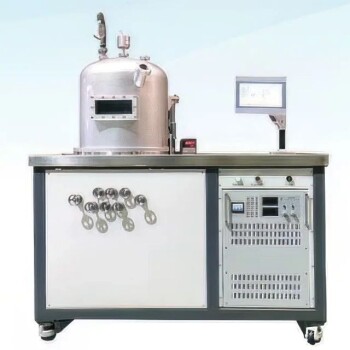
Sealed quartz tubes and integrated gas control systems serve as the fundamental "clean rooms" for vapor-phase nanowire synthesis. By isolating the reaction, these systems exclude destabilizing contaminants like atmospheric oxygen and allow for the precise regulation of argon pressure between 11 and 8000 Pa. This control is the deciding factor in stabilizing the Vapor-Liquid-Solid (VLS) mechanism and dictating the specific physical shape of the final Titanium Dioxide (TiO2) structures.
The success of TiO2 nanowire growth is defined not just by the ingredients, but by the mastery of the environment. A sealed, pressure-regulated system transforms a chaotic vapor reaction into a tunable process, giving you direct authority over nanowire morphology and chemical purity.
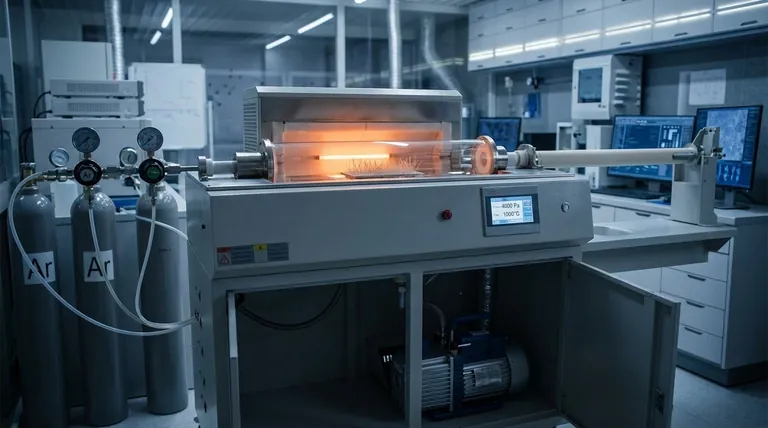
The Necessity of Environmental Isolation
Eliminating Chemical Interference
The primary function of the sealed quartz tube is to create a pristine reaction chamber. High-purity argon gas is introduced to displace standard air, which contains oxygen and moisture that can ruin the synthesis.
Preventing Premature Oxidation
Without a sealed environment, uncontrolled oxygen would react with the source materials too early. This "parasitic" oxidation alters the chemical composition before the nanowire can form, leading to impurities or failed growth.
Ensuring Vapor Retention
The sealed nature of the tube performs a critical containment function described as "limiting the loss of vapor-phase TiOx species." By keeping these vapor species inside the hot zone, the system maintains the necessary concentration for consistent growth.
Pressure Control and Morphology
The Link Between Pressure and Shape
The integrated vacuum and gas systems allow you to dial in specific pressures, typically ranging from 11 to 8000 Pa. This is not merely about safety; pressure is a shaping tool.
Defining Structure Types
Variations in this pressure directly influence the physical form of the TiO2. Adjusting the argon pressure can drive the transition between smooth, prismatic nanowires and more complex "beaded" structures.
Controlling Nanoparticle Interaction
Pressure regulation also dictates how the catalyst interacts with the wire. Specifically, the pressure environment controls the embedding behavior of gold (Au) nanoparticles within the wire, a critical feature for catalytic applications.
Stabilizing the Growth Mechanism
Mass Transport Stability
For the Vapor-Liquid-Solid (VLS) mechanism to work, the movement of vapor to the liquid catalyst must be steady. The gas control system ensures that the flow of mass—the "mass transport"—remains stable throughout the heating cycle.
Thermal Consistency
A sealed system at a controlled pressure aids in maintaining a consistent thermal profile. Fluctuations in pressure or gas flow can cause temperature spikes or drops, which immediately disrupt the uniformity of the growing nanowires.
Understanding the Trade-offs
Complexity of Setup
While critical for quality, these systems add significant complexity. Achieving and maintaining a vacuum or specific low-pressure environment requires high-quality seals, pumps, and gauges that introduce potential points of mechanical failure.
The Leak Risk
The reliability of your results is entirely dependent on the integrity of the quartz seal. Even a microscopic leak in the tube can reintroduce oxygen, rendering the precise pressure controls useless and contaminating the batch.
Equipment Cost
High-purity argon systems and precision vacuum controllers increase the overhead of the experiment. You are trading low-cost simplicity for high-fidelity control and reproducibility.
Making the Right Choice for Your Goal
To maximize the quality of your TiO2 nanowires, you must align your system settings with your specific scientific objective.
- If your primary focus is specific morphology (e.g., beaded vs. prismatic): Prioritize the precision of your vacuum controller to maintain exact pressure setpoints between 11 and 8000 Pa.
- If your primary focus is material purity and repeatability: Focus on the integrity of the quartz seal and the purity grade of your argon source to ensure zero oxygen contamination.
Mastering the pressure and seal of your system is the single most effective way to transition from random growth to engineered synthesis.
Summary Table:
| Feature | Function in TiO2 Synthesis | Impact on Nanowire Quality |
|---|---|---|
| Sealed Quartz Tube | Environmental Isolation | Prevents parasitic oxidation & retains vapor-phase species |
| Argon Gas Control | Atmospheric Displacement | Eliminates contaminants like oxygen and moisture |
| Vacuum System | Pressure Regulation (11-8000 Pa) | Dictates morphology (prismatic vs. beaded structures) |
| VLS Stabilization | Mass Transport Control | Ensures uniform growth and consistent thermal profiles |
Elevate Your Nanomaterial Synthesis with KINTEK
Precision in vapor-phase growth requires uncompromised environmental control. KINTEK provides high-performance, customizable Muffle, Tube, and Vacuum systems designed to meet the rigorous demands of TiO2 nanowire synthesis.
Backed by expert R&D and manufacturing, our systems ensure the vacuum integrity and thermal stability necessary for mastering the VLS mechanism. Whether you are engineering specific morphologies or requiring high-purity results, KINTEK offers the specialized lab high-temp furnaces you need to transition from random growth to engineered excellence.
Ready to optimize your lab's synthesis capabilities? Contact KINTEK today to discuss your custom furnace needs!
Visual Guide

References
- Zhina Razaghi, Guo‐zhen Zhu. Ni‐Assisted Endotaxial Growth of Au Nanoparticles Within TiO<sub>2</sub> Nanowires. DOI: 10.1002/admi.202500490
This article is also based on technical information from Kintek Furnace Knowledge Base .
Related Products
- High Pressure Laboratory Vacuum Tube Furnace
- HFCVD Machine System Equipment for Drawing Die Nano Diamond Coating
- Vacuum Sealed Continuous Working Rotary Tube Furnace Rotating Tube Furnace
- Split Chamber CVD Tube Furnace with Vacuum Station CVD Machine
- Custom Made Versatile CVD Tube Furnace Chemical Vapor Deposition CVD Equipment Machine
People Also Ask
- What role does a high vacuum tube furnace play in Co-Al sintering? Master High-Purity Porous Material Synthesis
- What are the different types of tube furnaces available? Find the Perfect Fit for Your Lab's Needs
- What is the role of a vacuum tube furnace during the final thermal treatment stage of Fe3O4@CSAC catalysts?
- What are the main advantages of vacuum tube furnaces in the market? Achieve Purity and Precision in Material Processing
- What role does a laboratory tube furnace play in geological and mineralogical research? Unlock Earth's Secrets with Precision