
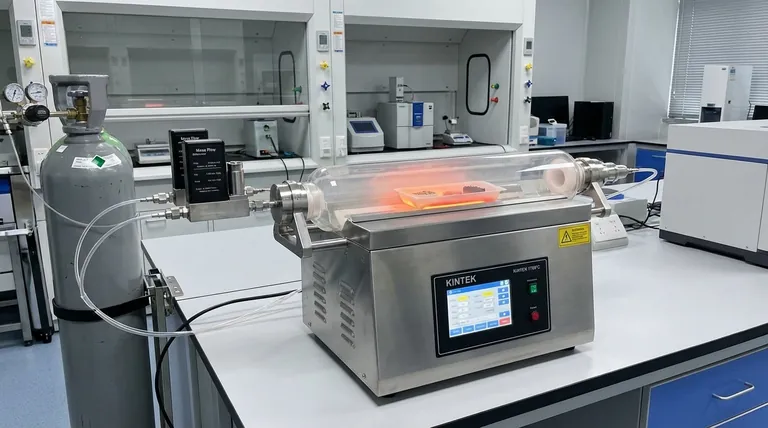
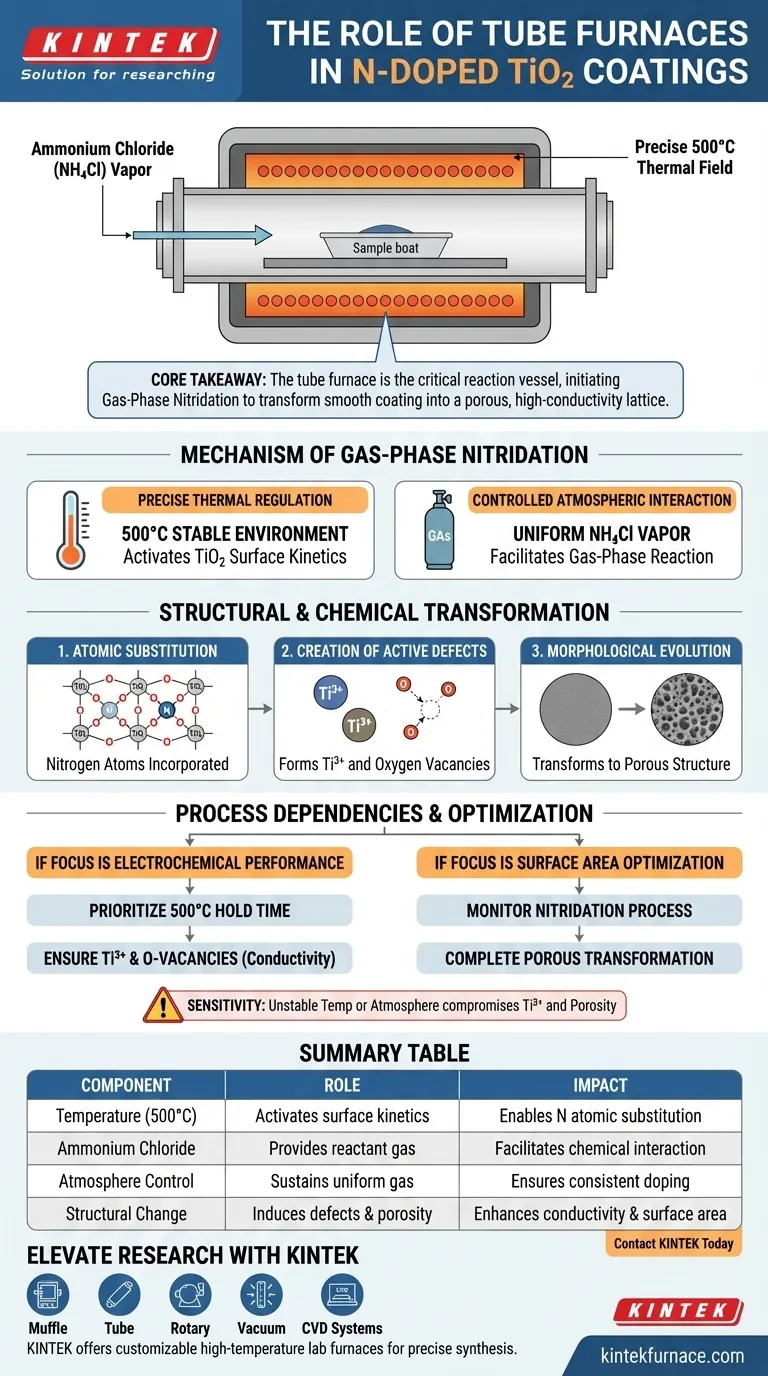
The tube furnace serves as the critical reaction vessel for synthesizing nitrogen-doped titanium dioxide coatings. It establishes a precise temperature field, typically maintained at 500 °C, and sustains the specific atmospheric environment necessary for the chemical reaction between the titanium dioxide coating and ammonium chloride.
Core Takeaway The tube furnace does not merely heat the sample; it facilitates a gas-phase nitridation process that fundamentally alters the material's atomic structure. By enabling the introduction of nitrogen atoms, it transforms a smooth coating into a porous, high-conductivity lattice essential for advanced performance.
The Mechanism of Gas-Phase Nitridation
Precise Thermal Regulation
The furnace provides a stable, high-temperature environment mandated by the reaction kinetics.
Maintained specifically at 500 °C, this thermal energy is required to activate the surface of the titanium dioxide. Without this precise heat application, the chemical interaction with the dopant source cannot initiate.
Controlled Atmospheric Interaction
The equipment ensures the coating is exposed to a consistent concentration of reactant gas.
The furnace contains the ammonium chloride vapor, facilitating its reaction with the solid titanium dioxide coating. This controlled gas-phase environment allows for uniform exposure across the material's surface.
Structural and Chemical Transformation
Atomic Substitution
The primary function of this thermal process is the strategic introduction of nitrogen.
Under these conditions, nitrogen atoms are successfully incorporated into the titanium oxide lattice. This doping is the root cause of the material's altered properties.
Creation of Active Defects
The high-temperature nitridation induces specific chemical changes within the crystal structure.
The process leads to the formation of trivalent titanium (Ti3+) and oxygen vacancies. these defects are critical for enhancing the material's electronic and ionic behavior.
Morphological Evolution
The physical architecture of the coating changes drastically during the furnace treatment.
The initial coating, which is typically smooth, is transformed into a porous structure. This increased porosity creates pathways that significantly enhance high ionic conductivity.
Understanding the Process Dependencies
Sensitivity to Conditions
The success of this process relies heavily on the stability of the tube furnace environment.
If the temperature deviates from the 500 °C target or the ammonium chloride atmosphere is inconsistent, the formation of Ti3+ and oxygen vacancies may be compromised. The transformation from smooth to porous is a direct result of these specific parameters being met.
Optimizing Material Performance
Based on the transformative capabilities of the tube furnace, here is how to view the process relative to your engineering goals:
- If your primary focus is electrochemical performance: Prioritize the precise 500 °C hold time to ensure the generation of sufficient Ti3+ and oxygen vacancies for conductivity.
- If your primary focus is surface area optimization: Monitor the nitridation process to ensure the complete transformation from a smooth surface to the desired porous morphology.
The tube furnace is the enabling tool that converts a standard oxide coating into a highly conductive, chemically active component.
Summary Table:
| Process Component | Role in Nitridation | Impact on TiO2 Coating |
|---|---|---|
| Temperature (500°C) | Activates surface kinetics | Enables atomic substitution of Nitrogen |
| Ammonium Chloride | Provides reactant gas vapor | Facilitates gas-phase chemical interaction |
| Atmosphere Control | Sustains uniform gas concentration | Ensures consistent doping across lattice |
| Structural Change | Induces oxygen vacancies | Transforms smooth surface to porous morphology |
Elevate Your Material Research with KINTEK
Precision is the difference between a standard coating and a high-performance nitrogen-doped lattice. KINTEK provides the advanced heating solutions required for sensitive gas-phase reactions. Backed by expert R&D and manufacturing, we offer Muffle, Tube, Rotary, Vacuum, and CVD systems—all fully customizable to meet your specific temperature and atmospheric requirements.
Whether you are focusing on electrochemical performance or surface area optimization, our high-temperature lab furnaces deliver the stability needed to generate critical Ti3+ defects and oxygen vacancies. Contact KINTEK today to discuss your unique laboratory needs and discover how our equipment can streamline your synthesis process.
Visual Guide
References
- Xiangqi Liu, Mark H. Rümmeli. LiF‐Dominated SEI Formation via a Lychee‐Like Primary Interphase for Fast‐Charging Natural Graphite Anodes. DOI: 10.1002/smll.202504255
This article is also based on technical information from Kintek Furnace Knowledge Base .
Related Products
- 1200℃ Controlled Inert Nitrogen Atmosphere Furnace
- Slide PECVD Tube Furnace with Liquid Gasifier PECVD Machine
- Vertical Laboratory Quartz Tube Furnace Tubular Furnace
- Magnesium Extraction and Purification Condensing Tube Furnace
- Multi Zone Laboratory Quartz Tube Furnace Tubular Furnace
People Also Ask
- What controlled-atmosphere furnace conditions are required for sintering powder metallurgy copper alloy compacts? Ideal Setup
- How do surface oxide layers on ceramic powders like silicon nitride affect sintering? Master Atmosphere Control
- Why is a controlled atmosphere furnace required for 316L debinding? Ensure Structural Integrity & Zero Cracks
- What causes discrepancies between theoretical and experimental grain boundary mobility during ceramic sintering? Explained
- What are the operational considerations for a controlled atmosphere furnace? Master Key Factors for Material Processing



















