
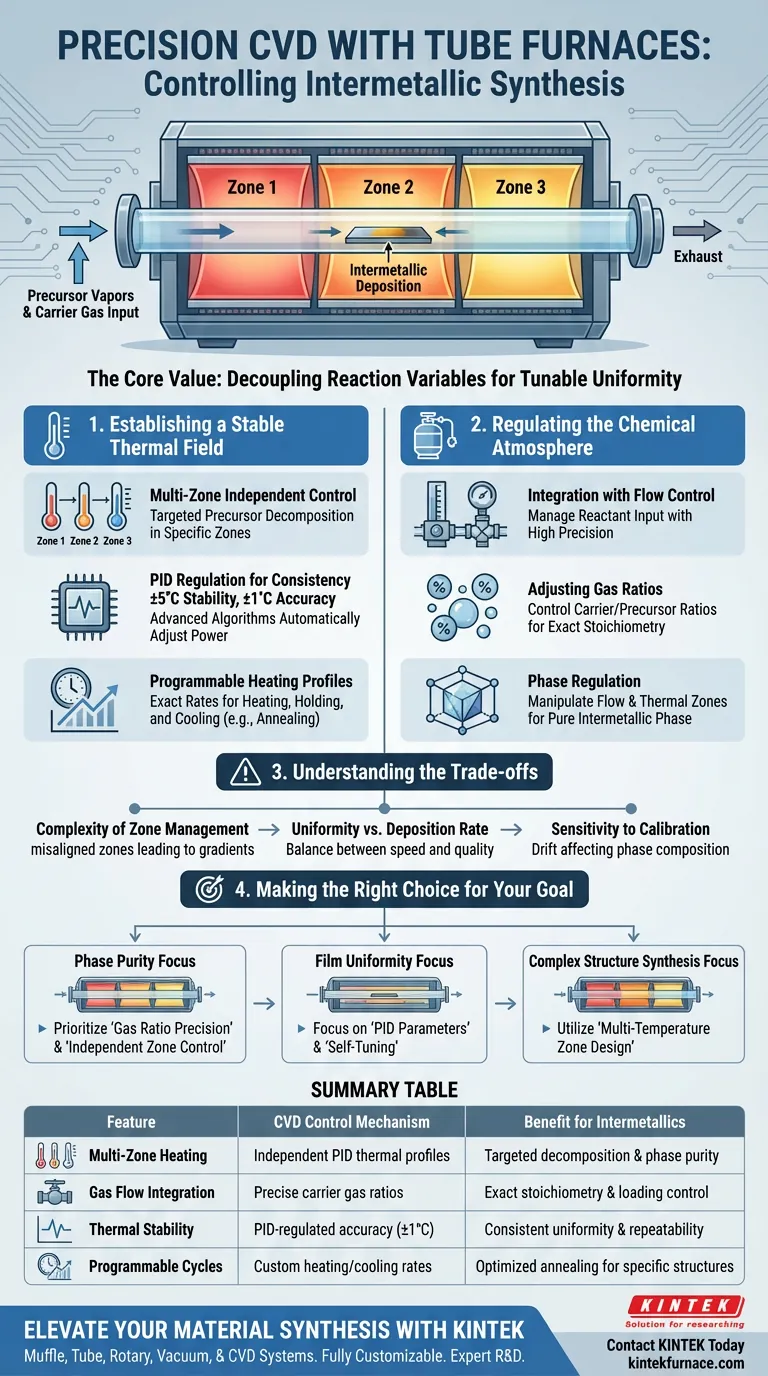
A Tube Furnace facilitates precise control in CVD by acting as a highly stable reaction vessel that integrates multi-zone thermal management with high-precision gas flow regulation. By creating a specific, adjustable thermal field, the furnace ensures that gaseous precursors—such as silane or metal chloride vapors—decompose and deposit only in targeted zones. This architecture allows you to strictly dictate the ratio of carrier gases like hydrogen, enabling exact control over the loading and phase formation of intermetallic compounds.
The core value of a Tube Furnace in CVD is its ability to decouple reaction variables. It provides a stabilized environment where temperature gradients and gas flow rates are managed independently, allowing you to "tune" the chemical phase and uniformity of the deposited material with high repeatability.
Establishing a Stable Thermal Field
Multi-Zone Independent Control
The primary mechanism for precision is the furnace's multi-zone design. Unlike a standard oven, a CVD tube furnace allows you to control different heating zones independently.
Targeted Precursor Decomposition
This zonal control creates a specific thermal profile across the tube. It ensures that precursors decompose only when they reach the specific zone maintained at the reaction temperature.
PID Regulation for Consistency
Advanced systems utilize PID (Proportional-Integral-Derivative) algorithms to automatically adjust heating power. This maintains temperature stability, often within ±5℃, and display accuracy as tight as ±1℃.
Programmable Heating Profiles
You can define exact parameters for heating rates, holding times, and cooling curves. This temporal control is critical for processes like annealing, which may induce specific structural changes or defects required for the material's final properties.
Regulating the Chemical Atmosphere
Integration with Flow Control Systems
Thermal control alone is insufficient for intermetallic compounds; the chemical supply must also be precise. The tube furnace integrates with high-precision flow control systems to manage the input of reactants.
Adjusting Gas Ratios
The system allows for the accurate adjustment of carrier gases, such as hydrogen, relative to the precursor vapors. Mastering this ratio is the key to controlling the stoichiometry of the final compound.
Phase Regulation
By manipulating the flow rate and the thermal zone simultaneously, you control the phase regulation of the material. This ensures the substrate is loaded with the correct intermetallic phase rather than an unwanted byproduct.
Understanding the Trade-offs
Complexity of Zone Management
While multi-zone furnaces offer precision, they introduce complexity. Improper calibration between zones can lead to unintended temperature gradients that skew the deposition profile.
Uniformity vs. Deposition Rate
There is often a balance between the speed of deposition and the quality of the film. pushing for higher flow rates to increase loading can compromise the uniformity and consistency of the thermal field, leading to uneven film thickness.
Sensitivity to Calibration
The high precision of PID controllers and flow systems requires regular calibration. A slight drift in sensor accuracy can significantly alter the phase composition of sensitive intermetallic compounds.
Making the Right Choice for Your Goal
To maximize the effectiveness of your CVD process, align your furnace settings with your specific material objectives:
- If your primary focus is Phase Purity: Prioritize the gas ratio precision and independent zone control to isolate the exact decomposition temperature of your precursors.
- If your primary focus is Film Uniformity: Focus on the PID parameters and self-tuning technologies to ensure the thermal field remains stable (±5℃) throughout the entire reaction zone.
- If your primary focus is Complex Structure Synthesis: Utilize a multi-temperature zone design to create distinct heating and annealing stages within a single pass.
True precision in CVD comes from viewing the Tube Furnace not just as a heater, but as a programmable flow reactor.
Summary Table:
| Feature | CVD Control Mechanism | Benefit for Intermetallics |
|---|---|---|
| Multi-Zone Heating | Independent PID thermal profiles | Targeted precursor decomposition & phase purity |
| Gas Flow Integration | Precise carrier gas ratios | Exact control over stoichiometry and loading |
| Thermal Stability | PID-regulated accuracy (±1℃) | Consistent film uniformity and repeatability |
| Programmable Cycles | Custom heating/cooling rates | Optimized annealing for specific crystal structures |
Elevate Your Material Synthesis with KINTEK
Precise CVD processes demand the highest standards of thermal and atmospheric control. At KINTEK, we bridge the gap between complex research requirements and reliable industrial performance.
Backed by expert R&D and manufacturing, we offer a comprehensive range of Muffle, Tube, Rotary, Vacuum, and CVD systems, all of which are fully customizable to meet your unique intermetallic compound research or production needs. Whether you require advanced multi-zone independent control or high-precision gas delivery, our systems provide the stability and repeatability your lab deserves.
Ready to optimize your deposition profiles?
Contact KINTEK Today to discuss your custom furnace requirements with our technical specialists.
Visual Guide
References
- Zhiquan Hou, Hongxing Dai. Exploring Intermetallic Compounds: Properties and Applications in Catalysis. DOI: 10.3390/catal14080538
This article is also based on technical information from Kintek Furnace Knowledge Base .
Related Products
- Vacuum Sealed Continuous Working Rotary Tube Furnace Rotating Tube Furnace
- 1400℃ High Temperature Laboratory Tube Furnace with Alumina Tube
- 1700℃ High Temperature Laboratory Tube Furnace with Alumina Tube
- Magnesium Extraction and Purification Condensing Tube Furnace
- High Pressure Laboratory Vacuum Tube Furnace
People Also Ask
- What is the purpose of rotary tube furnaces? Achieve Uniform Heat Treatment for Powders and Granules
- What are the key advantages of using a rotary tube furnace? Achieve Dynamic, Uniform Heating for Powders
- How does the amount of material processed vary between batch and continuous rotary tube furnaces? Scale Your Production Efficiently
- What are the advantages of rotary tube furnaces in fuel compatibility? Boost Efficiency and Cut Costs
- What is the temperature range of some rotary tube furnaces? Achieve Uniform Heating Up to 1200°C



















