
Synthesizing high-quality monolayer Molybdenum Disulfide (MoS2) requires far more than simple heating; it demands an environment where thermal energy is distributed with surgical precision. A tube furnace with advanced temperature control is necessary because it allows you to decouple the evaporation temperatures of the precursors from the reaction temperature at the substrate, ensuring the distinct thermodynamic conditions required for monolayer growth are met simultaneously.
Achieving monolayer thickness is not just about reaching a specific temperature; it is about orchestrating a precise sequence of phase changes. A tube furnace provides the multi-zone architecture necessary to evaporate precursors at their unique optimal temperatures, ensuring that crystal growth is driven by controlled kinetics rather than chaotic thermal fluctuation.
The Mechanics of Precursor Management
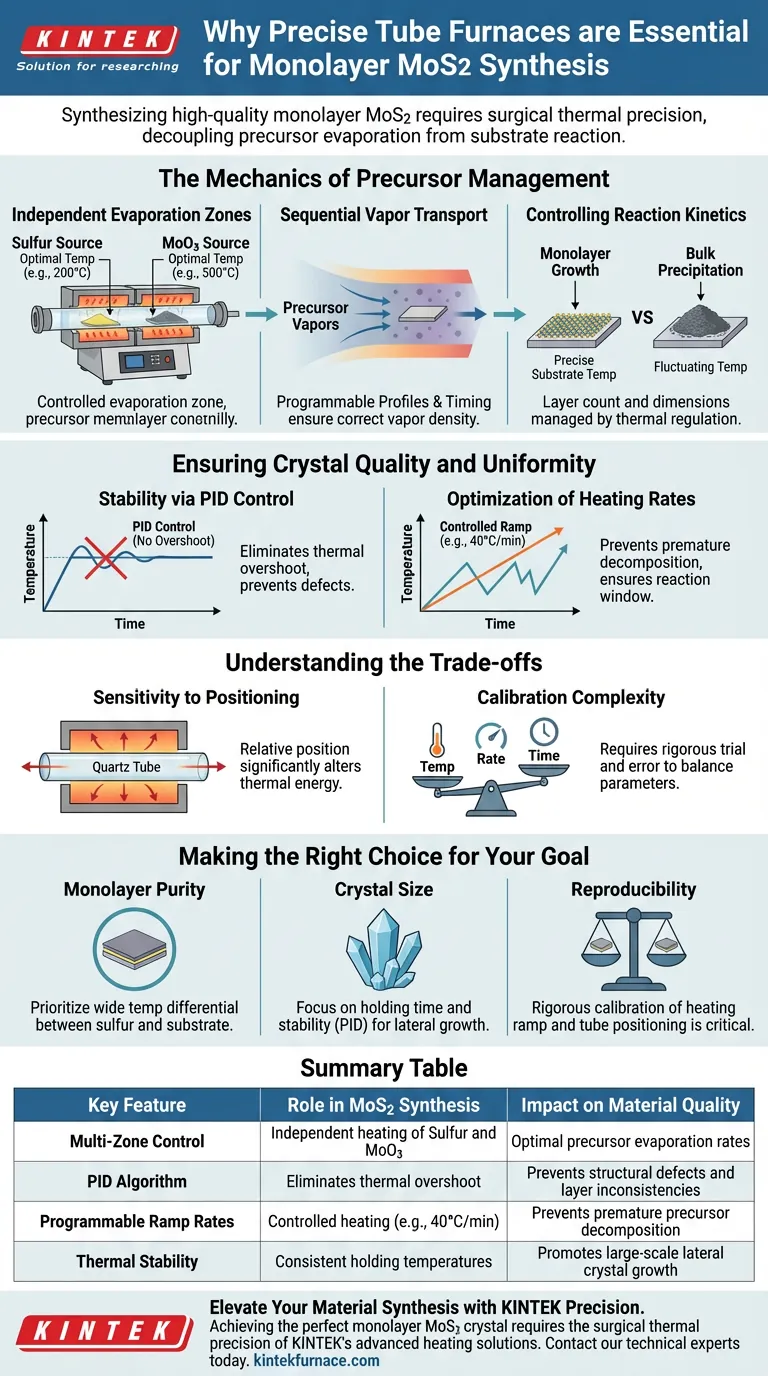
Independent Evaporation Zones
The fundamental challenge in MoS2 synthesis is that the precursors—typically sulfur powder and Molybdenum Trioxide (MoO3)—have vastly different vaporization points.
A precise tube furnace allows for independent control of heating zones. This ensures that the sulfur source and the molybdenum source are kept at their specific optimal evaporation temperatures, rather than a single compromised temperature.
Sequential Vapor Transport
High-quality crystallization relies on the timing of when precursor vapors reach the substrate.
By utilizing programmable heating profiles or adjusting the position of the quartz tube within the gradient, the furnace facilitates sequential heating. This ensures that sulfur atoms are available in the correct density to replace active sites in the molybdenum source effectively.
Controlling Reaction Kinetics
Once the vapors reach the substrate, the local temperature determines how they settle and crystallize.
Precise thermal regulation at the substrate surface is essential for managing the layer count and dimensions of the final film. If the reaction temperature fluctuates, the growth mode can shift from monolayer surface adsorption to bulk precipitation.
Ensuring Crystal Quality and Uniformity
Stability via PID Control
Advanced tube furnaces utilize PID (Proportional-Integral-Derivative) algorithms to automatically adjust heating power.
This eliminates thermal overshoot and maintains strict stability inside the chamber. Consistent temperature prevents the formation of structural defects and ensures the crystalline quality of the MoS2 thin film remains uniform across the sample.
Optimization of Heating Rates
The rate at which temperature rises is just as critical as the final holding temperature.
Industrial-grade furnaces allow for programmable rates, such as 40 °C per minute. Controlling this ramp-up prevents the premature decomposition of precursors and ensures the reaction proceeds strictly within the desired thermodynamic window.
Understanding the Trade-offs
Sensitivity to Positioning
While tube furnaces offer gradients, the results are highly sensitive to physical positioning.
Even with precise electronic control, the relative position of the quartz tube within the chamber significantly alters the thermal energy the precursors receive. A shift of a few millimeters can change the evaporation rate, leading to inconsistent stoichiometry in the final crystal.
Calibration Complexity
The flexibility of multi-zone control introduces complexity in parameter tuning.
Achieving the perfect "recipe" requires rigorous trial and error to balance the heating temperature, rate, and holding time. This is not a "plug-and-play" solution; it requires a deep understanding of the thermal profile of the specific furnace being used.
Making the Right Choice for Your Goal
To maximize the quality of your MoS2 synthesis, align your equipment usage with your specific scientific objectives:
- If your primary focus is Monolayer Purity: Prioritize a multi-zone furnace that allows for the widest possible temperature differential between the sulfur source and the substrate.
- If your primary focus is Crystal Size: Focus on the precision of the holding time and stability (PID control) to allow for prolonged, undisturbed lateral growth of the crystals.
- If your primary focus is Reproducibility: rigorous calibration of the heating ramp rate and exact tube positioning is more critical than maximum temperature capability.
Precision in thermal control is the difference between growing a high-performance semiconductor and creating generic soot.
Summary Table:
| Key Feature | Role in MoS2 Synthesis | Impact on Material Quality |
|---|---|---|
| Multi-Zone Control | Independent heating of Sulfur and MoO3 | Optimal precursor evaporation rates |
| PID Algorithm | Eliminates thermal overshoot | Prevents structural defects and layer inconsistencies |
| Programmable Ramp Rates | Controlled heating (e.g., 40°C/min) | Prevents premature precursor decomposition |
| Thermal Stability | Consistent holding temperatures | Promotes large-scale lateral crystal growth |
Elevate Your Material Synthesis with KINTEK Precision
Achieving the perfect monolayer MoS2 crystal requires more than just heat—it requires the surgical thermal precision of KINTEK’s advanced heating solutions. Backed by expert R&D and world-class manufacturing, we provide high-performance Tube, Muffle, Rotary, Vacuum, and CVD systems tailored for the most demanding laboratory environments.
Whether you need independent multi-zone control for complex precursor management or customizable systems for unique research scales, KINTEK delivers the stability and reproducibility your science deserves.
Ready to optimize your thin-film growth? Contact our technical experts today to find the perfect furnace for your lab.
Visual Guide
References
- Effects of Reaction Temperature and Catalyst Type on Fluid Catalytic Cracking (FCC) of Crude Oil Feeds: A Microactivity Test Unit Study. DOI: 10.64589/juri/207996
This article is also based on technical information from Kintek Furnace Knowledge Base .
Related Products
- Multi Heating Zones CVD Tube Furnace Machine for Chemical Vapor Deposition Equipment
- Split Multi Heating Zone Rotary Tube Furnace Rotating Tube Furnace
- Multi Zone Laboratory Quartz Tube Furnace Tubular Furnace
- Magnesium Extraction and Purification Condensing Tube Furnace
- Vacuum Sealed Continuous Working Rotary Tube Furnace Rotating Tube Furnace
People Also Ask
- What is the function of a multi-zone tube furnace in CVD synthesis? Master 2D In2Se3 Nanosheet Precision
- What environmental protection applications utilize multi zone tube furnaces? Unlock Precision in Waste Treatment and Green Tech
- Why are multi zone tube furnaces particularly useful for nanomaterial research? Unlock Precise Thermal Control for Advanced Synthesis
- What temperature-related capabilities make multi zone tube furnaces valuable for research? Unlock Precision Thermal Control
- What role do multi zone tube furnaces play in new energy research? Unlock Precise Thermal Control for Innovation



















