
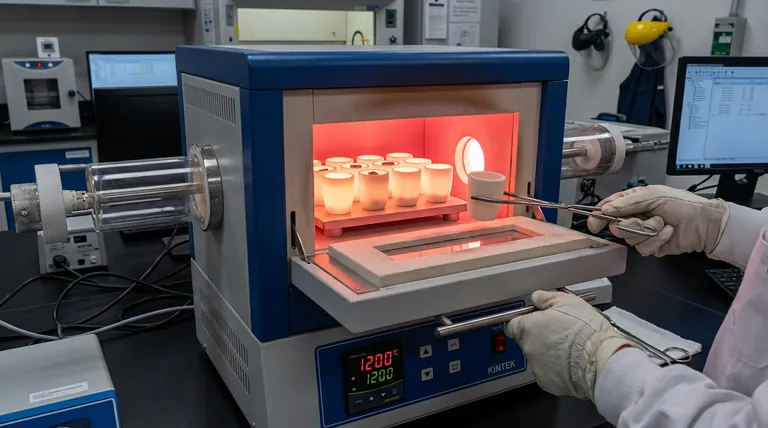
High-purity alumina crucibles are the definitive choice for this application due to their exceptional thermal stability and chemical inertness. When sintering boron-containing stainless steel at temperatures around 1200 °C, the material generates a reactive partial liquid phase. Alumina substrates act as a robust barrier, preventing this liquid phase from adhering to furnace hardware or undergoing high-temperature chemical reactions that would degrade the sample.
Sintering boron-containing steel creates a "sticky" liquid phase that threatens specimen integrity. High-purity alumina is selected because it remains chemically neutral and mechanically rigid at 1200 °C, ensuring the final product retains its intended composition and surface quality.
Preventing Chemical Interaction
The Challenge of the Liquid Phase
During the sintering process at 1200 °C, boron-containing stainless steel generates a partial liquid phase.
While this phase is necessary for densification, it is highly reactive and prone to sticking to contacting surfaces.
Without the correct substrate, this liquid phase can bond with the furnace hardware, ruining both the sample and the equipment.
Alumina as an Inert Barrier
High-purity alumina is chemically inert, meaning it does not react with the molten constituents of the steel.
By using alumina, you effectively isolate the specimen, preventing the diffusion of impurities into the steel.
This ensures the compositional integrity of the sample remains compromised by the sintering environment.
Thermal Stability and Mechanical Strength
Resisting Deformation at High Heat
Crucibles must maintain their shape and surface smoothness under extreme thermal loads.
High-purity alumina exhibits excellent mechanical strength at elevated temperatures, ensuring the crucible does not warp or sag during the heating cycle.
This stability preserves the surface quality of the samples, keeping them smooth and free from physical defects caused by substrate failure.
The Risks of Alternative Materials
Comparing alumina to quartz (silicon dioxide) highlights why alumina is superior.
At high steelmaking temperatures, quartz approaches its softening point and is prone to deformation or breakage.
Furthermore, quartz can introduce unwanted silicon and oxygen impurities into the melt, whereas alumina remains intact and reduces side reactions.
Understanding the Trade-offs
The Necessity of High Purity
It is critical to specifically select high-purity alumina, rather than standard industrial grades.
Lower-grade alumina may contain binders or impurities that could leach into the boron-containing steel during the liquid phase.
Mechanical Rigidity vs. Contamination
While softer substrates might offer lower costs, they lack the rigidity required for high-temperature processing.
The trade-off for using a cheaper substrate like quartz is a high risk of chemical contamination and physical adhesion.
Therefore, the investment in high-purity alumina is a necessary cost to ensure data accuracy and specimen survival.
Making the Right Choice for Your Goal
When designing a sintering protocol for boron-containing alloys, select your substrate based on your specific quality requirements:
- If your primary focus is Compositional Purity: Choose high-purity alumina to prevent the introduction of silicon or oxygen impurities caused by reactive substrates.
- If your primary focus is Surface Quality: Rely on alumina’s mechanical stability to prevent adhesion between the liquid phase of the steel and the furnace hardware.
High-purity alumina provides the necessary isolation to turn a volatile sintering process into a controlled, reproducible manufacturing step.
Summary Table:
| Feature | High-Purity Alumina | Quartz (Silicon Dioxide) |
|---|---|---|
| Chemical Reactivity | Inert; no reaction with liquid phase | High; potential Si/O contamination |
| Thermal Stability | Excellent up to 1200°C+ | Poor; approaches softening point |
| Mechanical Strength | Maintains rigidity under heat | Prone to deformation or breakage |
| Adhesion Risk | Prevents bonding with steel | High risk of sample-to-crucible bonding |
| Primary Application | Precision sintering & purity-critical | Low-temp or non-reactive processes |
Elevate Your Sintering Precision with KINTEK
Don't compromise your material integrity with subpar substrates. KINTEK's high-purity alumina crucibles are engineered to withstand the reactive liquid phases of boron-containing steels, ensuring zero contamination and superior surface quality.
Backed by expert R&D and manufacturing, KINTEK offers Muffle, Tube, Rotary, Vacuum, and CVD systems, all customizable for your unique lab high-temp needs. Whether you are scaling production or refining research, our technical experts are ready to help you optimize your thermal processing.
Contact KINTEK Today to Find Your Custom Solution
References
- Microstructural Evolution of a Pre-Alloyed Duplex Stainless Steel 2205 with Boron Addition Prepared by Powder Metallurgy. DOI: 10.3390/powders4030024
This article is also based on technical information from Kintek Furnace Knowledge Base .
Related Products
- 1400℃ High Temperature Laboratory Tube Furnace with Alumina Tube
- 1700℃ High Temperature Laboratory Tube Furnace with Alumina Tube
- Magnesium Extraction and Purification Condensing Tube Furnace
People Also Ask
- How does zone-melting in tube furnaces synthesize bismuth micro-wires? Master Single-Crystal Thermoelectric Growth
- How do high-temperature laboratory tube furnaces ensure environmental stability? Precision Thermal Reduction Tips
- How are high-temperature laboratory tube furnaces applied in long-term vacuum homogenization heat treatments for intermetallic samples?
- How are high-temp tube furnaces used to measure diffusion coefficients per Fick's law? Master Precision Annealing
- How are high-temperature tube furnaces applied in testing ceramic-supported alloy membranes? Insights


