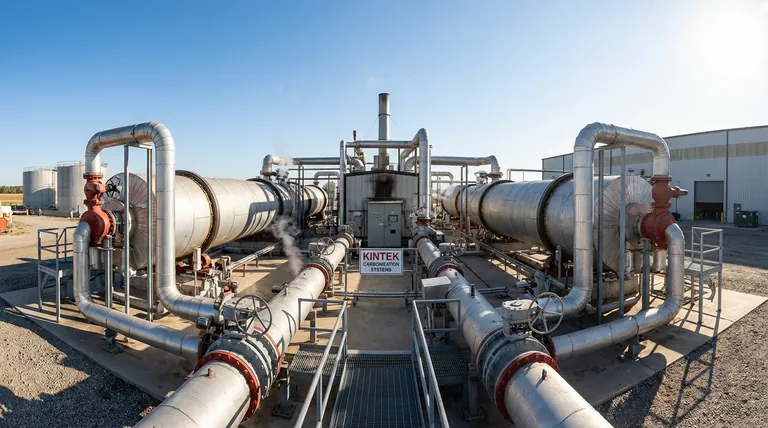
In a multi-kiln carbonization system, the piping and butterfly valves serve as the critical infrastructure for gas distribution and isolation. This network connects individual kilns to a central furnace, allowing operators to channel combustible gas efficiently while maintaining the ability to segregate specific parts of the system.
These components transform independent kilns into a synchronized cluster by regulating gas flow to a central furnace. Their primary value lies in allowing continuous operation of the system while isolating individual units for maintenance or ignition.
Facilitating Process Control
Regulating Gas Volume
The butterfly valves provide variable control rather than a simple on/off switch. This allows operators to precisely regulate the volume of combustible gas traveling from each kiln to the central furnace.
Synchronizing Production
By adjusting flow rates, operators can balance the output of the cluster. This facilitates the synchronized management of the entire production cycle, ensuring the central furnace receives a steady fuel supply.
Ensuring Operational Continuity
Isolation for Maintenance
The system allows for selective shutdown via the piping network. Valves can isolate specific kilns for repairs or inspection without forcing the entire cluster to stop operations.
Safe Ignition Procedures
Isolation is also critical during the startup phase. Operators can safely ignite specific kilns independently before integrating their gas flow into the main network.
Operational Criticality and Trade-offs
Dependency on Valve Integrity
The system's flexibility relies entirely on the seal integrity of the butterfly valves. If a valve fails to close completely, isolation is compromised, potentially leaking gas during maintenance procedures.
Precision Requirements
Effective synchronization requires accurate manipulation of the valves. Poorly calibrated adjustments can disrupt the gas balance to the central furnace, affecting the efficiency of the entire cluster.
Making the Right Choice for Your Goal
To maximize the utility of this distribution network, consider how you operate the valves based on your immediate needs:
- If your primary focus is continuous production: Prioritize the precise regulation of the valves to synchronize gas flow, ensuring the central furnace is never starved of fuel.
- If your primary focus is maintenance safety: Rely on the isolation function to fully segregate a unit, verifying the valve seal before commencing work on any specific kiln.
Understanding this network allows you to treat a multi-kiln setup not as separate units, but as a cohesive, adaptable energy system.
Summary Table:
| Component | Primary Function | Operational Impact |
|---|---|---|
| Piping Network | Gas Distribution | Connects multiple kilns to a central furnace for synchronized fuel supply. |
| Butterfly Valves | Flow Regulation | Allows precise volume control and variable gas flow management. |
| Isolation Mode | System Segregation | Enables maintenance or ignition of individual kilns without stopping the entire cluster. |
| Seal Integrity | Safety & Efficiency | Prevents gas leaks and ensures reliable performance during independent unit operation. |
Optimize Your Production Efficiency with KINTEK
Precise gas management is the backbone of high-performance carbonization. Backed by expert R&D and manufacturing, KINTEK offers high-quality lab high-temp furnaces, including Muffle, Tube, Rotary, Vacuum, and CVD systems—all fully customizable to meet your unique thermal processing needs.
Whether you are scaling up a multi-kiln cluster or require precision laboratory equipment, our team provides the technical expertise and durable components your facility demands.
Ready to enhance your thermal control? Contact us today to consult with our engineers about your custom solution!
References
- Lívia Ferreira Da Silva, Fernando Colen. Kiln-Furnace System: Validation of a Technology for Producing Charcoal with Less Environmental Impact in Brazil. DOI: 10.3390/f15040645
This article is also based on technical information from Kintek Furnace Knowledge Base .
Related Products
- Electric Rotary Kiln Small Rotary Furnace for Activated Carbon Regeneration
- Electric Rotary Kiln Small Rotary Furnace Biomass Pyrolysis Plant Rotating Furnace
- Electric Rotary Kiln Pyrolysis Furnace Plant Machine Small Rotary Kiln Calciner
- Vacuum Sealed Continuous Working Rotary Tube Furnace Rotating Tube Furnace
- Electric Rotary Kiln Continuous Working Small Rotary Furnace Kiln for Pyrolysis Plant Heating
People Also Ask
- What are the main applications of a rotary kiln electric furnace? Achieve Uniform Heat Treatment for Powders
- What are the key components of a rotary kiln electric furnace? Unlock Efficient Thermal Processing
- What is the significance of the refractory lining in a rotary kiln electric furnace? Unlock Efficiency and Longevity
- What advantages do electric rotary kilns offer over fuel-based kilns? Boost Efficiency and Purity in Your Process
- What materials can be processed in an electric rotary kiln? Versatile Solutions for Advanced Materials