
The Stockbarger method and vacuum-sealed quartz ampoules function as the physical engine and the protective vessel, respectively, in the growth of NaCl:Li and KCl:Na single crystals. The Stockbarger technique drives the directional solidification process by moving the material through a controlled temperature gradient. Simultaneously, the quartz ampoule acts as a critical isolation barrier, maintaining a high-vacuum environment to preserve chemical purity and prevent oxidation during the high-temperature melt.
The successful growth of doped single crystals requires a synergy between thermal mechanics and chemical isolation. While the Stockbarger method dictates how the crystal forms structurally, the vacuum-sealed ampoule ensures what the crystal is made of chemically by preventing contamination.
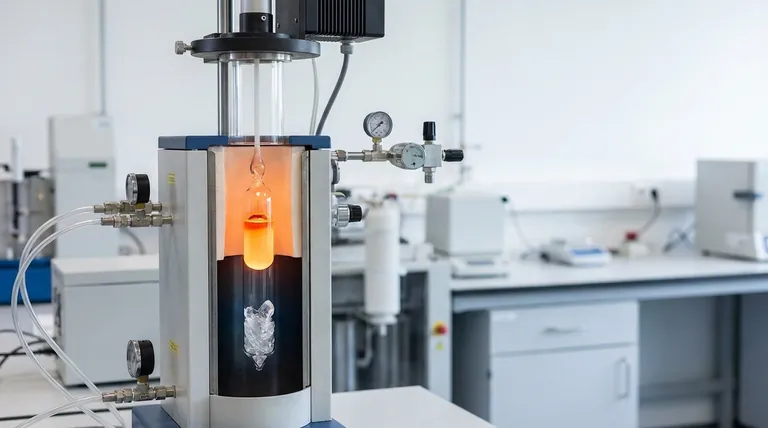
The Role of the Stockbarger Method
Facilitating Directional Solidification
The primary function of the Stockbarger method is to convert the raw material from a liquid melt into a structured solid.
This is achieved by physically moving the container from a high-temperature zone to a low-temperature zone. By controlling this movement, the method forces the material to solidify in a specific, organized direction.
Leveraging the Temperature Gradient
The success of this method hinges on a precisely controlled temperature gradient.
As the ampoule moves across this gradient, the interface between liquid and solid slowly advances. This slow progression allows the atoms to arrange themselves into a single, continuous crystal lattice rather than a disorganized mass.
The Role of the Vacuum-Sealed Quartz Ampoule
Creating an Oxidation Barrier
At the high temperatures required to melt NaCl and KCl, raw materials are highly susceptible to reacting with oxygen.
The vacuum-sealed quartz ampoule creates a high-vacuum environment around the materials. This eliminates the presence of air, effectively preventing oxidation and contamination that would otherwise ruin the crystal's clarity and performance.
Ensuring Dopant Precision
When growing doped crystals like NaCl:Li or KCl:Na, maintaining the exact ratio of additives (such as LiCl and NaCl) is essential.
The quartz material offers high chemical stability, meaning it does not react with the melt inside. This inert nature allows for precise control over the concentration distribution of these additives, ensuring the dopants are incorporated correctly into the crystal lattice.
Critical Dependencies and Process Constraints
The Necessity of Environmental Isolation
It is impossible to rely solely on the Stockbarger method's thermal controls without the ampoule's protection.
Without the vacuum seal, the raw materials would degrade immediately upon heating. The ampoule is not just a container; it is a prerequisite for the chemical viability of the process.
Mechanical Stability Requirements
The process requires the ampoule to be moved "slowly" to respect the crystallization physics.
Any vibration or irregularity in the movement mechanism can disturb the melt. This disruption can cause the additive concentrations to shift or induce flaws in the single crystal structure.
Optimizing the Growth Strategy
To achieve high-quality NaCl:Li and KCl:Na crystals, you must balance mechanical precision with environmental control.
- If your primary focus is Structural Integrity: Prioritize the precision of the temperature gradient and the smoothness of the ampoule's movement between zones to ensure a flawless lattice.
- If your primary focus is Chemical Purity: Focus on the quality of the vacuum seal and the cleanliness of the quartz ampoule to prevent oxidation and ensure accurate dopant distribution.
The highest quality crystals result when the thermal gradient is steep enough to force alignment, and the vacuum is deep enough to ensure absolute purity.
Summary Table:
| Component | Primary Role | Key Benefit |
|---|---|---|
| Stockbarger Method | Directional Solidification | Creates a single continuous crystal lattice via controlled temp gradients. |
| Quartz Ampoule | Protective Isolation | Prevents oxidation and contamination at high melting temperatures. |
| Vacuum Seal | Environmental Control | Maintains chemical purity and ensures precise dopant concentration distribution. |
| Temperature Gradient | Phase Transition | Drives the advancement of the solid-liquid interface for structured growth. |
Elevate Your Material Science with KINTEK Precision
Achieving the perfect single crystal requires absolute control over thermal mechanics and environmental purity. KINTEK provides the high-performance laboratory solutions needed to master these variables.
Backed by expert R&D and manufacturing, we offer Muffle, Tube, Rotary, Vacuum, and CVD systems, along with other specialized lab high-temp furnaces—all fully customizable to meet your unique research requirements. Whether you are scaling up crystal growth or refining delicate dopant concentrations, our systems deliver the stability and vacuum integrity your work demands.
Ready to optimize your high-temperature processes?
Contact KINTEK today to discuss your custom furnace needs
Visual Guide

References
- K. Shunkeyev, Zarina Serikkaliyeva. The Nature of High-Temperature Peaks of Thermally Stimulated Luminescence in NaCl:Li and KCl:Na Crystals. DOI: 10.3390/cryst15010067
This article is also based on technical information from Kintek Furnace Knowledge Base .
Related Products
People Also Ask
- What role does a high vacuum tube furnace play in Co-Al sintering? Master High-Purity Porous Material Synthesis
- What are the different types of tube furnaces available? Find the Perfect Fit for Your Lab's Needs
- What is the role of a vacuum tube furnace during the final thermal treatment stage of Fe3O4@CSAC catalysts?
- What are the main advantages of vacuum tube furnaces in the market? Achieve Purity and Precision in Material Processing
- What conditions does a tube furnace provide for post-ion-implantation? Achieve Precise Microstructural Repair
