
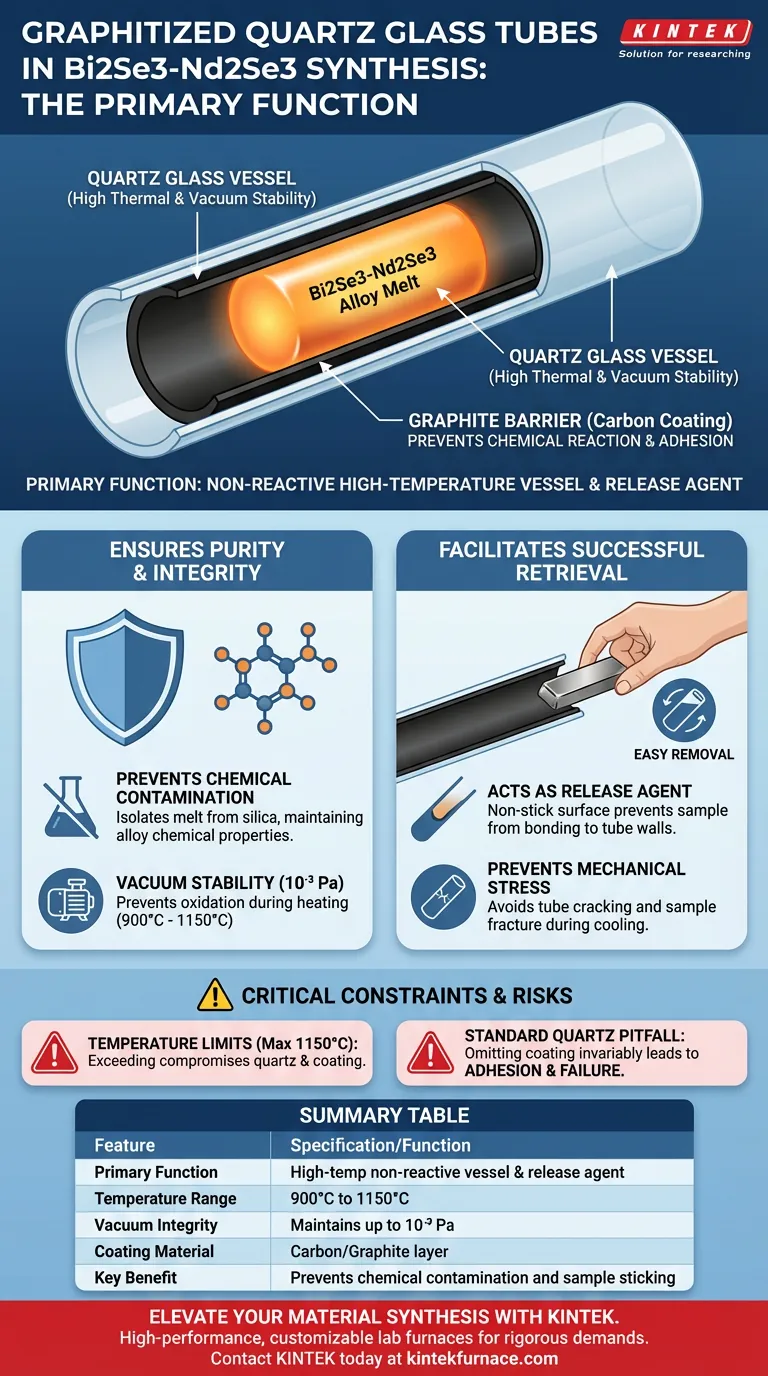
The primary function of graphitized quartz glass tubes in this context is to serve as a non-reactive, high-temperature vessel that prevents the synthesized alloy from bonding to the container. By coating the inner wall with carbon, the tube acts as a barrier that stops the metallic melt from chemically reacting with or adhering to the quartz, ensuring the final sample is pure and retrievable.
The graphitized coating is the critical interface that transforms a standard quartz tube into a viable synthesis vessel. It separates the reactive metallic melt from the silica glass, preserving both the chemical integrity of the alloy and the physical structure of the sample.
The Role of the Reaction Vessel
Thermal and Vacuum Stability
Synthesis of Bi2Se3-Nd2Se3 alloys requires a vessel capable of enduring extreme conditions. The quartz glass structure provides the necessary thermal resistance to withstand temperatures ranging from 900°C to 1150°C.
Simultaneously, the tube acts as a sealed chamber. It must maintain a high vacuum level of 10^-3 Pa throughout the heating process. This vacuum is essential to prevent oxidation or contamination from the ambient atmosphere.
The Graphite Barrier
The defining feature of these tubes is the graphitization of the inner wall. This carbon layer creates a physical shield between the metallic melt and the silicon dioxide of the quartz.
Without this barrier, molten metals at high temperatures have a high tendency to wet and adhere to quartz surfaces. The graphite effectively acts as a high-temperature release agent.
Why Graphitization Ensures Success
Preventing Chemical Contamination
At elevated temperatures, there is a risk of chemical interaction between the alloy components and the quartz glass. Such reactions would introduce impurities into the alloy, altering its properties.
The graphitized layer prevents this direct contact. By isolating the melt, it ensures the chemical purity of the Bi2Se3-Nd2Se3 alloy is maintained throughout the synthesis.
Facilitating Sample Removal
The success of the synthesis is not just about chemistry; it is about retrieval. If the alloy adheres to the tube walls during cooling, extracting the sample becomes difficult or destructive.
Graphitization ensures that the solidified ingot does not stick to the vessel. This allows for the successful removal of the sample without damaging the alloy or requiring the dangerous shattering of the quartz tube.
Critical Constraints and Trade-offs
Temperature Limitations
While the tubes are robust, they operate within a defined thermal window. The reference specifies a maximum operational temperature of 1150°C.
Exceeding this limit compromises the structural integrity of the quartz. It may also degrade the graphitized coating, leading to the very adhesion issues the tube is designed to prevent.
The Necessity of the Coating
The use of standard, non-graphitized quartz is a common pitfall in metallic alloy synthesis. Omitting the graphitization step almost invariably leads to sample adhesion.
This adhesion results in mechanical stress during cooling due to mismatched thermal expansion coefficients. This often causes the quartz tube to crack or the sample to fracture, ruining the experiment.
Making the Right Choice for Your Synthesis
To ensure the successful synthesis of Bi2Se3-Nd2Se3 alloys, apply the following guidelines:
- If your primary focus is alloy purity: Ensure the graphitization layer is uniform and intact to prevent any chemical leaching or reaction with the quartz substrate.
- If your primary focus is sample retrieval: Rely on the graphite coating as a release agent to ensure the ingot can be removed smoothly without mechanical extraction tools.
Graphitized quartz is not merely a container; it is an active component in ensuring the chemical and physical viability of your alloy synthesis.
Summary Table:
| Feature | Specification/Function |
|---|---|
| Primary Function | High-temp non-reactive vessel and release agent |
| Temperature Range | 900°C to 1150°C |
| Vacuum Integrity | Maintains up to 10^-3 Pa |
| Coating Material | Carbon/Graphite layer |
| Key Benefit | Prevents chemical contamination and sample sticking |
Elevate Your Material Synthesis with KINTEK
Precision in alloy synthesis starts with the right equipment. Backed by expert R&D and manufacturing, KINTEK offers high-performance Muffle, Tube, Rotary, Vacuum, and CVD systems designed to meet the rigorous demands of material science. Our lab high-temp furnaces are fully customizable for your unique research needs, ensuring optimal thermal stability and purity for every sample.
Ready to optimize your synthesis process? Contact KINTEK today to find the perfect customizable furnace solution for your laboratory.
Visual Guide
References
- PHASE FORMATION IN THE TRINARY SYSTEM NdBi-Te ACCORDING TO THE SECTION Bi2Se3-Nd2Se3. DOI: 10.30546/209501.201.2024.1.04.035
This article is also based on technical information from Kintek Furnace Knowledge Base .
Related Products
- Vertical Laboratory Quartz Tube Furnace Tubular Furnace
- Multi Zone Laboratory Quartz Tube Furnace Tubular Furnace
- Laboratory Quartz Tube Furnace RTP Heating Tubular Furnace
- High Pressure Laboratory Vacuum Tube Furnace
- 1200℃ Split Tube Furnace Laboratory Quartz Tube Furnace with Quartz Tube
People Also Ask
- What are the key differences between single-zone and multi-zone vertical tube furnaces? Choose the Right Furnace for Your Lab
- What are the main characteristics of vertical tube furnaces? Optimize Your Lab with Space-Saving, Uniform Heating
- How are wafers loaded and unloaded in a vertical tube furnace? Achieve Precision and Purity in Wafer Processing
- How are metal support wires selected for sample suspension? Expert Guide to High-Temp Furnace Materials
- How does a vertical tube furnace achieve precise temperature control? Unlock Superior Thermal Stability for Your Lab






