
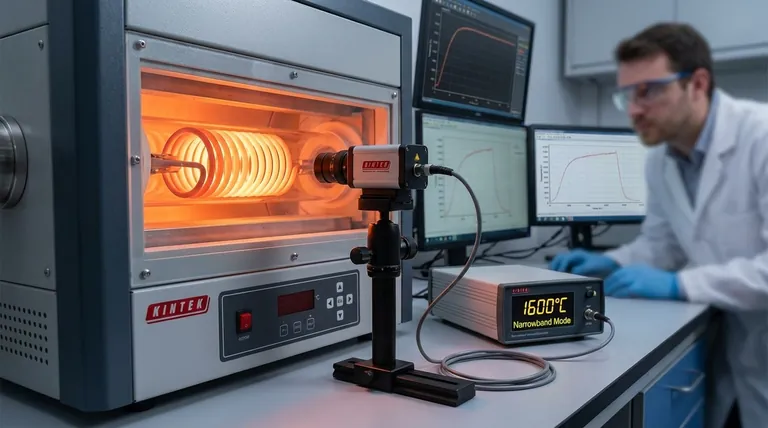
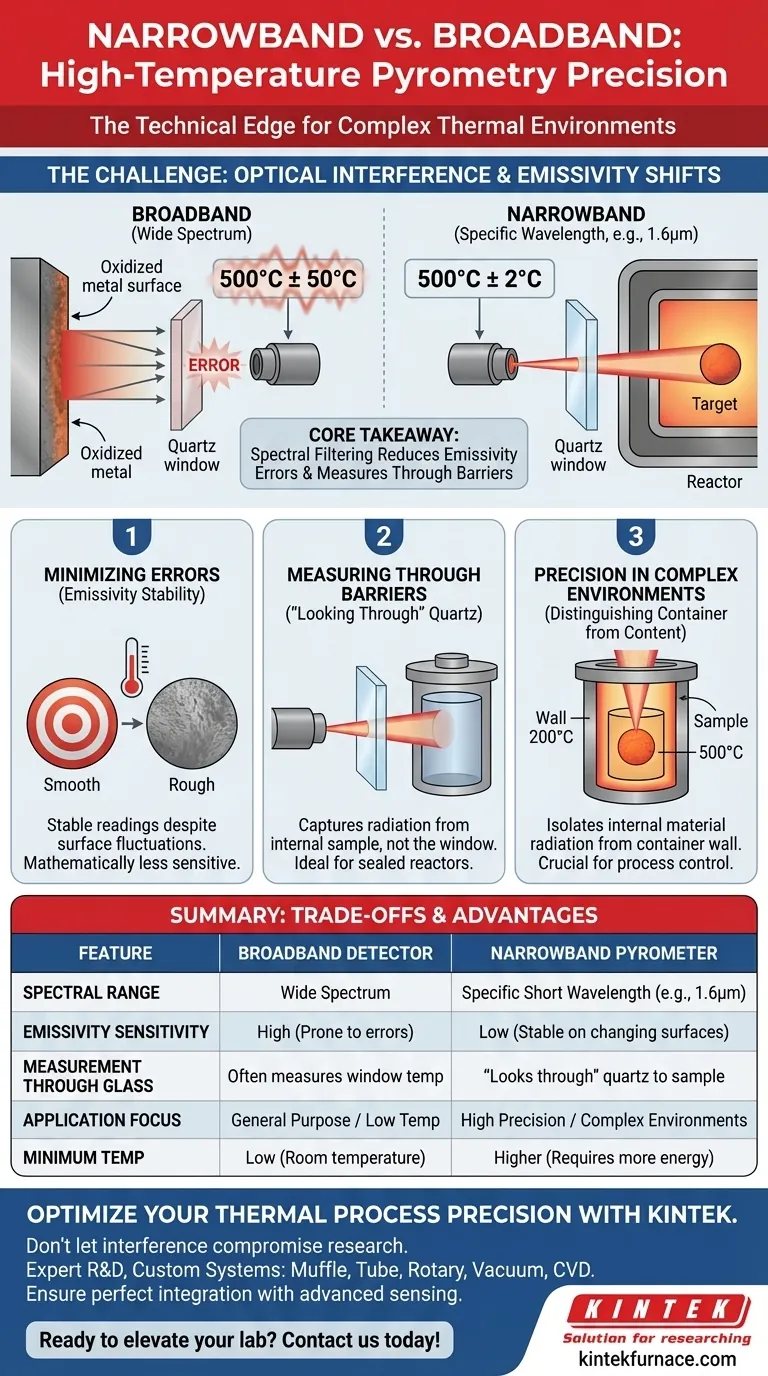
Narrowband infrared pyrometers offer superior precision in complex thermal environments by filtering out optical interference. Unlike broadband detectors that capture a wide spectrum of radiation, narrowband devices operate at specific short wavelengths (such as 1.6 micrometers). This selectivity minimizes errors caused by fluctuating surface conditions and allows the device to measure specific internal targets through intervening materials like quartz windows.
Core Takeaway By restricting measurement to specific short wavelengths, narrowband pyrometers significantly reduce measurement errors caused by emissivity changes. This "spectral filtering" capability enables precise temperature control of internal samples inside closed vessels, distinct from the container walls.
Minimizing Measurement Errors
Reducing Sensitivity to Emissivity Changes
Broadband detectors are highly susceptible to errors when a target's surface properties change. If a material oxidizes or changes texture during heating, its emissivity shifts, skewing the temperature reading.
A narrowband pyrometer operating at short wavelengths (like 1.6 micrometers) is mathematically less sensitive to these shifts. It provides stable, accurate data even when the target material's surface condition fluctuates significantly during the process.
Measuring Through Barriers
The Capability to "Look Through" Quartz
In many industrial applications, the target material is sealed inside a reaction chamber or a vacuum vessel. Broadband detectors often fail here because standard window materials (like glass or quartz) are opaque to long-wavelength infrared, causing the sensor to measure the window temperature rather than the sample.
Narrowband pyrometers tuned to specific spectral regions are designed to pass through these materials. By operating at 1.6 micrometers, the sensor "looks through" a quartz window as if it were transparent, capturing radiation directly from the internal sample.
Precision in Complex Environments
Distinguishing Container from Content
In advanced applications, such as microwave thermal processing, thermal gradients can be extreme. The container wall holding a sample may be significantly cooler or hotter than the material inside.
Narrowband technology allows you to isolate the radiation from the internal material while ignoring the container. This distinction is critical for process control, ensuring you are regulating the chemistry of the sample rather than the temperature of the vessel holding it.
Understanding the Trade-offs
Minimum Temperature Requirements
While short-wavelength sensors offer higher accuracy, they require sufficient energy to function. This means they often have a higher minimum temperature range compared to broadband detectors. They are generally unsuited for measuring objects at room temperature.
Specificity vs. Versatility
Broadband detectors are general-purpose tools that work reasonably well across many standard applications. Narrowband pyrometers are specialized instruments; they must be matched to the specific window material and temperature range of your unique process to provide value.
Making the Right Choice for Your Goal
To determine if a narrowband pyrometer is the correct solution for your application, consider your specific constraints:
- If your primary focus is measuring inside a sealed reactor: Choose a narrowband pyrometer tuned to a wavelength transparent to your viewport (e.g., quartz) to measure the internal sample directly.
- If your primary focus is stability on changing surfaces: Opt for short-wavelength narrowband sensors to mitigate errors caused by oxidation or fluctuating emissivity.
- If your primary focus is separating layer temperatures: Use narrowband technology to distinguish between a container wall and the material inside, particularly in microwave processing.
True precision in non-contact thermometry comes from selecting the wavelength that sees your target, not the obstacles surrounding it.
Summary Table:
| Feature | Broadband Detector | Narrowband Pyrometer |
|---|---|---|
| Spectral Range | Wide Spectrum | Specific Short Wavelength (e.g., 1.6µm) |
| Emissivity Sensitivity | High (Prone to errors) | Low (Stable on changing surfaces) |
| Measurement Through Glass | Often measures window temp | "Looks through" quartz to sample |
| Application Focus | General Purpose / Low Temp | High Precision / Complex Environments |
| Minimum Temp | Low (Room temperature) | Higher (Requires more thermal energy) |
Optimize Your Thermal Process Precision with KINTEK
Don't let optical interference or emissivity shifts compromise your research. Backed by expert R&D and manufacturing, KINTEK offers high-performance Muffle, Tube, Rotary, Vacuum, and CVD systems—all customizable for your unique high-temperature needs. Our expert team ensures your thermal equipment integrates perfectly with advanced sensing technologies like narrowband pyrometers to provide the accuracy your materials demand.
Ready to elevate your lab's capabilities? Contact us today to discuss your custom furnace solution!
Visual Guide
References
- Gloria Cosoli, Gian Marco Revel. A Measurement Approach for Characterizing Temperature-Related Emissivity Variability in High-Emissivity Materials. DOI: 10.3390/s25020487
This article is also based on technical information from Kintek Furnace Knowledge Base .
Related Products
- Multi Zone Laboratory Quartz Tube Furnace Tubular Furnace
- Multi Heating Zones CVD Tube Furnace Machine for Chemical Vapor Deposition Equipment
- 1200℃ Controlled Inert Nitrogen Atmosphere Furnace
- High Temperature Muffle Oven Furnace for Laboratory Debinding and Pre Sintering
- Laboratory Quartz Tube Furnace RTP Heating Tubular Furnace
People Also Ask
- Why are multi zone tube furnaces particularly useful for nanomaterial research? Unlock Precise Thermal Control for Advanced Synthesis
- What role do multi zone tube furnaces play in new energy research? Unlock Precise Thermal Control for Innovation
- What temperature-related capabilities make multi zone tube furnaces valuable for research? Unlock Precision Thermal Control
- What environmental protection applications utilize multi zone tube furnaces? Unlock Precision in Waste Treatment and Green Tech
- What are the main applications of multi zone tube furnaces in university laboratories? Unlock Precision in Material Science and Energy Research



















