
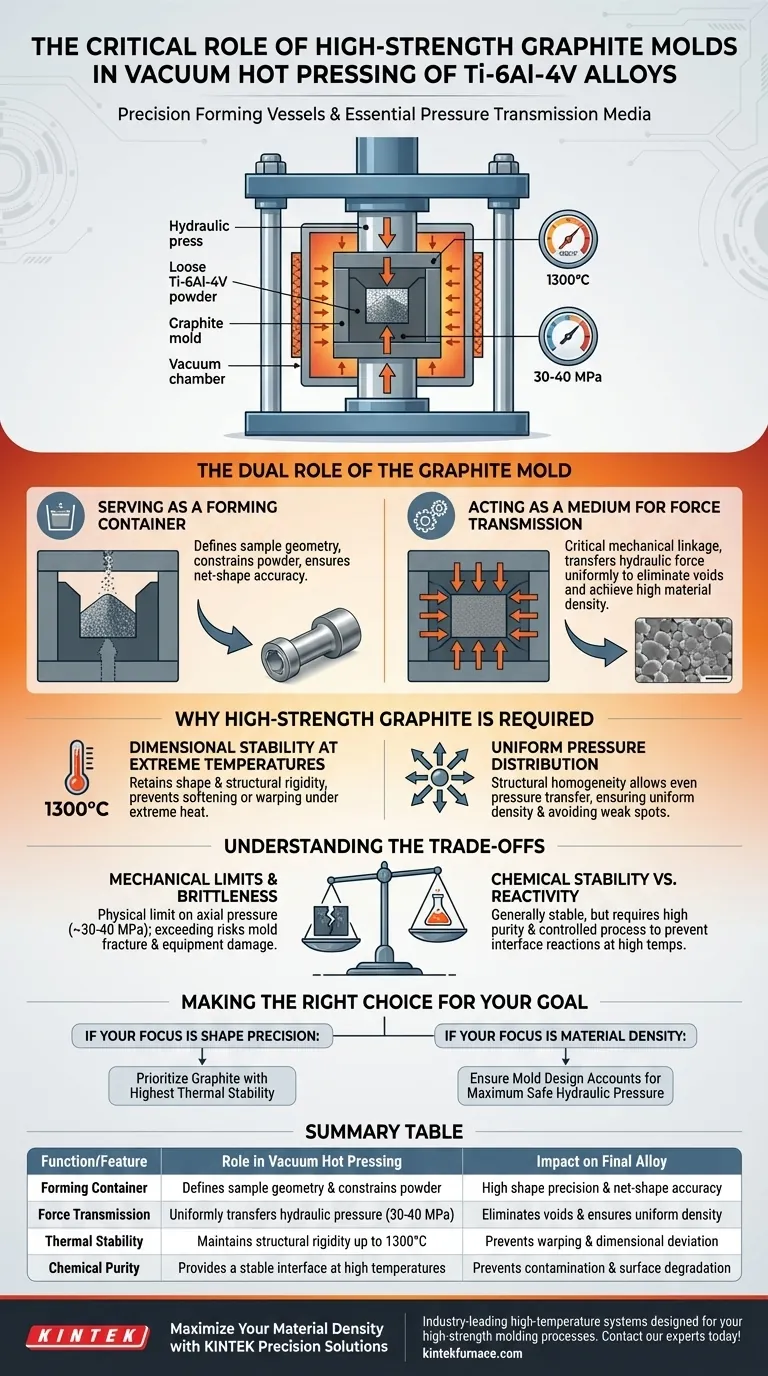
High-strength graphite molds function primarily as precision forming vessels and essential pressure transmission media. In the vacuum hot pressing of Ti-6Al-4V alloys, they contain the metal powder while uniformly transferring hydraulic force to the compact. Crucially, they must maintain precise dimensional stability under extreme thermal conditions reaching 1300°C.
These molds are not passive containers; they are active mechanical components in the densification process. By acting as a stable medium for force transmission, they directly dictate the final density, shape precision, and structural integrity of the alloy sample.
The Dual Role of the Graphite Mold
Serving as a Forming Container
The most immediate function of the mold is to act as a containment vessel for the loose Ti-6Al-4V powder.
Because the process involves extreme heat, the mold defines the geometry of the final sample. It constrains the powder, ensuring the alloy consolidates into the specific desired shape rather than spreading uncontrollably.
Acting as a Medium for Force Transmission
Beyond simple containment, the mold serves as a critical mechanical linkage between the press and the powder.
The hydraulic system applies force to the mold (often via a ram), and the mold must transmit this pressure uniformly to the powder body. This transmission is what forces the powder particles together, eliminating voids and achieving high material density.
Why High-Strength Graphite is Required
Dimensional Stability at Extreme Temperatures
Vacuum hot pressing of Ti-6Al-4V occurs at temperatures up to 1300°C.
Standard materials would soften or warp under this thermal load. High-strength graphite retains its shape and structural rigidity in these environments, ensuring the final component meets precise dimensional tolerances.
Uniform Pressure Distribution
The quality of the final alloy depends on how evenly pressure is applied.
Graphite’s structural homogeneity allows it to transfer pressure without localized stress concentrations. This results in a sample with uniform density throughout its volume, preventing weak spots or structural inconsistencies in the final part.
Understanding the Trade-offs
Mechanical Limits and Brittleness
While graphite has excellent high-temperature strength, it is inherently brittle compared to metals.
There is a physical limit to the axial pressure the mold can withstand (typically around 30-40 MPa depending on the grade). Exceeding this limit to achieve higher density carries the risk of mold fracture, which would ruin the sample and potentially damage the pressing equipment.
Chemical Stability vs. Reactivity
Graphite is generally chemically stable, which is vital for preventing reactions with the Ti-6Al-4V powder.
However, at elevated temperatures and pressures, interface reactions can still occur if the graphite is not of high purity or if the process parameters drift. This requires a careful balance of temperature and hold time to ensure successful forming without degrading the alloy's surface properties.
Making the Right Choice for Your Goal
To optimize your vacuum hot pressing process, consider your specific manufacturing priorities:
- If your primary focus is Shape Precision: Prioritize graphite grades with the highest available thermal stability to prevent deformation at peak temperatures (1300°C).
- If your primary focus is Material Density: Ensure your mold design accounts for the maximum safe hydraulic pressure to avoid fracture while achieving optimal compaction.
The graphite mold is the defining boundary of your product; its stability determines the success of the entire sintering operation.
Summary Table:
| Function/Feature | Role in Vacuum Hot Pressing | Impact on Final Alloy |
|---|---|---|
| Forming Container | Defines sample geometry and constrains powder | High shape precision and net-shape accuracy |
| Force Transmission | Uniformly transfers hydraulic pressure (30-40 MPa) | Eliminates voids and ensures uniform density |
| Thermal Stability | Maintains structural rigidity up to 1300°C | Prevents warping and dimensional deviation |
| Chemical Purity | Provides a stable interface at high temperatures | Prevents contamination and surface degradation |
Maximize Your Material Density with KINTEK Precision Solutions
Achieving the perfect densification of Ti-6Al-4V alloys requires the right combination of high-temperature equipment and structural integrity. KINTEK provides industry-leading Muffle, Tube, Rotary, Vacuum, and CVD systems, all designed to integrate seamlessly with your high-strength molding processes. Backed by expert R&D and world-class manufacturing, our lab high-temp furnaces are fully customizable to meet your unique metallurgical needs.
Ready to enhance your lab's efficiency and sample precision? Contact our technical experts today to find the perfect thermal solution for your workflow.
Visual Guide
Related Products
- Vacuum Hot Press Furnace Machine Heated Vacuum Press
- Vacuum Hot Press Furnace Machine Heated Vacuum Press Tube Furnace
- Vacuum Heat Treat Sintering Furnace with Pressure for Vacuum Sintering
- 600T Vacuum Induction Hot Press Vacuum Heat Treat and Sintering Furnace
- Vacuum Hot Press Furnace Machine for Lamination and Heating
People Also Ask
- What are the primary components of a vacuum hot press furnace? Master the Core Systems for Precise Material Processing
- What safety features are incorporated in vacuum hot press furnaces? Ensure Operator and Equipment Protection
- What are the benefits of the vacuum environment system in a vacuum hot press furnace? Unlock High-Density Sintering
- What types of heating elements are used in vacuum hot press furnaces? Optimize for High-Temp Performance
- What are the core advantages of using a vacuum hot press furnace? Achieve Near-Forged Density for Ti-6Al-4V Alloys



















