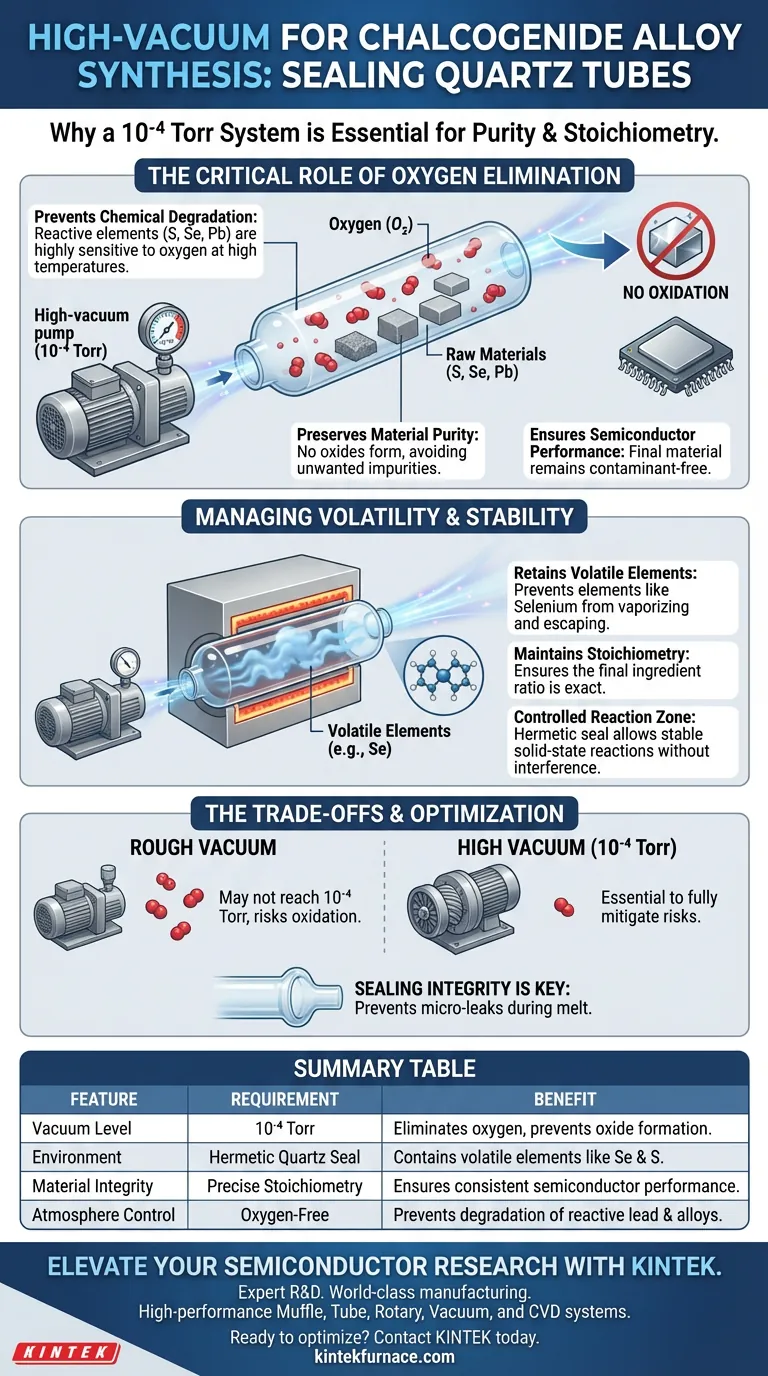
A high-vacuum system is essential for sealing quartz tubes to facilitate the complete removal of oxygen from the reaction environment, typically achieving a pressure level of $10^{-4}$ Torr. This evacuation is critical to prevent the oxidation of reactive components like sulfur, selenium, and lead during the high-temperature melting process.
By eliminating oxygen and encapsulating volatile components, the high-vacuum seal guarantees the chemical purity and precise stoichiometry required for the chalcogenide material to function as a semiconductor.
The Critical Role of Oxygen Elimination
Preventing Chemical Degradation
Chalcogenide alloys are composed of elements such as sulfur, selenium, and lead. These materials are highly sensitive to oxygen, especially when subjected to the high temperatures required for melting.
Preserving Material Purity
If oxygen is present in the tube, it reacts immediately with the raw materials to form oxides. This chemical reaction introduces unwanted impurities that fundamentally alter the physical characteristics of the final alloy.
Ensuring Semiconductor Performance
For the material to function correctly as a semiconductor, it must remain free of these oxide contaminants. A high-vacuum system reaching $10^{-4}$ Torr ensures that the environment is sufficiently void of oxygen to prevent these damaging reactions.
Managing Volatility and Stability
Retaining Volatile Elements
Beyond oxidation, the melting process poses a risk to volatile components like Selenium. At high temperatures, these elements can easily vaporize and escape the mixture.
Maintaining Stoichiometry
The vacuum-sealed environment acts as a containment system. It prevents the loss of volatile elements, ensuring the final ratio of ingredients (stoichiometry) remains exactly as intended.
Creating a Controlled Reaction Zone
The sealed quartz tube provides a stable, isolated environment. This allows solid-state reactions to proceed in a controlled manner without interference from the outside atmosphere or fluctuating pressures.
Understanding the Trade-offs
The Necessity of High Vacuum
It is important to distinguish between a rough vacuum and the high vacuum required here. A simple roughing pump may not reach the $10^{-4}$ Torr threshold necessary to fully mitigate oxidation risks.
Sealing Integrity
Achieving the vacuum is only half the battle; maintaining it is the other. If the quartz tube is not sealed perfectly after evacuation, micro-leaks will reintroduce oxygen during the melt, rendering the vacuum step useless.
Optimizing Your Sealing Process
If your primary focus is Material Purity:
- Ensure your pumping system can consistently achieve and hold a vacuum level of $10^{-4}$ Torr to completely rule out oxidation.
If your primary focus is Composition Control:
- Rely on the physical integrity of the quartz seal to encapsulate volatile elements like Selenium, preventing mass loss during heating.
The high-vacuum seal is not merely a preparatory step; it is the fundamental guarantor of your alloy's chemical identity and functional performance.
Summary Table:
| Feature | Requirement | Benefit |
|---|---|---|
| Vacuum Level | $10^{-4}$ Torr | Eliminates oxygen to prevent oxide formation |
| Environment | Hermetic Quartz Seal | Contains volatile elements like Selenium and Sulfur |
| Material Integrity | Precise Stoichiometry | Ensures consistent semiconductor performance |
| Atmosphere Control | Oxygen-Free | Prevents chemical degradation of reactive lead and alloys |
Elevate Your Semiconductor Research with KINTEK
Precise material synthesis starts with the right environment. At KINTEK, we understand the rigorous demands of high-vacuum processing. Backed by expert R&D and world-class manufacturing, we provide high-performance Muffle, Tube, Rotary, Vacuum, and CVD systems tailored for your laboratory's success.
Whether you are sealing quartz tubes for chalcogenide alloys or developing next-generation materials, our customizable high-temperature furnaces ensure the chemical purity and thermal stability your project requires.
Ready to optimize your thermal processing? Contact KINTEK today to discuss your unique needs.
Visual Guide
References
- Mohamed Muthana Ghazi, Kareem A. Jasim. An investigation into the implications of partial substitution of selenium with lead on the thermal properties for S<sub>60</sub>Se<sub>40-X</sub>Pb<sub>X</sub> Chalcogenide Compound. DOI: 10.1088/1742-6596/2857/1/012007
This article is also based on technical information from Kintek Furnace Knowledge Base .
Related Products
- Vacuum Induction Melting Furnace
- Ultra Vacuum Electrode Feedthrough Connector Flange Power Lead for High Precision Applications
- Ultra-High Vacuum Flange Aviation Plug Glass Sintered Airtight Circular Connector for KF ISO CF
- 304 316 Stainless Steel High Vacuum Ball Stop Valve for Vacuum Systems
- Molybdenum Vacuum Heat Treat Furnace
People Also Ask
- What are the core functions of the High Vacuum Induction Melting (VIM) furnace? Optimize DD5 Superalloy Purification
- What are the advantages of using a VIM furnace to control residual oxygen pressure? Achieve Superior Metal Uniformity
- What role does a Vacuum Induction Melting furnace play in the production of high-aluminum nickel-based superalloys?
- Why is a Vacuum Induction Melting furnace (VIM) used for Cu-Zn-Al-Sn alloys? Achieve Precision Composition Control
- What are the technical advantages of using a Vacuum Induction Melting furnace in the development of advanced packaging steel?