
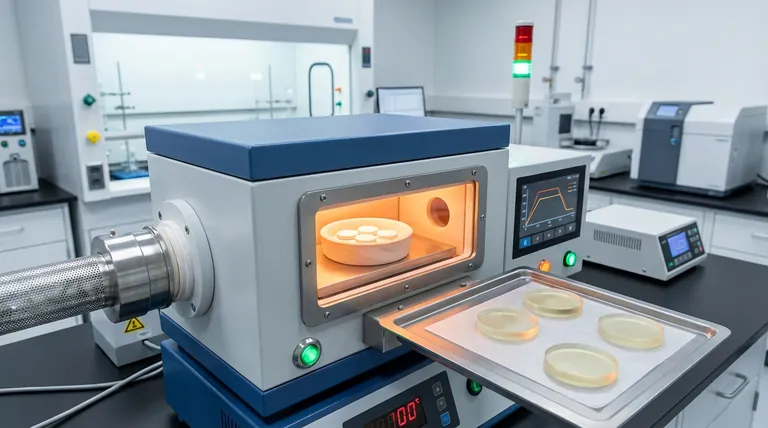
The sintering process is the critical final step that transforms a pressed powder compact into a functional, high-performance battery component. For imprinted Li6PS5Cl solid electrolyte disks, utilizing a laboratory high-temperature furnace is necessary to eliminate the internal stresses caused by high-pressure pressing and to fuse the material particles together. This controlled heating—specifically around 300°C for 30 minutes—creates the dense, cohesive structure required for optimal ionic conductivity and mechanical strength.
Core Takeaway Mechanical pressing shapes the disk, but thermal sintering locks in its performance. By relieving residual stress and merging particle boundaries, the furnace treatment creates the continuous pathways necessary for high-speed ion transport and ensures the disk does not crumble during operation.
The Mechanics of Sintering Li6PS5Cl
The transition from a pressed powder to a solid electrolyte involves complex microstructural changes. The laboratory furnace facilitates these changes through precise thermal control.
Relieving Residual Stress
Imprinting and shaping solid electrolyte disks require high-pressure pressing. While this forms the shape, it leaves the material with significant internal tension.
Without thermal treatment, these residual stresses compromise the structural stability of the disk. The furnace acts as a relaxation chamber, allowing the material to settle and removing the risk of spontaneous cracking or warping.
Enhancing Particle Bonding
Pressure alone does not fully bond the electrolyte particles. Sintering promotes diffusion between particles, effectively welding them together at the microscopic level.
This process eliminates the voids and gaps that naturally exist between powder granules. The result is a unified, dense solid rather than a compacted aggregate of dust.
Impact on Battery Performance
The physical changes induced by the furnace directly translate to the electrochemical capabilities of the solid electrolyte.
Maximizing Ionic Conductivity
Lithium ions move most efficiently through a continuous medium. Gaps between particles act as roadblocks that drastically slow down ion movement.
By densifying the disk and merging grain boundaries, sintering creates high-speed ion transport channels. This ensures the battery can charge and discharge efficiently without internal resistance bottlenecks.
Ensuring Mechanical Integrity
A battery component must withstand physical handling and assembly pressure. A non-sintered disk is often brittle and prone to crumbling.
The sintering activity enhances mechanical strength, producing a robust disk that maintains its integrity during cell assembly and long-term operation.
Understanding the Trade-offs
While heat treatment is essential, it must be applied with high precision. The specific chemistry of Li6PS5Cl dictates strict processing limits.
Temperature Sensitivity
Unlike oxide-based ceramics (such as SSZ used in fuel cells) which may require temperatures exceeding 1400°C, sulfide electrolytes like Li6PS5Cl are much more sensitive.
You must adhere strictly to the lower temperature range (e.g., 300°C). Overheating can cause the material to decompose, melt, or undergo unwanted phase changes, which would destroy its conductivity rather than enhance it.
Balance of Time and Density
The duration of the sinter (e.g., 30 minutes) is a balance. It must be long enough to allow for stress relief and densification, but short enough to prevent grain growth that could negatively alter the material's properties.
Making the Right Choice for Your Goal
To achieve the best results with your solid electrolyte fabrication, tailor your approach to your specific performance metrics.
- If your primary focus is maximum conductivity: Ensure your sintering profile is optimized to maximize density and eliminate particle voids without exceeding the thermal stability limit of the sulfide.
- If your primary focus is mechanical reliability: Prioritize the stress-relief phase of the heat treatment to ensure the disk remains crack-free during the assembly of the battery stack.
Ultimately, the laboratory furnace is not just a heater; it is the tool that stabilizes your material to unlock its full electrochemical potential.
Summary Table:
| Feature | Purpose in Li6PS5Cl Processing | Benefit to Solid Electrolyte |
|---|---|---|
| Stress Relief | Eliminates tension from high-pressure imprinting | Prevents cracking and warping during use |
| Particle Fusion | Promotes diffusion across grain boundaries | Creates a dense, cohesive solid structure |
| Densification | Fills voids and gaps between powder granules | Minimizes internal resistance for ion flow |
| Thermal Control | Precise 300°C soak for 30 minutes | Optimizes performance without material decay |
Unlock the Full Potential of Your Solid Electrolytes
Precision thermal processing is the key to transforming pressed powders into high-performance battery components. KINTEK provides the specialized equipment needed to achieve perfect sintering results for sensitive materials like Li6PS5Cl.
Backed by expert R&D and manufacturing, KINTEK offers a comprehensive range of lab solutions, including:
- Muffle & Tube Furnaces for precise atmospheric control.
- Vacuum & CVD Systems for advanced material synthesis.
- Customizable High-Temp Furnaces tailored to your unique electrolyte research needs.
Ensure your solid electrolyte disks achieve maximum ionic conductivity and mechanical strength with KINTEK's industry-leading technology.
Contact Our Experts Today to Find Your Ideal Furnace Solution
References
- Shengming Zhang, Peter G. Bruce. Influence of contouring the lithium metal/solid electrolyte interface on the critical current for dendrites. DOI: 10.1039/d3ee03322h
This article is also based on technical information from Kintek Furnace Knowledge Base .
Related Products
- Spark Plasma Sintering SPS Furnace
- Chairside Dental Porcelain Zirconia Sintering Furnace with Transformer for Ceramic Restorations
- Vacuum Heat Treat Sintering Furnace Molybdenum Wire Vacuum Sintering Furnace
- Dental Porcelain Zirconia Sintering Ceramic Vacuum Press Furnace
- High Temperature Muffle Oven Furnace for Laboratory Debinding and Pre Sintering
People Also Ask
- How does the heating mechanism of Spark Plasma Sintering (SPS) function? Enhance TiC/SiC Composite Fabrication
- Why is it necessary to maintain a high vacuum environment during the SPS of SiC? Key to High-Density Ceramics
- What are the technical advantages of using an SPS sintering furnace? Elevate Al2O3-TiC Material Performance
- What are the steps in the discharge plasma sintering process? Master Fast, High-Density Material Consolidation
- What are the advantages of spark plasma sintering (SPS) over traditional forging? Precision Microstructural Control















