
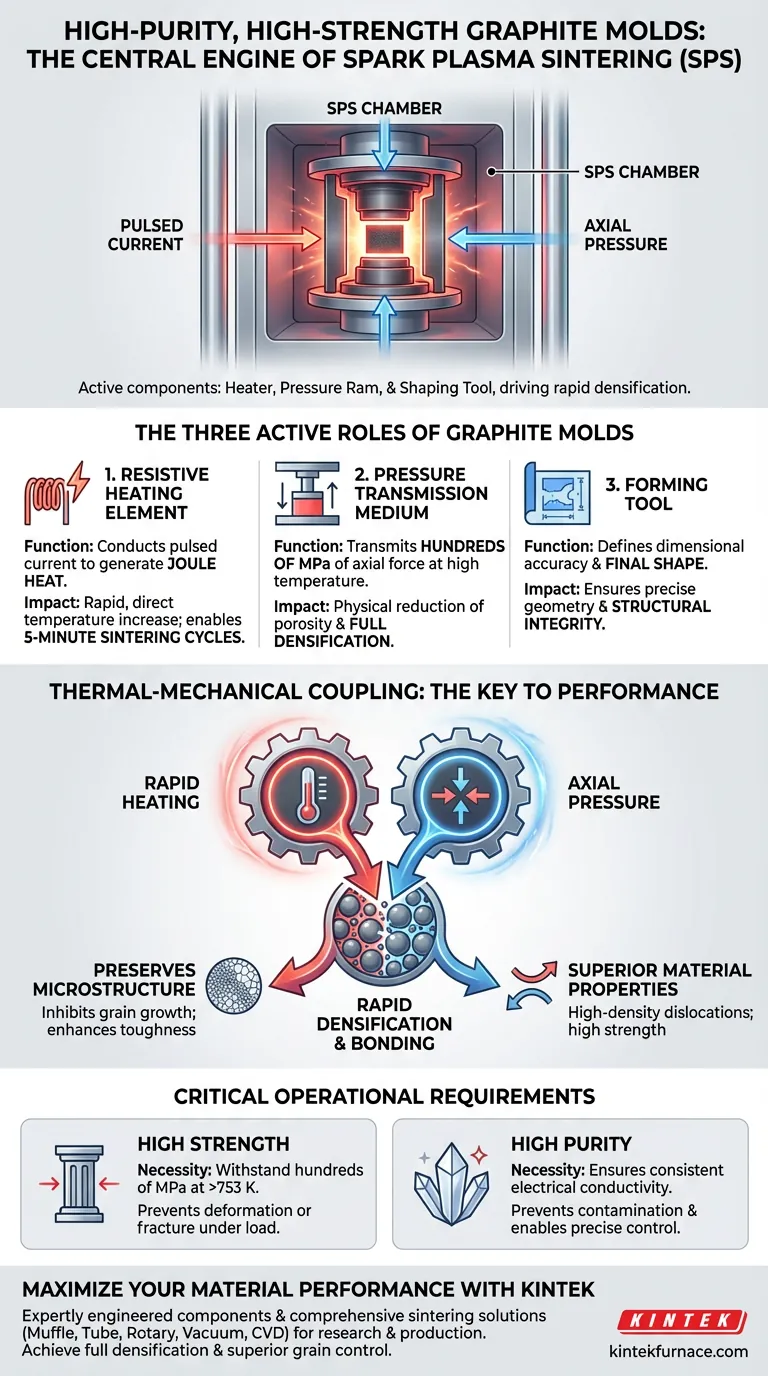
High-purity, high-strength graphite molds act as the central engine of the Spark Plasma Sintering (SPS) process, functioning simultaneously as the heating element, the pressure ram, and the shaping tool. Rather than merely holding the powder, these molds actively convert electrical energy into heat and transmit immense physical force to drive rapid densification.
Core Takeaway The unique value of these graphite molds lies in their ability to facilitate "thermal-mechanical coupling." By acting as both a resistive heater and a high-strength pressure transmitter, they enable full densification of composite materials in minutes while effectively suppressing grain growth.
The Three Active Roles of Graphite Molds
In the SPS process, the mold is an active component of the machine's electrical and mechanical circuit.
1. The Resistive Heating Element
The primary reference highlights that graphite molds possess excellent electrical conductivity. They act directly as resistive heating elements within the system.
When thousands of amperes of pulsed current pass through the mold, it efficiently converts this electrical energy into thermal energy. This generation of Joule heat allows for rapid and direct temperature increases, unlike conventional sintering which relies on external heating elements.
2. The Pressure Transmission Medium
High-strength graphite is essential because it must retain its mechanical integrity at extremely high temperatures.
The molds function as a transmission medium, accurately transferring hundreds of megapascals of axial pressure to the sample. This forces the powder particles together, physically reducing porosity even before full sintering temperatures are reached.
3. The Forming Tool
As noted in the supplementary data, the graphite mold serves as the physical containment vessel.
It defines the dimensional accuracy and final shape of the sample. This ensures that the loose powder is consolidated into a precise geometric form during the sintering cycle.
The Phenomenon of Thermal-Mechanical Coupling
The "deep need" in SPS is achieving full density without degrading the material's microstructure. Graphite molds make this possible through a specific physical basis.
Achieving Rapid Densification
The combination of internal heating and axial pressure creates thermal-mechanical coupling.
This coupling drives materials like TiB2-SiC-Ti3SiC2 to achieve full densification in a very short period. The simultaneous application of heat and force accelerates the bonding between particles far faster than heat alone.
Preserving Microstructure
The speed of this process is critical for material performance.
Because the graphite molds allow for fast heating rates and short sintering times (often within 5 minutes), the process effectively inhibits grain growth. This suppression of grain coarsening preserves fine nano-precipitate phases, which significantly enhances fracture toughness and flexural strength.
Critical Operational Requirements
While graphite is the material of choice, standard grades are insufficient for SPS applications.
The Necessity of High Strength
The process requires the mold to withstand axial pressures of up to hundreds of megapascals while at sintering temperatures (e.g., 753 K or higher).
If the graphite lacks high-temperature mechanical strength, the mold will deform or fracture under the load, compromising the pressure transmission necessary for high-density dislocations.
The Necessity of High Purity
Impurities in the graphite can alter the electrical resistance and contaminate the composite material.
High purity ensures consistent conductivity for stable Joule heating. This consistency is vital for maintaining the precise temperature control required to inhibit grain growth while ensuring full density.
Making the Right Choice for Your Goal
When evaluating the role of graphite molds in your specific SPS application, consider the following outcome-based principles:
- If your primary focus is Speed and Efficiency: Capitalize on the mold's high conductivity to maximize the heating rate, allowing for sintering cycles as short as 5 minutes.
- If your primary focus is Mechanical Performance: rely on the mold's high-temperature strength to apply maximum axial pressure (hundreds of MPa), which enhances fracture toughness and flexural strength.
- If your primary focus is Microstructural Integrity: Utilize the rapid heating capabilities of the mold to suppress grain coarsening, maintaining fine grain structures and high-density dislocations.
Ultimately, the graphite mold is the critical interface that transforms raw electricity and pressure into a fully densified, high-performance composite material.
Summary Table:
| Role | Primary Function | Impact on Composite Material |
|---|---|---|
| Heating Element | Conducts pulsed current to generate Joule heat | Rapid, direct heating; enables 5-minute cycles |
| Pressure Medium | Transmits hundreds of megapascals of axial force | Physical reduction of porosity and full densification |
| Forming Tool | Defines dimensional accuracy and vessel shape | Ensures precise geometry and structural integrity |
| Microstructure Control | Facilitates thermal-mechanical coupling | Inhibits grain growth; enhances fracture toughness |
Maximize Your Material Performance with KINTEK
High-performance Spark Plasma Sintering requires more than just a furnace; it requires the precision of expertly engineered components. Backed by industry-leading R&D and advanced manufacturing, KINTEK provides high-purity, high-strength graphite molds and comprehensive sintering solutions—including Muffle, Tube, Rotary, Vacuum, and CVD systems—all customizable to your specific research or production needs.
Ready to achieve full densification and superior grain control? Contact our technical experts today to find the perfect high-temperature solution for your lab.
Visual Guide
References
- I O Poenaru, V Puţan. Research Regarding Advanced Degassing of Steels for Manufacturing Automotive Components. DOI: 10.1088/1742-6596/3153/1/012016
This article is also based on technical information from Kintek Furnace Knowledge Base .
Related Products
People Also Ask
- Why are vacuum heat treating furnaces essential for aerospace? Ensure Superior Material Integrity for High-Stakes Applications
- What is the primary application of vacuum heat treating furnaces in aerospace? Enhance Component Performance with Precision
- How does a vacuum heat treating furnace improve the condition of metal alloys? Achieve Superior Metal Performance
- How does vacuum heat treating work in terms of temperature and time control? Master Precise Material Transformations
- What is the process of vacuum heat treating? Achieve Superior Metallurgical Properties
