
The vacuum radiation environment acts as the primary thermal regulator during the final CAP capping stage of vacuum consumable arc melting. Once the electrode has fully melted, the vacuum prevents convective cooling, meaning the ingot’s top surface dissipates heat almost exclusively through thermal radiation. This specific mechanism dictates the solidification rate and the physical behavior of the shrinking liquid core.
During the capping stage, thermal radiation is not just a passive byproduct; it is the governing force that determines how the top metal layer solidifies. Controlling this radiative heat loss is essential for managing the inward shrinkage of the liquid core and preventing costly defects.
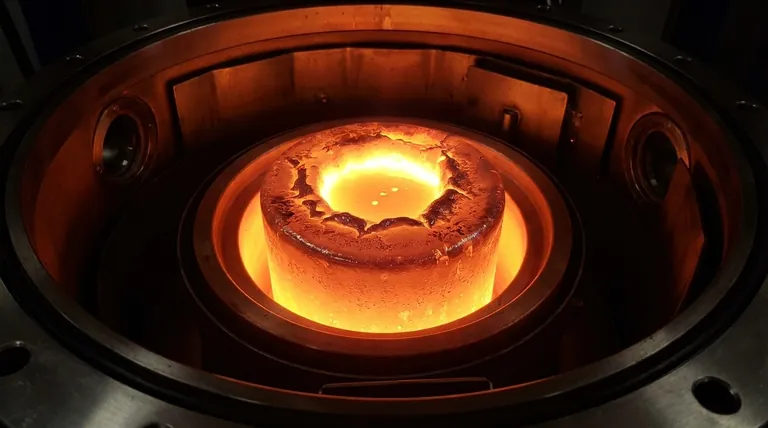
The Physics of the Capping Stage
The Shift to Radiative Cooling
The CAP capping stage initiates immediately after the electrode has completely melted. At this precise moment, the external energy input changes, and the thermal dynamics of the system shift dramatically.
Mechanics of Heat Dissipation
Because the process occurs within a vacuum, air convection is effectively non-existent. Consequently, the top surface of the molten ingot must release its thermal energy through thermal radiation. This is the only significant pathway for heat to leave the top of the ingot during this phase.
Driving Solidification
This radiation-driven cooling is the direct cause of solidification in the top metal layer. The rate at which energy radiates into the vacuum environment determines the velocity at which the liquid metal transforms into a solid structure.
Impact on Ingot Integrity
Liquid Core Behavior
As the top surface radiates heat and cools, the internal liquid core begins to shrink inward. This is a physical contraction caused by the phase change from liquid to solid, governed by the speed of the radiative heat loss.
Preventing Shrinkage Defects
The interaction between the vacuum environment and the metal surface is critical for quality control. If the radiative cooling causes the surface to solidify too quickly or unevenly, it traps the shrinking core, leading to internal voids or deep piping.
Improving Material Yield
The ultimate objective of managing this environment is to minimize shrinkage defects at the top of the ingot. By effectively controlling the radiation cooling stage, operators can ensure a flatter, sounder top, significantly improving the overall yield of usable material.
Understanding the Trade-offs
The Balance of Cooling Speed
While rapid cooling might seem efficient for cycle times, relying solely on aggressive radiative loss can be detrimental. Uncontrolled radiation often leads to severe shrinkage cavities, forcing you to crop and discard a larger portion of the ingot top.
Complexity of Control
Achieving the perfect solidification rate requires precise management of the environment. Attempting to influence the natural radiative cooling rate to optimize yield adds a layer of complexity to the process control parameters.
Making the Right Choice for Your Goal
To optimize your vacuum arc melting process, you must view the vacuum radiation environment as a controllable variable rather than a passive condition.
- If your primary focus is Defect Minimization: Regulate the cooling phase to ensure the radiative heat loss allows for a gradual, consistent inward shrinkage of the liquid core.
- If your primary focus is Material Yield: Calibrate the capping stage duration to prevent deep shrinkage pipes, thereby maximizing the usable volume of the ingot top.
Mastering the thermal radiation profile during capping is the difference between a high-yield ingot and one plagued by top-end defects.
Summary Table:
| Feature | Impact of Vacuum Radiation Environment |
|---|---|
| Primary Cooling Mode | Thermal radiation (convection is absent in vacuum) |
| Solidification Driver | Directs the cooling rate of the ingot's top surface |
| Core Behavior | Governs the inward shrinkage of the liquid core |
| Yield Optimization | Minimizes internal voids and deep piping defects |
| Process Control | Requires precise regulation to balance cooling speed and material soundness |
Maximize Your Material Yield with KINTEK Expertise
Precision control over the vacuum radiation environment is vital for producing defect-free ingots. At KINTEK, we specialize in advanced thermal solutions tailored for high-stakes metallurgy. Backed by expert R&D and world-class manufacturing, we provide Muffle, Tube, Rotary, Vacuum, and CVD systems—all of which are fully customizable to meet the rigorous demands of your lab or production facility.
Ready to refine your high-temperature processes and reduce shrinkage defects? Contact KINTEK today to discover how our customizable furnace systems can enhance your research and material quality.
References
- Zhenquan Jing, Yanhui Sun. Simulation of Solidification Structure in the Vacuum Arc Remelting Process of Titanium Alloy TC4 Based on 3D CAFE Method. DOI: 10.3390/pr12040802
This article is also based on technical information from Kintek Furnace Knowledge Base .
Related Products
People Also Ask
- What are the core functions of the High Vacuum Induction Melting (VIM) furnace? Optimize DD5 Superalloy Purification
- Why is a Vacuum Induction Melting furnace (VIM) used for Cu-Zn-Al-Sn alloys? Achieve Precision Composition Control
- What is the role of VIM and directional solidification in aero-engine blade substrates? Engineering Extreme Durability
- What are the technical advantages of using a Vacuum Induction Melting furnace in the development of advanced packaging steel?
- What are the advantages of using a VIM furnace to control residual oxygen pressure? Achieve Superior Metal Uniformity

