Principal Component Analysis (PCA) serves as the primary filter for managing the massive data overload in industrial furnace monitoring. It functions by applying dimension reduction techniques to data from thousands of sensors, effectively isolating critical variables from background noise. This process transforms raw, redundant information into a clear signal, directly improving fault detection accuracy and suppressing false alarms.
The sheer volume of sensor data in industrial settings often obscures real problems. PCA solves this by extracting only the most vital features, thereby increasing the reliability of anomaly diagnosis to approximately 89%.
The Challenge of Sensor Saturation
Managing Data Volume
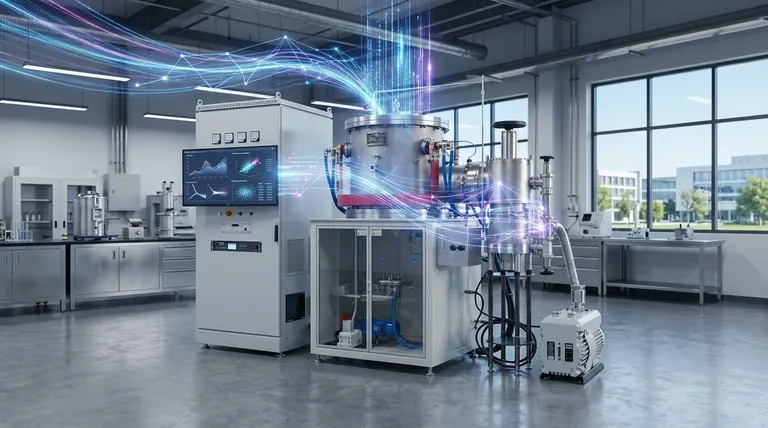
Industrial furnaces are complex systems equipped with thousands of sensors. These sensors continuously stream data, creating a dataset so vast that manual monitoring or standard linear analysis becomes inefficient.
The Problem of Redundancy
A significant portion of this generated data is redundant. Multiple sensors often report on correlated variances, creating "noise" that complicates the identification of distinct performance issues.
How PCA Enhances Monitoring
Dimension Reduction techniques
PCA algorithms address data saturation through dimension reduction. Instead of processing thousands of individual data points, the algorithm compresses this information into a smaller set of "principal components" that retain the essential patterns of the original data.
Critical Feature Extraction
By stripping away the redundancy, PCA isolates the most critical feature variables. This allows the monitoring system to focus its computational power on the specific data trends that actually indicate furnace health.
Improving Fault Detection
Filtering Background Noise
Raw sensor data contains significant background noise—random fluctuations that do not represent actual mechanical or thermal issues. PCA effectively filters this out, preventing the system from interpreting normal operational variance as a problem.
Reducing False Alarms
One of the most valuable outcomes of this noise reduction is a sharp decrease in false alarms. By distinguishing between noise and actual anomalies, operators are only alerted when a genuine deviation occurs.
Quantifiable Reliability
The implementation of PCA has a measurable impact on diagnostic success. By cleaning the data stream, the reliability of furnace anomaly diagnosis is increased to approximately 89%.
Understanding the Trade-offs
The Reliability Gap
While PCA significantly improves performance, the resulting 89% reliability rate implies an 11% margin of error. It is a powerful tool, but not an infallible solution for every possible anomaly.
Loss of Granularity
The process of dimension reduction inherently involves summarizing data. While this removes noise, there is always a theoretical risk that highly subtle, non-redundant signals could be compressed or overlooked if they do not align with the principal components.
Making the Right Choice for Your System
If your primary focus is Noise Reduction: Implement PCA to filter out the random background fluctuations common in high-volume sensor environments.
If your primary focus is Operational Efficiency: Use PCA to drastically reduce false alarms, ensuring your team only reacts to genuine maintenance needs.
If your primary focus is Diagnostic Accuracy: Leverage PCA to achieve an anomaly diagnosis reliability rate of roughly 89%, far surpassing raw data monitoring.
By converting thousands of noisy signals into a streamlined data model, PCA turns sensor overload into actionable diagnostic precision.
Summary Table:
| Feature | Impact of PCA on Furnace Monitoring |
|---|---|
| Data Management | Uses dimension reduction to manage thousands of sensor inputs |
| Signal Quality | Filters background noise and removes redundant data points |
| Reliability | Increases anomaly diagnosis accuracy to approximately 89% |
| Efficiency | Drastically reduces false alarms for improved operational focus |
| Core Function | Extracts critical variables to isolate essential performance patterns |
Optimize Your Thermal Processing with KINTEK Expertise
Don't let data noise compromise your operational efficiency. Backed by expert R&D and manufacturing, KINTEK offers high-performance Muffle, Tube, Rotary, Vacuum, and CVD systems, along with other specialized lab high-temperature furnaces. Our systems are fully customizable to meet your unique research and production needs, ensuring precise control and reliable results.
Ready to elevate your lab's performance? Contact us today to discover how our advanced furnace solutions and technical support can streamline your processes and enhance diagnostic accuracy.
Visual Guide

Related Products
- Stainless Steel Quick Release Vacuum Chain Three Section Clamp
- 915MHz MPCVD Diamond Machine Microwave Plasma Chemical Vapor Deposition System Reactor
- High Performance Vacuum Bellows for Efficient Connection and Stable Vacuum in Systems
- Multi Heating Zones CVD Tube Furnace Machine for Chemical Vapor Deposition Equipment
- Electric Rotary Kiln Small Rotary Furnace for Activated Carbon Regeneration
People Also Ask
- What is the function of quartz vacuum encapsulation in RhSeCl CVT? Mastering Pure Crystal Growth
- What type of pump is used in water circulating vacuum pumps and how is it installed? Discover Robust Fluid-Based Vacuum Solutions
- What role do vacuum-sealed high-purity silica ampoules play in phase equilibrium experiments? Enhance Sample Integrity
- What is the operating principle of a vacuum freeze-dryer in the fabrication of carbon aerogels? Master Sublimation
- What role does a vacuum atmosphere play in Sn-Ag-Co TLP soldering? Optimize Bond Purity and Joint Strength