
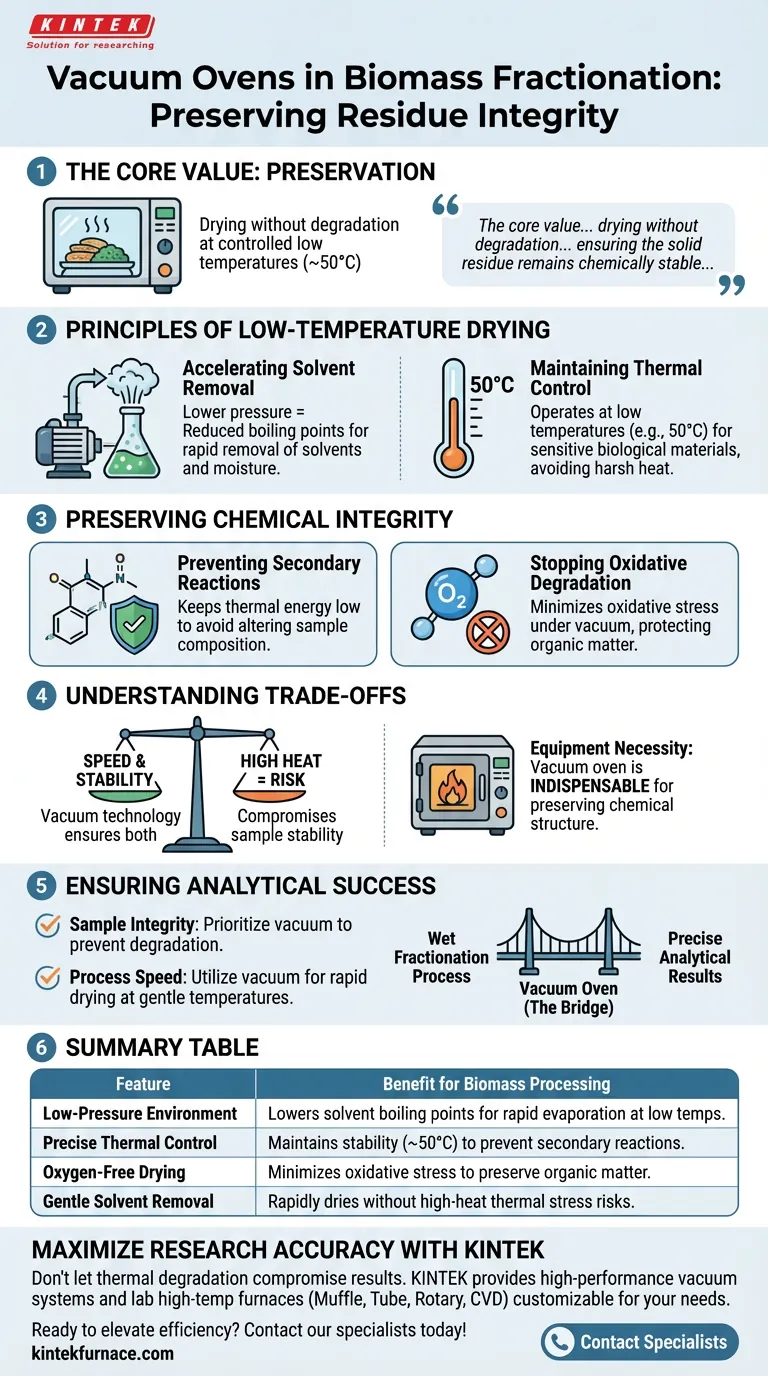
A vacuum oven serves a critical preservation role in the processing of solid residues during biomass fractionation. It is primarily utilized to dry solid filter cakes at controlled, low temperatures—typically around 50°C. By operating under reduced pressure, the oven facilitates the rapid removal of residual solvents and moisture without subjecting the material to destructive thermal stress.
The core value of a vacuum oven is not just drying, but drying without degradation. It allows you to remove moisture and solvents efficiently while preventing secondary reactions and oxidative damage, ensuring the solid residue remains chemically stable for accurate downstream analysis.
The Principles of Low-Temperature Drying
Accelerating Solvent Removal
The vacuum environment fundamentally alters the thermodynamics of evaporation. By lowering the pressure, the boiling points of solvents and water are significantly reduced.
This allows for the rapid removal of moisture and residual solvents from solid filter cakes. You achieve drying speeds comparable to high-heat methods without actually applying high heat.
Maintaining Thermal Control
Because the vacuum handles the heavy lifting of evaporation, the oven operates at much lower temperatures, such as 50°C.
This low-temperature operation is essential for processing sensitive biological materials. It avoids the harsh conditions typical of standard convection ovens.
Preserving Chemical Integrity
Preventing Secondary Reactions
Biomass components are chemically complex and often reactive. High temperatures can trigger undesirable secondary reactions that alter the composition of the sample.
The vacuum oven prevents these reactions by keeping the thermal energy input below the threshold that triggers chemical changes. This ensures the residue you analyze represents the actual outcome of the fractionation, not a byproduct of the drying process.
Stopping Oxidative Degradation
Heat combined with oxygen is a recipe for degrading organic matter.
By drying under vacuum, you minimize the sample's exposure to oxidative stress. This protects the biomass components from oxidative degradation, preserving their structural fidelity.
Understanding the Trade-offs
Speed vs. Stability
In many processing scenarios, speed is achieved by cranking up the heat. However, in biomass fractionation, this approach compromises the sample.
The trade-off here is that to ensure sample stability, you must rely on vacuum technology rather than simple thermal energy. You cannot simply increase the temperature to dry faster without risking the integrity of the data.
Equipment Necessity
Achieving this level of preservation requires specific hardware. Simple air drying is too slow and may allow biological degradation, while standard ovens are too aggressive.
Therefore, the vacuum oven is an indispensable, non-negotiable tool for any process where the chemical structure of the solid residue must be preserved for analysis.
Ensuring Analytical Success
To maximize the quality of your biomass data, consider the following recommendations:
- If your primary focus is Sample Integrity: Prioritize the vacuum oven to prevent oxidative degradation and secondary reactions during the drying phase.
- If your primary focus is Process Speed: Utilize the vacuum setting to lower solvent boiling points, allowing for rapid drying even at gentle temperatures like 50°C.
The vacuum oven is the bridge between the wet fractionation process and precise analytical results, ensuring what you measure is exactly what you produced.
Summary Table:
| Feature | Benefit for Biomass Processing |
|---|---|
| Low-Pressure Environment | Lowers solvent boiling points for rapid evaporation at low temperatures. |
| Precise Thermal Control | Maintains stability (approx. 50°C) to prevent secondary chemical reactions. |
| Oxygen-Free Drying | Minimizes oxidative stress to preserve organic matter and structural fidelity. |
| Gentle Solvent Removal | Rapidly dries solid filter cakes without the risks of high-heat thermal stress. |
Maximize Your Biomass Research Accuracy with KINTEK
Don’t let thermal degradation compromise your analytical results. At KINTEK, we understand that preserving the chemical integrity of your samples is paramount. Backed by expert R&D and world-class manufacturing, we provide high-performance vacuum systems and lab high-temp furnaces—including Muffle, Tube, Rotary, and CVD systems—all customizable to meet your specific fractionation requirements.
Ready to elevate your lab’s efficiency and data precision?
Contact our specialists today to find your custom solution!
Visual Guide
References
- Multi-step pre-treatment of rice husk for fractionation of components including silica. DOI: 10.3389/fchem.2025.1538797
This article is also based on technical information from Kintek Furnace Knowledge Base .
Related Products
- Vacuum Heat Treat Sintering and Brazing Furnace
- Vacuum Heat Treat Sintering Furnace Molybdenum Wire Vacuum Sintering Furnace
- Dental Porcelain Zirconia Sintering Ceramic Vacuum Press Furnace
- Vacuum Hot Press Furnace Machine for Lamination and Heating
- Vacuum Hot Press Furnace Machine Heated Vacuum Press
People Also Ask
- What are the benefits of using vacuum heat treating furnaces for metal alloys? Achieve Superior Metal Properties and Performance
- What is one of the most important uses of vacuum heat treating furnaces in aerospace? Achieve Superior Strength in Aircraft Alloys
- How does vacuum heat treating affect the grain structure of metal alloys? Achieve Precise Microstructure Control
- What is the temperature of a vacuum furnace brazing? Optimize Your Joint Strength and Cleanliness
- What are the steps involved in a typical vacuum brazing treatment? Master the Process for Strong, Clean Joints



















