
In essence, vacuum furnaces are classified by the specific thermal process they are engineered to perform. The main categories are defined by their method of cooling materials (quenching) or their primary application, such as joining parts (brazing), consolidating powders (sintering), or executing other specialized heat treatments in a controlled, contamination-free environment.
The "type" of a vacuum furnace is not just a label; it is a direct reflection of its intended function. The core distinction lies in how a furnace heats and cools a part to achieve a specific material property, whether it's extreme hardness, a permanent bond, or enhanced purity.
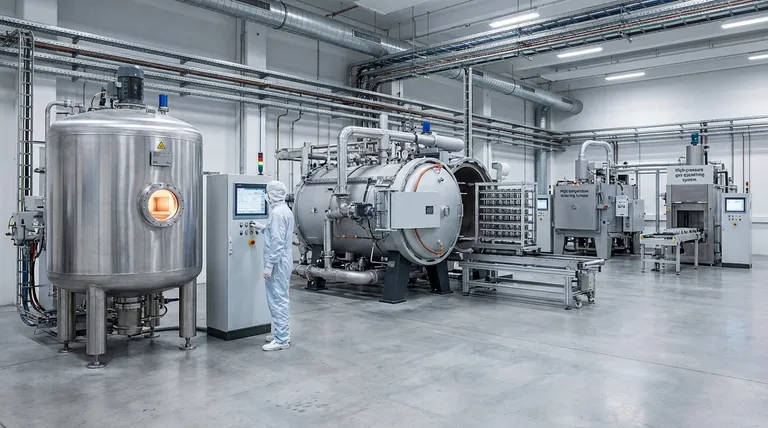
The Core Principle: Matching the Process to the Furnace
A vacuum furnace's primary advantage is its environment. By removing air and other gases, it prevents oxidation and eliminates sources of contamination, ensuring the material's integrity during high-temperature processing.
However, different metallurgical processes require unique thermal cycles. The specific design of a furnace—its heating elements, chamber configuration, and especially its cooling system—is tailored to execute one of these cycles perfectly.
The Critical Role of Cooling (Quenching)
For many materials, especially steels and certain alloys, the rate of cooling is just as important as the heating temperature. This rapid cooling process, known as quenching, locks in a desirable crystalline structure, dramatically increasing hardness and strength.
Furnace types are often distinguished by how they quench.
A Breakdown of Key Furnace Types by Process
The most common way to categorize vacuum furnaces is by the specific job they do, which is directly tied to their cooling technology and operational capabilities.
Furnaces for Hardening and Quenching
These furnaces are designed for heat treatments that require rapid cooling to harden materials.
-
High-Pressure Gas Quenching (HPGQ) Furnaces: These use inert gases like nitrogen or argon at high pressure (up to 20 bar or more) to cool parts rapidly. This method provides controlled, uniform cooling with minimal part distortion, making it ideal for tool steel, die steel, and high-performance alloys like titanium.
-
Oil Quenching Furnaces: For certain steels (e.g., bearing or spring steel), an even faster cooling rate is needed than gas can provide. These furnaces use a specialized vacuum-grade oil as the quenching medium. They often feature a double-chamber design to keep the hot zone separate from the cooler oil tank, preventing oil vapor contamination.
Furnaces for Joining and Assembly
These furnaces are optimized for creating strong, clean joints between metal components without the need for traditional welding or soldering flux.
-
Vacuum Brazing Furnaces: Brazing uses a filler metal with a lower melting point than the base components to join them. In a vacuum, this process creates exceptionally clean, strong, and hermetically sealed joints. This is critical for complex assemblies like automotive radiators, air conditioner evaporators, and aerospace components.
-
High-Temperature Brazing Furnaces: This is a subset designed for joining advanced materials like stainless steel, titanium alloys, and other high-temperature alloys that require very high processing temperatures.
Furnaces for Sintering and Specialized Applications
This category covers furnaces built for consolidating powders into solid objects or for other unique material transformations.
-
Vacuum Sintering Furnaces: Sintering is the process of fusing metallic or ceramic powders together under heat and pressure. Vacuum furnaces provide the pure, high-temperature environment needed for producing high-density parts from materials like tungsten carbide or advanced ceramics.
-
Vacuum Hydrogen Furnaces: Some processes require a specific reactive atmosphere. These dual-purpose furnaces can operate under a vacuum or be backfilled with a gas like hydrogen, which acts as a reducing agent. They are primarily used for specialized applications, such as manufacturing synthetic diamonds and composite sheets.
Understanding the Trade-offs and Design Factors
Choosing a furnace involves understanding the engineering compromises inherent in their design.
Gas Quenching vs. Oil Quenching
The primary trade-off is between cooling speed and part integrity. Oil quenching is faster and necessary for some low-alloy steels to achieve full hardness. However, it can cause more thermal shock and part distortion, and requires post-process cleaning.
Gas quenching is cleaner, more controllable, and results in less distortion, but its cooling rate may be insufficient for certain alloys.
Temperature Range and Construction
A furnace's maximum operating temperature dictates its internal components.
- Lower temperatures (below 800°C) may use nickel-chromium heating elements.
- Medium-high temperatures (up to 1600°C) require robust elements like molybdenum or graphite.
- Very high temperatures (up to 2400°C) demand advanced graphite or tungsten elements and specialized insulation like carbon felt.
Chamber Configuration and Pressure Level
The physical layout can be horizontal (for easy loading of various parts) or vertical (often for long, cylindrical parts to minimize distortion). Furthermore, the required vacuum level—from high vacuum for general heat treatment to ultra-high vacuum for sensitive electronics—also dictates pump selection and chamber design.
Making the Right Choice for Your Goal
Your choice of vacuum furnace should be driven entirely by the material you are processing and the final properties you need to achieve.
- If your primary focus is hardening common tool and die steels with minimal distortion: A high-pressure gas quenching (HPGQ) furnace is the industry standard.
- If your primary focus is achieving maximum hardness in specific low-alloy steels: An oil quenching furnace is required, despite the potential for distortion and need for cleaning.
- If your primary focus is joining complex or sensitive components with perfect, flux-free joints: A dedicated vacuum brazing furnace is the correct tool for the job.
- If your primary focus is processing advanced ceramics or refractory metals: You will need a high-temperature furnace capable of sintering or other specialized treatments.
Ultimately, understanding your process requirements is the key to selecting the right vacuum furnace technology.
Summary Table:
| Furnace Type | Primary Use | Key Features |
|---|---|---|
| High-Pressure Gas Quenching (HPGQ) | Hardening with minimal distortion | Controlled, uniform cooling using inert gases |
| Oil Quenching | Fast hardening of specific steels | Rapid cooling with vacuum-grade oil, double-chamber design |
| Vacuum Brazing | Joining components with clean joints | Flux-free, strong bonds for complex assemblies |
| Vacuum Sintering | Consolidating powders into solid parts | High-density production for ceramics and metals |
| Vacuum Hydrogen | Specialized applications with reactive gases | Dual-purpose for processes like diamond synthesis |
Need a Custom Vacuum Furnace Solution?
At KINTEK, we leverage exceptional R&D and in-house manufacturing to provide diverse laboratories with advanced high-temperature furnace solutions. Our product line includes Muffle, Tube, Rotary Furnaces, Vacuum & Atmosphere Furnaces, and CVD/PECVD Systems, all backed by strong deep customization capabilities to precisely meet your unique experimental requirements. Whether you're hardening, brazing, sintering, or handling other thermal processes, we can design a furnace that optimizes performance and efficiency for your specific goals.
Contact us today to discuss how we can enhance your lab's capabilities with a tailored vacuum furnace!
Visual Guide

Related Products
- 600T Vacuum Induction Hot Press Vacuum Heat Treat and Sintering Furnace
- Vacuum Hot Press Furnace Machine Heated Vacuum Press Tube Furnace
- Vacuum Hot Press Furnace Machine Heated Vacuum Press
- 2200 ℃ Tungsten Vacuum Heat Treat and Sintering Furnace
- Molybdenum Vacuum Heat Treat Furnace
People Also Ask
- Why use Vacuum Hot Press (VHP) for ZnS Ceramics? Achieve Superior IR Transparency and Mechanical Strength
- How does a vacuum hot press sintering furnace mitigate copper sintering swelling? Solve Fe-Cu Expansion Issues
- How does the vacuum environment in a vacuum hot press sintering furnace protect chromium-containing ceramics? Find out.
- What is the core function of a vacuum hot press sintering furnace in the preparation of high-density RuTi alloys? Achieve Maximum Density and Purity
- What are the key advantages of vacuum hot press sintering furnaces? Achieve Superior Density and Purity in Materials



















