
In the processing of Ti-33Mo-0.2C alloy, the vacuum induction furnace equipped with a water-cooled copper cold crucible serves as a specialized high-purity melting system designed to overcome the extreme chemical reactivity of molten titanium.
Its primary function is to eliminate contamination sources by combining a high-vacuum environment—which prevents the absorption of atmospheric gases like oxygen and nitrogen—with a cold crucible technique that prevents the molten alloy from ever touching a reactive ceramic liner.
Core Takeaway Processing titanium alloys requires isolating the melt from both the air and the containment vessel itself. The cold crucible method uses electromagnetic forces to create a "skull" or levitation effect, ensuring the reactive alloy is melted solely within a container of its own frozen material, guaranteeing absolute compositional purity.
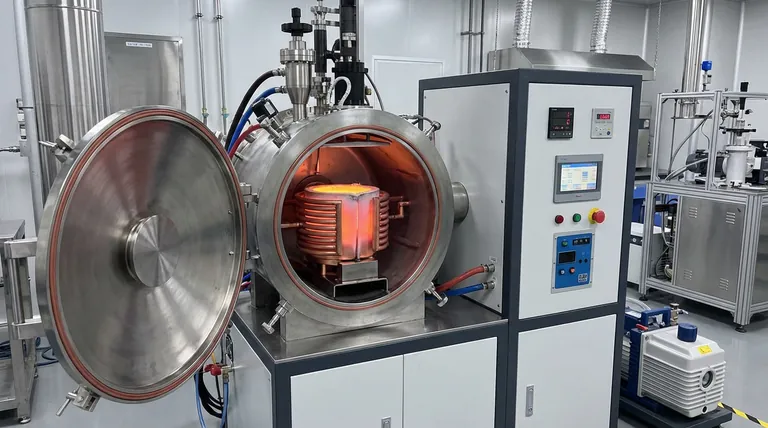
Overcoming Material Reactivity
The Challenge of Titanium Melting
Titanium is highly reactive in its liquid state. When melted in traditional ceramic or refractory crucibles, it aggressively attacks the vessel walls.
This reaction introduces ceramic inclusions and impurities into the melt, compromising the mechanical properties of the final Ti-33Mo-0.2C alloy.
The Water-Cooled Copper Solution
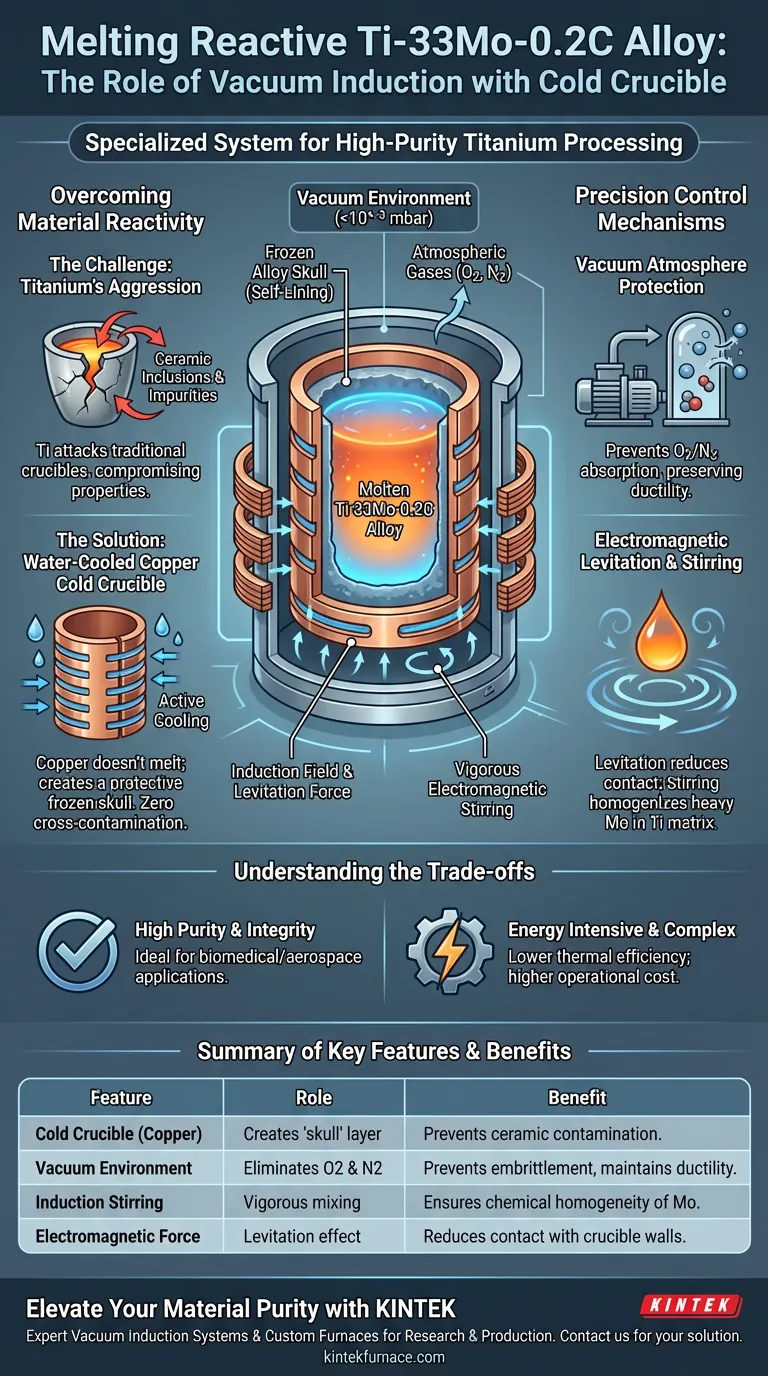
The "cold crucible" is constructed from segmented, water-cooled copper. Because copper is highly conductive and actively cooled, it does not melt.
Instead of the alloy touching the copper, the intense cooling causes a thin layer of the titanium alloy to freeze instantly against the wall.
The "Skull" Effect
This frozen layer is known as a skull. It acts as a protective lining, meaning the molten Ti-33Mo-0.2C is actually contained inside a shell of its own solid material.
This eliminates any interaction between the liquid metal and foreign refractory materials, ensuring zero cross-contamination.
Precision Control Mechanisms
Vacuum Atmosphere Protection
The vacuum induction furnace operates in an extremely pure vacuum environment.
This is critical because titanium absorbs oxygen and nitrogen rapidly at high temperatures. These interstitial elements can embrittle the alloy; the vacuum prevents this absorption, preserving the alloy's ductility.
Electromagnetic Levitation and Stirring
The induction field used to heat the metal also generates strong electromagnetic forces.
These forces can create a levitation effect, further reducing contact with the crucible walls. Additionally, induction provides vigorous electromagnetic stirring.
This stirring is vital for Ti-33Mo-0.2C because Molybdenum (Mo) has a higher density and melting point than Titanium. The stirring ensures the refractory Mo is fully dissolved and chemically homogenized within the Ti matrix.
Understanding the Trade-offs
Thermal Efficiency
While the cold crucible guarantees purity, it is thermally inefficient compared to traditional furnaces.
A significant amount of energy is lost through the water-cooled walls to maintain the "skull." This makes the process more energy-intensive and generally limits the maximum superheat (temperature above melting point) that can be achieved.
Complexity and Cost
The system requires complex power supplies and high-pressure water cooling systems.
It is generally reserved for high-value applications—such as biomedical or aerospace components—where material purity is more critical than production cost.
Making the Right Choice for Your Goal
To determine if this melting method aligns with your specific metallurgical objectives, consider the following:
- If your primary focus is absolute purity and biocompatibility: This is the definitive choice, as the cold crucible completely negates the risk of ceramic inclusions and refractory contamination.
- If your primary focus is precise composition control: The vacuum environment combined with electromagnetic stirring ensures that the specific ratio of Titanium, Molybdenum, and Carbon remains exact and homogeneous.
The cold crucible vacuum induction furnace is the industry standard for transforming reactive raw elements into high-integrity Ti-33Mo-0.2C alloy without structural compromise.
Summary Table:
| Feature | Role in Ti-33Mo-0.2C Melting | Benefit to Final Alloy |
|---|---|---|
| Cold Crucible (Copper) | Creates a "skull" (frozen alloy layer) | Prevents ceramic inclusion & contamination |
| Vacuum Environment | Eliminates atmospheric O2 and N2 | Prevents embrittlement & maintains ductility |
| Induction Stirring | Vigorous electromagnetic mixing | Ensures chemical homogeneity of Molybdenum |
| Electromagnetic Force | Provides a levitation effect | Reduces contact with crucible walls |
Elevate Your Material Purity with KINTEK
Precision melting of reactive alloys like Ti-33Mo-0.2C requires more than just heat—it requires a contamination-free environment. Backed by expert R&D and manufacturing, KINTEK offers high-performance Vacuum Induction Systems and custom lab high-temp furnaces (Muffle, Tube, Rotary, CVD) tailored to your specific research or production needs.
Ready to achieve absolute compositional integrity? Contact KINTEK experts today to discuss your custom furnace solution.
Visual Guide
References
- W. Szkliniarz, Agnieszka Szkliniarz. The Role of Titanium Carbides in Forming the Microstructure and Properties of Ti-33Mo-0.2C Alloy. DOI: 10.3390/coatings15050546
This article is also based on technical information from Kintek Furnace Knowledge Base .
Related Products
- Vacuum Induction Melting Furnace
- 600T Vacuum Induction Hot Press Vacuum Heat Treat and Sintering Furnace
- Vacuum Heat Treat Sintering Furnace with Pressure for Vacuum Sintering
- Small Vacuum Heat Treat and Tungsten Wire Sintering Furnace
- 2200 ℃ Tungsten Vacuum Heat Treat and Sintering Furnace
People Also Ask
- What are the core functions of the High Vacuum Induction Melting (VIM) furnace? Optimize DD5 Superalloy Purification
- What are the technical advantages of using a Vacuum Induction Melting furnace in the development of advanced packaging steel?
- What is the role of VIM and directional solidification in aero-engine blade substrates? Engineering Extreme Durability
- What are the advantages of using a VIM furnace to control residual oxygen pressure? Achieve Superior Metal Uniformity
- What role does a Vacuum Induction Melting furnace play in the production of high-aluminum nickel-based superalloys?



















