
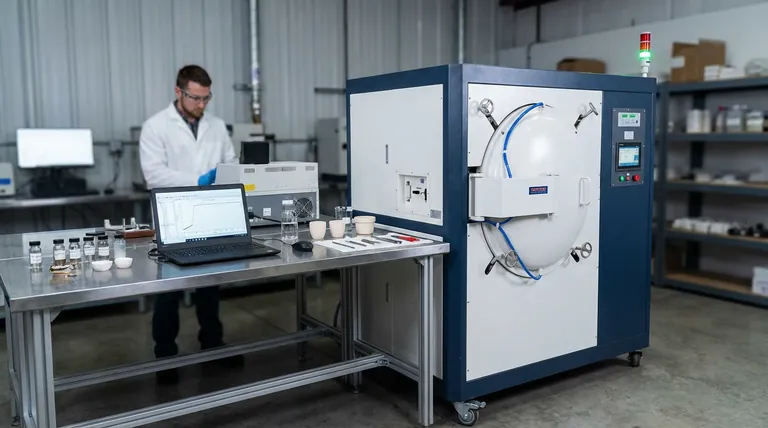
A vacuum annealing furnace functions as a precise environmental control chamber specifically designed to accelerate and isolate phase transitions in Ag2S1-xTex samples without environmental interference. By maintaining high vacuum levels and regulating temperatures between 373 K and 503 K for periods ranging from 4 to 14 days, the furnace enables the observation of slow-moving structural changes that define the material's long-term stability.
Core Takeaway Evaluating phase stability requires distinguishing between temporary (metastable) states and permanent structural changes. The vacuum annealing furnace facilitates this by providing a contamination-free thermal environment that forces amorphous phases to settle into their final low-temperature or secondary configurations, effectively mapping the material's phase diagram.
The Mechanics of Phase Stability Evaluation
Precise Temperature Regulation
The furnace maintains a strictly controlled thermal window, specifically between 373 K and 503 K for this material class.
This range is critical because it straddles the activation energy thresholds required to initiate phase changes in silver chalcogenides.
Extended Duration Testing
Phase transitions in Ag2S1-xTex are not always instantaneous; they often require significant time to reach equilibrium.
Researchers utilize the furnace for extended durations, typically 4 to 14 days. This allows the material sufficient time to relax from a metastable state into a stable structural configuration.
Why Vacuum Conditions are Non-Negotiable
Prevention of Sample Deterioration
Standard thermal treatment in air would lead to oxidation or corrosion, ruining the integrity of the Ag2S1-xTex surface.
The high vacuum environment eliminates oxygen and moisture, ensuring that any observed changes are purely thermal and structural, rather than chemical reactions with the atmosphere.
Isolating Intrinsic Behavior
To determine a phase diagram accurately, the external variables must be minimized.
Vacuum annealing ensures that the material properties observed are intrinsic to the Ag2S1-xTex alloy itself, rather than artifacts of environmental stress or processing impurities.
Critical Observations Enabled by Annealing
Transition of Metastable Phases
Freshly synthesized samples often possess metastable amorphous phases that are not representative of long-term behavior.
The annealing process supplies the thermal energy needed to resolve these amorphous regions into defined low-temperature phases.
Identification of Secondary Phases
Prolonged heat treatment reveals the formation of secondary phases that may not appear during short-term testing.
Specifically, this process highlights the emergence of Ag5-dTe3, a crucial data point for researchers trying to understand the material's purity and homogeneity boundaries.
Determining Phase Diagram Boundaries
By correlating the temperature and duration with the resulting crystal structure, researchers can plot precise phase boundaries.
This data is the foundation for establishing the thermal stability limits of the material for practical applications.
Understanding the Trade-offs
Time Intensity vs. Data Quality
The primary drawback of this method is the significant time investment required (up to two weeks per cycle).
However, fast-acting thermal characterization methods often miss the slow-growing secondary phases like Ag5-dTe3, leading to incomplete phase diagrams.
Complexity of Vacuum Systems
maintaining a high vacuum for 14 days requires robust equipment with reliable seals and pumps.
Any failure in the vacuum integrity during the annealing cycle can lead to oxidation, rendering weeks of testing invalid.
Making the Right Choice for Your Research
To effectively evaluate Ag2S1-xTex, align your furnace parameters with your specific analytical goals:
- If your primary focus is Phase Mapping: Prioritize duration (10+ days) over high temperature to ensure the material reaches true equilibrium and reveals secondary phases.
- If your primary focus is Sample Purity: Ensure your vacuum levels are maximal to prevent oxidation, which can mimic or obscure phase degradation.
The reliability of your phase diagram depends entirely on your ability to isolate thermal evolution from environmental contamination.
Summary Table:
| Parameter | Specification/Requirement | Purpose in Phase Evaluation |
|---|---|---|
| Temperature Range | 373 K to 503 K | Straddles activation energy for phase changes |
| Annealing Duration | 4 to 14 Days | Allows metastable states to reach equilibrium |
| Environment | High Vacuum | Prevents oxidation and ensures intrinsic results |
| Key Outcome | Secondary Phase Identification | Detects Ag5-dTe3 and defines phase boundaries |
Optimize Your Material Research with KINTEK Precision
Ensure the integrity of your phase stability studies with KINTEK’s high-performance vacuum systems. Backed by expert R&D and manufacturing, KINTEK offers specialized Vacuum, Muffle, Tube, and CVD systems designed to maintain rigorous thermal and atmospheric control for extended durations. Whether you are mapping complex phase diagrams or testing material purity, our customizable lab high-temp furnaces provide the reliability you need to eliminate environmental variables.
Ready to achieve superior thermal precision? Contact our experts today to find the perfect solution for your unique research needs.
Visual Guide

References
- Kosuke Sato, Tsunehiro Takeuchi. Composition, time, temperature, and annealing-process dependences of crystalline and amorphous phases in ductile semiconductors Ag2S1−<i>x</i>Te<i>x</i> with <i>x</i> = 0.3–0.6. DOI: 10.1063/5.0180950
This article is also based on technical information from Kintek Furnace Knowledge Base .
Related Products
- Vacuum Heat Treat Sintering and Brazing Furnace
- Small Vacuum Heat Treat and Tungsten Wire Sintering Furnace
- Vacuum Sealed Continuous Working Rotary Tube Furnace Rotating Tube Furnace
- Vacuum Heat Treat Sintering Furnace Molybdenum Wire Vacuum Sintering Furnace
- Vacuum Heat Treat Sintering Furnace with Pressure for Vacuum Sintering
People Also Ask
- What are the benefits of using vacuum heat treating furnaces for metal alloys? Achieve Superior Metal Properties and Performance
- What is one of the most important uses of vacuum heat treating furnaces in aerospace? Achieve Superior Strength in Aircraft Alloys
- How does vacuum heat treating affect the grain structure of metal alloys? Achieve Precise Microstructure Control
- What is the temperature of a vacuum furnace brazing? Optimize Your Joint Strength and Cleanliness
- What are the steps involved in a typical vacuum brazing treatment? Master the Process for Strong, Clean Joints



















