
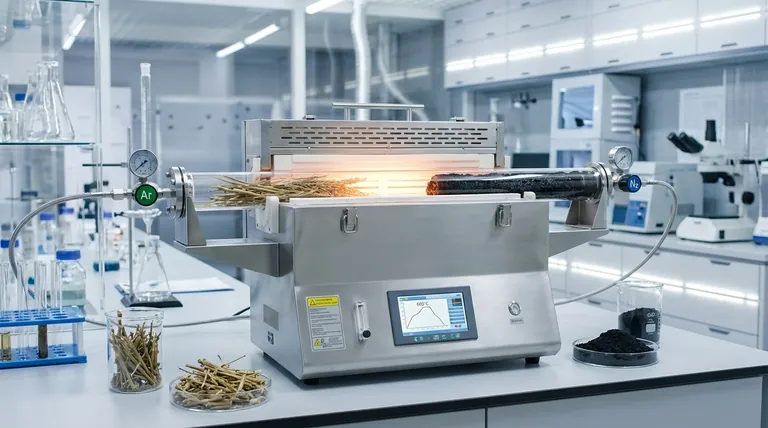
The tube furnace serves as the precise control environment necessary to transform raw biomass into functional carbon materials. Its role is twofold: it provides a sealed, oxygen-free chamber to safely strip away volatile components during pre-carbonization, and it maintains the exact high-temperature conditions required for chemical activators to etch complex pore structures into the carbon matrix.
The Core Value The tube furnace is not merely a heater; it is a reaction stabilizer. By strictly isolating the biomass from oxygen and regulating thermal kinetics, it ensures the material undergoes controlled restructuring—like aromatization—rather than combustion, resulting in a stable, highly porous carbon framework.
The Role in Pre-Carbonization
During the initial stage of processing, the biomass (such as Spartina alterniflora) must be stripped of non-carbon elements without burning up the carbon skeleton.
Establishing the Inert Atmosphere
The primary function of the tube furnace here is to create a vacuum-tight seal against the outside air.
By purging the chamber with inert gases like argon or nitrogen, the furnace prevents oxidation side reactions. This ensures that the biomass creates a char rather than turning to ash.
Controlled Volatile Removal
As the temperature rises, the furnace facilitates the safe release of volatile components.
This process removes hydrogen and oxygen-rich compounds through reactions like dehydrogenation and decarboxylation. The furnace's stability ensures these volatiles are evacuated efficiently, leaving behind a carbon-rich precursor ready for activation.
The Role in the Activation Process
Once the raw material is pre-carbonized, the tube furnace shifts its role to supporting the chemical etching process that creates surface area.
Sustaining Reaction Kinetics
Activation requires precise, sustained heat—often around 600°C to 800°C—to drive the chemical reactions between the activator and the carbon.
The tube furnace maintains this specific thermal field, ensuring the temperature remains constant. This consistency is vital for the activator to react effectively with the carbon matrix.
Etching the Pore Structure
The ultimate goal of activation is to create a network of pores within the material.
Inside the furnace, the high temperature allows the chemical agent to "etch" or erode specific parts of the carbon. This creates a rich, porous structure that defines the material's final performance capabilities.
Advanced Thermal Programming
Sophisticated tube furnaces, such as those with dual-temperature zones, allow for multi-stage heating curves.
This capability enables precise control over heating rates and holding times. By manipulating these variables, operators can influence the degree of aromatization, fine-tuning the chemical stability and pore size of the final product.
Operational Criticalities and Trade-offs
While tube furnaces offer superior control, their effectiveness relies entirely on the integrity of the environment they create.
The Risk of Atmosphere Breach
The strict control of the inert atmosphere is the single most critical factor. Even a minor leak or insufficient gas purity can lead to the oxidation of the carbon at high temperatures, ruining the batch.
Precision vs. Throughput
Tube furnaces excel at precision, offering exact pyrolysis environments. However, this often comes at the cost of volume; they are typically batch-process tools designed for high-quality, specific structural outcomes rather than mass bulk processing.
Making the Right Choice for Your Goal
To maximize the utility of a tube furnace for biomass-derived carbon, align your operational parameters with your specific material goals:
- If your primary focus is High Surface Area: Prioritize precise temperature holding times at 600°C+ to ensure the activator has sufficient time to etch deep pore structures.
- If your primary focus is Chemical Purity: Focus heavily on the sealing integrity and continuous purging of inert gas (Argon/Nitrogen) to prevent any oxidation side reactions.
- If your primary focus is Structural Stability: Utilize programmed heating rates to control the speed of dehydrogenation and aromatization, preventing structural collapse during pyrolysis.
The tube furnace is the gatekeeper of quality, converting the chaotic chemistry of biomass into the ordered architecture of high-performance carbon.
Summary Table:
| Process Stage | Tube Furnace Role | Key Operational Benefit |
|---|---|---|
| Pre-Carbonization | Inert atmosphere & volatile removal | Prevents oxidation; ensures stable carbon-rich char |
| Activation | High-temp chemical etching (600°C-800°C) | Creates complex, high-surface-area pore structures |
| Thermal Control | Multi-stage heating curves | Precise aromatization and structural stability |
| Gas Management | Continuous inert gas purging | Maintains chemical purity and prevents ash formation |
Elevate Your Materials Research with KINTEK Precision
To transform raw biomass into high-performance carbon, you need more than just heat—you need total environmental control. Backed by expert R&D and manufacturing, KINTEK offers high-performance Tube, Muffle, Rotary, Vacuum, and CVD systems designed to meet the rigorous demands of carbonization and activation. Whether you require dual-temperature zones for complex thermal programming or superior vacuum seals for inert atmospheres, our lab furnaces are fully customizable for your unique research needs.
Ready to achieve superior pore structures and material purity? Contact KINTEK today to find the perfect high-temperature solution for your lab.
Visual Guide

References
- Hong Shang, Bing Sun. Activated Carbon from Spartina alterniflora and Its N-Doped Material for Li-Ion Battery Anode. DOI: 10.3390/nano15090658
This article is also based on technical information from Kintek Furnace Knowledge Base .
Related Products
- Electric Rotary Kiln Small Rotary Furnace for Activated Carbon Regeneration
- Vertical Laboratory Quartz Tube Furnace Tubular Furnace
- Multi Zone Laboratory Quartz Tube Furnace Tubular Furnace
- Slide PECVD Tube Furnace with Liquid Gasifier PECVD Machine
- Electric Rotary Kiln Small Rotary Furnace Biomass Pyrolysis Plant Rotating Furnace
People Also Ask
- What are the main applications of a rotary kiln electric furnace? Achieve Uniform Heat Treatment for Powders
- What are the key components of a rotary kiln electric furnace? Unlock Efficient Thermal Processing
- What is the significance of the refractory lining in a rotary kiln electric furnace? Unlock Efficiency and Longevity
- What advantages do electric rotary kilns offer over fuel-based kilns? Boost Efficiency and Purity in Your Process
- What materials can be processed in an electric rotary kiln? Versatile Solutions for Advanced Materials



















