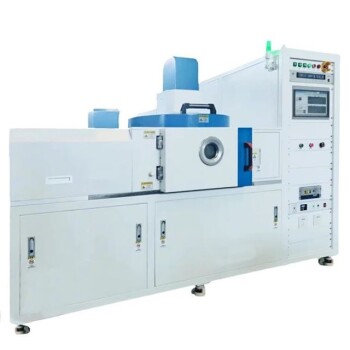
Spark Plasma Sintering (SPS) serves as the primary consolidation technique for transforming Al0.3CoCrFeNiMo0.75 alloy powders into solid bulk materials. It utilizes a combination of pulsed electric current and uniaxial pressure within graphite molds to generate internal heat, allowing for rapid densification.
The critical advantage of SPS for this specific alloy is its ability to densify the material at lower temperatures and faster rates than traditional methods, thereby preventing grain growth and preserving the powder's original metastable structure.

The Mechanics of Rapid Densification
Internal Heating Generation
Unlike conventional sintering which relies on external heating elements, SPS generates heat internally. The system applies pulsed direct current directly through the graphite molds and the alloy powder.
This creates plasma discharge heat between particles, leading to rapid thermal increases. This internal heating mechanism allows the system to reach required sintering temperatures almost instantly.
Simultaneous Pressure Application
While the electric current generates heat, the system simultaneously applies uniaxial mechanical pressure. This physical compression aids in rearranging particles and breaking down surface oxides.
The combination of thermal and mechanical energy facilitates the bonding process. This allows the Al0.3CoCrFeNiMo0.75 material to achieve high density in a very short timeframe.
Preserving Microstructural Integrity
Retaining Metastable Structures
The Al0.3CoCrFeNiMo0.75 alloy often possesses a metastable structure derived from its powder preparation. Traditional metallurgical methods, which require long holding times at high heat, often destroy these structures.
SPS completes the process quickly enough to lock these structures in place. By minimizing the thermal budget, the system effectively preserves the fine microstructure inherent to the powder.
Preventing Grain Coarsening
Prolonged exposure to high temperatures inevitably leads to grain coarsening, which can degrade mechanical properties. The rapid heating and cooling rates of SPS drastically reduce the window for grain growth.
This results in a bulk material that retains a finer grain size. Consequently, the final product exhibits optimized properties compared to materials processed via slower, conventional routes.
Understanding the Trade-offs
Density vs. Theoretical Maximums
While SPS is highly effective, it does not always guarantee absolute solidity. The process typically enables materials to reach over 94% of their theoretical density.
While this is sufficient for optimizing properties like electrical transport, it implies that a small fraction of porosity may remain. Users must verify if this density level meets the specific mechanical requirements of their application.
Equipment Specifics
The process relies heavily on specific tooling, notably graphite molds. The interaction between the pulsed current, the pressure, and these molds is complex and requires precise control to ensure uniform heating throughout the bulk sample.
Making the Right Choice for Your Goal
When preparing Al0.3CoCrFeNiMo0.75, your processing parameters should align with your specific performance targets:
- If your primary focus is Structural Integrity: Prioritize the rapid cooling capabilities of SPS to prevent grain coarsening and maintain the fine microstructure achieved during powder solidification.
- If your primary focus is Electrical Transport: Utilize the combination of high pressure and pulsed current to maximize densification (aiming for >94%), as this directly optimizes the electrical properties of the final bulk.
SPS offers a unique pathway to produce high-performance bulk alloys by decoupling densification from the grain growth usually associated with high-temperature processing.
Summary Table:
| Feature | Spark Plasma Sintering (SPS) Impact | Benefit for Al0.3CoCrFeNiMo0.75 |
|---|---|---|
| Heating Mechanism | Internal pulsed direct current | Rapid thermal increase & plasma discharge heat |
| Pressure Type | Simultaneous uniaxial pressure | Breaks surface oxides & aids particle rearrangement |
| Densification | Rapid consolidation (>94% density) | Optimizes electrical transport & structural integrity |
| Microstructure | Low thermal budget | Prevents grain coarsening & locks metastable structures |
Unlock High-Performance Material Synthesis with KINTEK
Are you looking to achieve superior densification without compromising the microstructural integrity of your advanced alloys? Backed by expert R&D and world-class manufacturing, KINTEK provides state-of-the-art Spark Plasma Sintering (SPS) systems, Muffle, Tube, Rotary, Vacuum, and CVD furnaces tailored for your specific lab requirements.
Our customizable high-temperature solutions empower researchers to preserve fine grain structures and optimize mechanical properties in complex alloys like Al0.3CoCrFeNiMo0.75.
Ready to elevate your material processing? Contact our technical experts today to find the perfect customizable system for your unique needs.
References
- Bianca Preuß, Thomas Lampke. Wear and Corrosion Resistant Eutectic High-Entropy Alloy Al0.3CoCrFeNiMo0.75 Produced by Laser Metal Deposition and Spark-Plasma Sintering. DOI: 10.1007/s11666-024-01711-9
This article is also based on technical information from Kintek Furnace Knowledge Base .
Related Products
- Spark Plasma Sintering SPS Furnace
- Chairside Dental Porcelain Zirconia Sintering Furnace with Transformer for Ceramic Restorations
- 600T Vacuum Induction Hot Press Vacuum Heat Treat and Sintering Furnace
- Dental Porcelain Zirconia Sintering Ceramic Vacuum Press Furnace
- 9MPa Air Pressure Vacuum Heat Treat and Sintering Furnace
People Also Ask
- How does the heating mechanism of Spark Plasma Sintering (SPS) function? Enhance TiC/SiC Composite Fabrication
- Why is it necessary to maintain a high vacuum environment during the SPS of SiC? Key to High-Density Ceramics
- What are the technical advantages of using an SPS sintering furnace? Elevate Al2O3-TiC Material Performance
- What are the steps in the discharge plasma sintering process? Master Fast, High-Density Material Consolidation
- What are the advantages of spark plasma sintering (SPS) over traditional forging? Precision Microstructural Control