
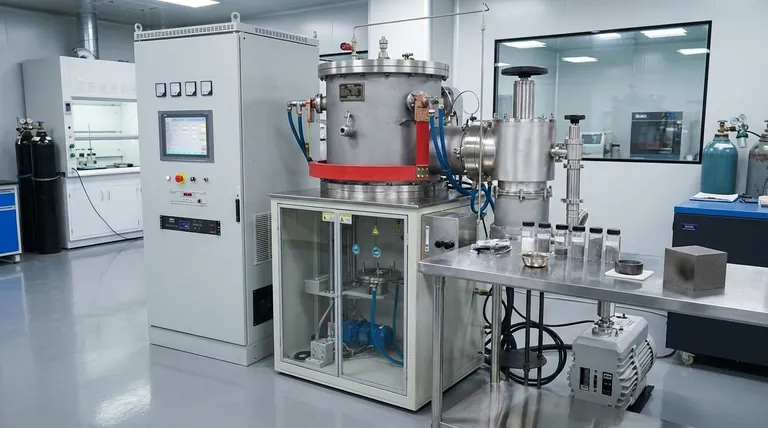
The vacuum hot press furnace acts as the definitive processing environment for synthesizing high-performance Fe-Cu-Ni-Sn-VN composites.
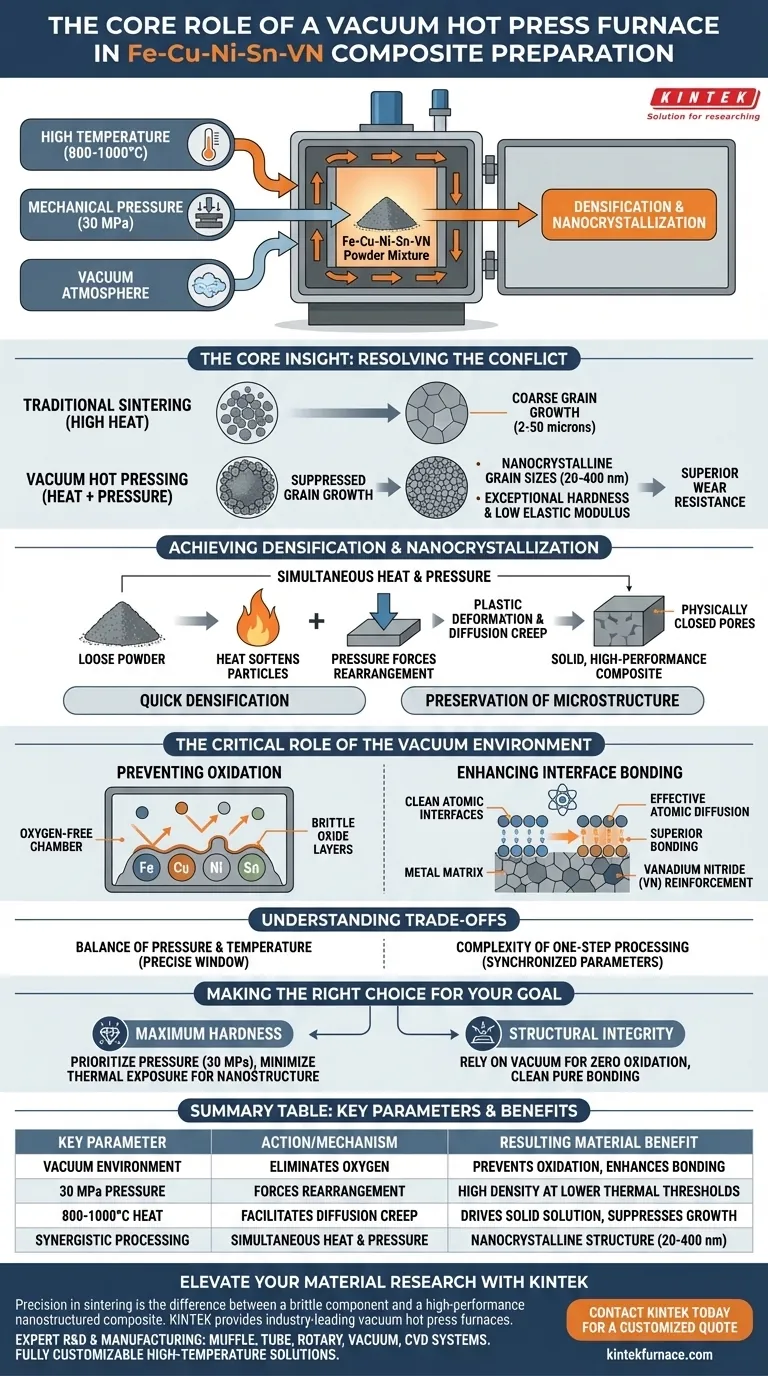
By simultaneously applying high temperatures (800-1000°C), mechanical pressure (30 MPa), and a vacuum atmosphere, the furnace drives densification and nanocrystallization. This process promotes the plastic deformation and diffusion creep of powder particles, resulting in a nanostructured material with exceptional hardness and low elastic modulus.
The Core Insight The vacuum hot press furnace solves the conflict between densification and grain growth. It utilizes mechanical pressure to force density at lower thermal thresholds, thereby suppressing the excessive grain growth typical of traditional sintering while ensuring a strictly oxidation-free environment.
Achieving Densification and Nanocrystallization
The primary function of this equipment is to transform loose powder into a solid, high-performance composite through a synergistic process.
Simultaneous Heat and Pressure
Unlike traditional methods that separate pressing and heating, this furnace applies both simultaneously. The 30 MPa mechanical pressure forces particles together while the 800-1000°C heat softens them.
This combination activates plastic deformation and diffusion creep. The external force physically closes internal pores and rearranges particles more effectively than thermal energy alone could achieve.
Suppressing Grain Growth
In standard sintering, maintaining high heat long enough to achieve density often causes grains to grow large, which weakens the material. The vacuum hot press furnace achieves density quickly through pressure, reducing the thermal exposure time.
This preservation of microstructure is critical. It results in nanocrystalline grain sizes (20-400 nm), whereas traditional methods often yield coarser grains (2-50 microns). The finer grain size directly correlates to superior wear resistance and hardness.
The Critical Role of the Vacuum Environment
Beyond shaping and hardening, the furnace acts as a protective chamber that dictates the chemical purity of the composite.
Preventing Oxidation
The metallic components of this composite—specifically Iron (Fe), Copper (Cu), Nickel (Ni), and Tin (Sn)—are highly susceptible to oxidation at sintering temperatures.
The vacuum environment effectively removes oxygen from the chamber. This prevents the formation of brittle oxide layers on the powder surfaces, which would otherwise compromise the structural integrity of the final part.
Enhancing Interface Bonding
By maintaining clean, oxide-free surfaces, the furnace facilitates effective atomic diffusion.
The vacuum allows for better solid solution formation between the metal matrix and the Vanadium Nitride (VN) reinforcement. This results in cleaner material interfaces and superior bonding, which are prerequisites for high tribological (wear) performance.
Understanding the Trade-offs
While the vacuum hot press furnace offers superior results, it introduces specific processing sensitivities that must be managed.
The Balance of Pressure and Temperature
The process relies on a precise "window" of operation. If the temperature is too high, you risk overriding the benefits of pressure and causing grain coarsening despite the equipment's capabilities.
Complexity of One-Step Processing
Combining sintering and densification into a single step removes the ability to inspect the part between forming and firing. All process parameters—pressure ramp-up, thermal dwell time, and vacuum levels—must be perfectly synchronized, as errors cannot be corrected in a subsequent stage.
Making the Right Choice for Your Goal
The vacuum hot press furnace is a specialized tool designed to maximize specific material properties.
- If your primary focus is Maximum Hardness: Prioritize the pressure parameters (30 MPa) to achieve full densification while keeping thermal exposure to the minimum required for bonding (maintaining the nanostructure).
- If your primary focus is Structural Integrity: Rely on the vacuum capability to ensure zero oxidation, guaranteeing that the Fe-Cu-Ni matrix bonds purely without brittle oxide inclusions.
Ultimately, this furnace is indispensable when the goal is to produce nanostructured composites that require high density without sacrificing fine grain size.
Summary Table:
| Key Process Parameter | Action/Mechanism | Resulting Material Benefit |
|---|---|---|
| Vacuum Environment | Eliminates oxygen exposure | Prevents oxidation & enhances interface bonding |
| 30 MPa Pressure | Forces particle rearrangement | High density at lower thermal thresholds |
| 800-1000°C Heat | Facilitates diffusion creep | Drives solid solution without excessive grain growth |
| Synergistic Processing | Simultaneous heat & pressure | Nanocrystalline structure (20-400 nm) |
Elevate Your Material Research with KINTEK
Precision in sintering is the difference between a brittle component and a high-performance nanostructured composite. KINTEK provides industry-leading vacuum hot press furnaces designed to solve the conflict between densification and grain growth.
Backed by expert R&D and manufacturing, we offer Muffle, Tube, Rotary, Vacuum, and CVD systems, all fully customizable for your unique lab requirements. Whether you are developing Fe-Cu-Ni-Sn-VN alloys or advanced ceramics, our high-temperature solutions ensure oxide-free environments and precise mechanical control.
Ready to optimize your synthesis process? Contact KINTEK today for a customized quote!
Visual Guide
Related Products
- Vacuum Hot Press Furnace Machine for Lamination and Heating
- 600T Vacuum Induction Hot Press Vacuum Heat Treat and Sintering Furnace
- Vacuum Hot Press Furnace Machine Heated Vacuum Press Tube Furnace
- Vacuum Hot Press Furnace Machine Heated Vacuum Press
- High Pressure Laboratory Vacuum Tube Furnace
People Also Ask
- What are the primary components of a vacuum hot press furnace? Master the Core Systems for Precise Material Processing
- What safety features are incorporated in vacuum hot press furnaces? Ensure Operator and Equipment Protection
- What are the benefits of the vacuum environment system in a vacuum hot press furnace? Unlock High-Density Sintering
- What industries benefit from the use of vacuum hot press furnaces? Unlock High-Performance Materials for Your Industry
- How does the uniaxial pressure applied by a vacuum hot press furnace affect the microstructure of ZrC-SiC materials?



















