
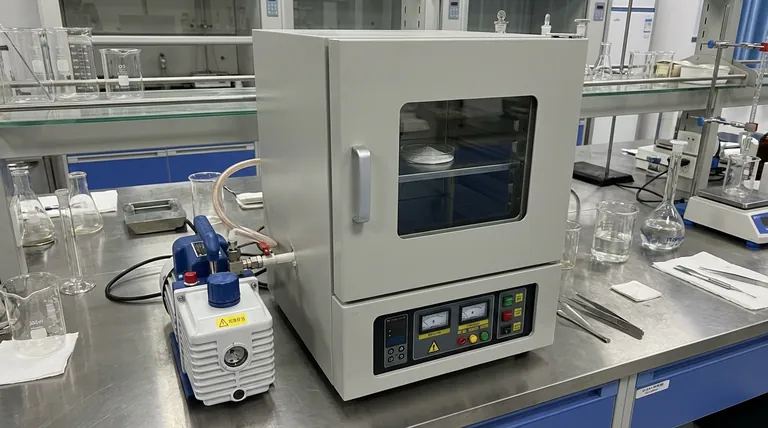
The primary role of a laboratory vacuum drying oven in treating filtered Y2O3-MgO precursors is to facilitate deep dehydration and solvent removal at a controlled, moderate temperature (typically 90 °C). This process ensures the precursor becomes chemically pure and physically stable by accelerating evaporation while simultaneously isolating the material from atmospheric contaminants and preventing high-temperature oxidation.
Core Takeaway: Vacuum drying is a dual-purpose step that prioritizes material integrity over simple moisture removal. By lowering the pressure, it allows for thorough drying at safer temperatures, ensuring the precursor remains free of oxidation and impurities prior to the critical calcination phase.
The Mechanism of Preservation and Drying
Lowering the Boiling Point
The fundamental advantage of a vacuum oven is its ability to alter the physical properties of the solvents within the precursor. By creating a low-pressure environment, the oven significantly lowers the boiling point of water and residual solvents.
This allows the Y2O3-MgO precursors to undergo rapid, thorough evaporation at a relatively low temperature (90 °C). You achieve the drying efficiency of a much hotter oven without exposing the delicate precursor to potentially damaging thermal stress.
Preventing High-Temperature Oxidation
Standard drying methods that rely on high heat in the presence of air can alter the chemical composition of the precursor.
The vacuum environment removes oxygen from the chamber, effectively preventing oxidation reactions that would otherwise occur at elevated temperatures. This ensures that the chemical structure of the Y2O3-MgO remains consistent and does not deteriorate before the next processing stage.
Isolation from Atmospheric Impurities
Filtered precursors are often sensitive to the environment. Drying in an open atmosphere or a standard convection oven exposes the wet material to airborne particulates and reactive gases.
A vacuum oven provides a sealed, isolated environment. This prevents the precursor from reacting with atmospheric impurities, ensuring the final dried product retains the high purity required for advanced material synthesis.
Preparation for Calcination
Ensuring Complete Solvent Removal
For Y2O3-MgO precursors, the drying step is the bridge between filtration and calcination.
The vacuum ensures that residual solvents are removed from deep within the material, not just the surface. This deep drying is critical because trapped moisture can cause structural failures, such as cracking or bursting, when the material is later subjected to the intense heat of calcination.
Minimizing Phase Changes
While the primary reference highlights oxidation, the gentle nature of vacuum drying also helps maintain the physical phase of the precursor.
By avoiding excessive heat, the process minimizes the risk of undesired phase changes or pre-mature sintering. This delivers a precursor in the optimal physical state for the specific thermal treatment that follows.
Understanding the Trade-offs
Process Duration vs. Intensity
While vacuum drying allows for lower temperatures, it is not instantaneous. The primary reference notes that this process occurs over "extended periods."
You are trading speed for quality. A standard blast oven might dry material faster through sheer thermal force, but it risks oxidizing the surface or trapping solvent inside a hardened crust (case hardening). Vacuum drying takes longer but ensures uniformity and purity.
Equipment Complexity
Unlike a standard oven, a vacuum drying setup requires a vacuum pump and a sealed chamber. This adds a layer of operational complexity, specifically regarding the maintenance of seals and pump oil to ensure a consistent vacuum level throughout the extended drying period.
Making the Right Choice for Your Goal
When treating Y2O3-MgO precursors, the drying method dictates the quality of the final ceramic or composite.
- If your primary focus is Chemical Purity: Rely on the vacuum oven to eliminate the risk of oxidation and atmospheric contamination that degrades the precursor's stoichiometry.
- If your primary focus is Structural Integrity: Use the vacuum setting to ensure deep solvent removal at 90 °C, preventing the structural damage caused by rapid boiling or trapped moisture during calcination.
The vacuum drying oven is not merely a heating device; it is a specialized tool for stabilizing sensitive chemical precursors in preparation for high-performance applications.
Summary Table:
| Feature | Role in Y2O3-MgO Treatment | Key Benefit |
|---|---|---|
| Low-Pressure Environment | Lowers boiling points of solvents | Thorough drying at safe 90 °C |
| Oxygen Removal | Prevents high-temperature oxidation | Maintains chemical stoichiometry |
| Sealed Chamber | Isolates from atmospheric contaminants | Ensures high material purity |
| Deep Dehydration | Removes moisture from deep within material | Prevents cracking during calcination |
Elevate Your Material Synthesis with KINTEK
Precision in drying is the foundation of high-performance ceramics. Backed by expert R&D and manufacturing, KINTEK offers specialized vacuum systems, Muffle, Tube, Rotary, and CVD furnaces—all customizable for your unique laboratory needs. Whether you are processing Y2O3-MgO precursors or advanced composites, our equipment ensures the chemical purity and structural integrity your research demands.
Ready to optimize your thermal processing? Contact our experts today to find the perfect drying solution for your lab.
References
- Quanqing Zhang, Nan Wu. Thermal Analysis Kinetics and Luminescence Properties of Y2O3-Coated MgO: Ce+3 Particles. DOI: 10.3390/coatings15020122
This article is also based on technical information from Kintek Furnace Knowledge Base .
Related Products
- Vacuum Heat Treat Sintering and Brazing Furnace
- Vacuum Heat Treat Sintering Furnace Molybdenum Wire Vacuum Sintering Furnace
- Dental Porcelain Zirconia Sintering Ceramic Vacuum Press Furnace
- Molybdenum Vacuum Heat Treat Furnace
- Vacuum Hot Press Furnace Machine Heated Vacuum Press
People Also Ask
- What is one of the most important uses of vacuum heat treating furnaces in aerospace? Achieve Superior Strength in Aircraft Alloys
- What are the benefits of using vacuum heat treating furnaces for metal alloys? Achieve Superior Metal Properties and Performance
- How does vacuum heat treating affect the grain structure of metal alloys? Achieve Precise Microstructure Control
- What is the temperature of a vacuum furnace brazing? Optimize Your Joint Strength and Cleanliness
- What are the steps involved in a typical vacuum brazing treatment? Master the Process for Strong, Clean Joints












