
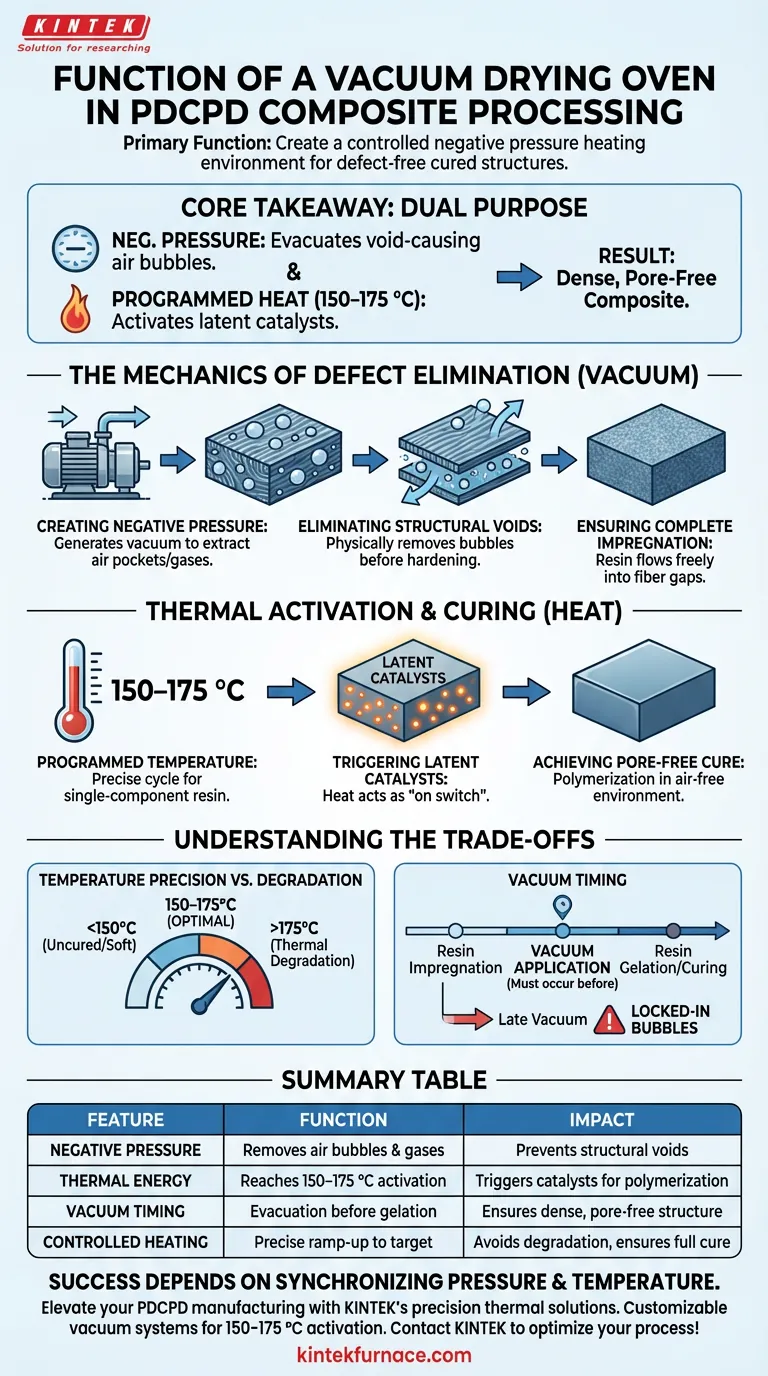
The primary function of a vacuum drying oven in processing poly(dicyclopentadiene) (PDCPD) composites is to create a controlled negative pressure heating environment that ensures a defect-free cured structure. Specifically, it eliminates air bubbles trapped during resin impregnation while simultaneously providing the thermal energy required to activate the resin's catalyst system.
Core Takeaway The vacuum drying oven serves a dual purpose: it utilizes negative pressure to evacuate void-causing air bubbles and applies programmed heat (typically 150–175 °C) to activate latent catalysts. This combination ensures the resin fully penetrates fiber gaps, resulting in a dense, pore-free composite.
The Mechanics of Defect Elimination
Creating a Negative Pressure Environment
The oven operates by generating a negative pressure atmosphere around the composite material.
This vacuum condition is essential for extracting air pockets and volatile gases that become trapped within the matrix during the resin impregnation process.
Eliminating Structural Voids
If these air bubbles are not removed, they result in voids within the final material.
By physically pulling these bubbles out of the resin before it hardens, the oven prevents the formation of structural weaknesses that would compromise the composite's integrity.
Ensuring Complete Impregnation
The removal of air creates space for the dicyclopentadiene monomer to flow freely.
This allows the resin to fully permeate the gaps between fibers, ensuring a consistent and solid internal structure.
Thermal Activation and Curing
Programmed Temperature Increases
The process relies on a precise thermal cycle, typically ranging from 150 °C to 175 °C.
This temperature range is not arbitrary; it is specifically calibrated to the chemistry of the single-component resin system used in these composites.
Triggering Latent Catalysts
The heat supplied by the oven serves as the "on switch" for latent catalysts mixed within the resin.
These catalysts remain inactive at lower temperatures, preventing premature curing and allowing time for the vacuum to do its work.
Achieving a Pore-Free Cure
Once activated by the heat, the catalyst initiates the polymerization of the dicyclopentadiene.
Because the vacuum has already removed the air, the resin cures into a pore-free structure, locking the dense, impregnated state into place permanently.
Understanding the Trade-offs
Temperature Precision vs. Degradation
While heat is necessary for activation, strict adherence to the 150 °C to 175 °C range is critical.
Deviating below this range may fail to activate the catalyst, leading to an uncured, soft part. Exceeding it could risk thermal degradation of the polymer matrix.
Vacuum Timing
The application of vacuum must coincide with the heating ramp before the resin gels.
If the resin cures (hardens) before the vacuum has fully evacuated the air, the bubbles will be locked in permanently, rendering the process ineffective.
Making the Right Choice for Your Goal
To maximize the quality of your poly(dicyclopentadiene) composites, focus on the synchronization of pressure and temperature.
- If your primary focus is structural integrity: Prioritize the vacuum cycle to ensure all air is evacuated before the peak temperature is reached to prevent voids.
- If your primary focus is process efficiency: Optimize the heating ramp rate to reach the activation window (150–175 °C) as quickly as possible without causing thermal shock.
Success depends on balancing negative pressure for void removal with precise heating for catalyst activation.
Summary Table:
| Feature | Function in PDCPD Processing | Impact on Final Material |
|---|---|---|
| Negative Pressure | Removes air bubbles and volatile gases | Prevents structural voids and weaknesses |
| Thermal Energy | Reaches 150–175 °C activation window | Triggers latent catalysts for polymerization |
| Vacuum Timing | Evacuation before resin gelation | Ensures a dense, pore-free internal structure |
| Controlled Heating | Precise ramp-up to target temperature | Avoids thermal degradation and ensures full cure |
Elevate your PDCPD composite manufacturing with KINTEK’s precision thermal solutions. Backed by expert R&D and manufacturing, KINTEK offers customizable Muffle, Tube, Rotary, and Vacuum systems designed to meet the rigorous 150–175 °C activation requirements for high-performance resins. Ensure structural integrity and eliminate defects with our industry-leading high-temp lab furnaces. Contact KINTEK today to optimize your curing process!
Visual Guide
References
- Benjamin R. Kordes, Michael R. Buchmeiser. Ring‐Opening Metathesis Polymerization‐Derived Poly(dicyclopentadiene)/Fiber Composites Using Latent Pre‐Catalysts. DOI: 10.1002/mame.202300367
This article is also based on technical information from Kintek Furnace Knowledge Base .
Related Products
- Vacuum Heat Treat Sintering and Brazing Furnace
- Vacuum Heat Treat Sintering Furnace Molybdenum Wire Vacuum Sintering Furnace
- Dental Porcelain Zirconia Sintering Ceramic Vacuum Press Furnace
- Vacuum Hot Press Furnace Machine for Lamination and Heating
- Vacuum Hot Press Furnace Machine Heated Vacuum Press
People Also Ask
- What are the benefits of using vacuum heat treating furnaces for metal alloys? Achieve Superior Metal Properties and Performance
- How does vacuum heat treating affect the grain structure of metal alloys? Achieve Precise Microstructure Control
- What is one of the most important uses of vacuum heat treating furnaces in aerospace? Achieve Superior Strength in Aircraft Alloys
- What is the temperature of a vacuum furnace brazing? Optimize Your Joint Strength and Cleanliness
- What are the steps involved in a typical vacuum brazing treatment? Master the Process for Strong, Clean Joints







