
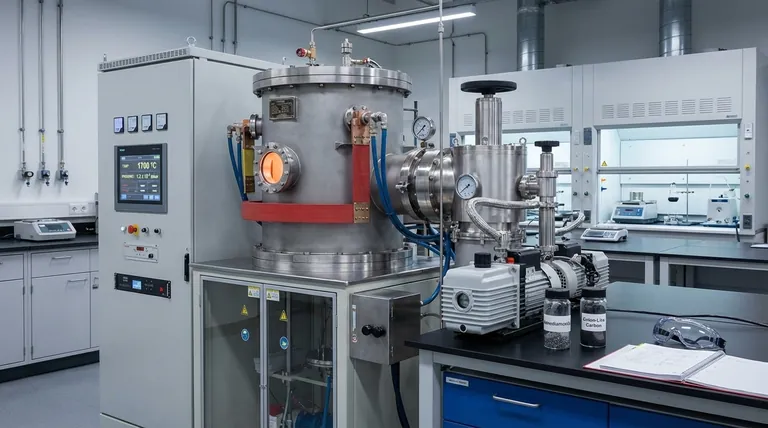
The high-temperature vacuum furnace serves as the primary catalyst for converting carbon nanodiamonds into onion-like carbon (OLC). It functions by creating a strictly controlled environment that combines extreme heat—specifically 1700 °C—with a deep vacuum pressure between 10⁻³ and 10⁻⁴ mbar. This unique combination of conditions forces the carbon nanodiamonds to undergo a physical phase transformation, reshaping their atomic structure into spherical, multi-layered nanoparticles.
Core Takeaway: The furnace does not merely heat the material; it provides an oxidation-free environment where nanodiamonds can be energetically reorganized. This allows for the precise creation of multi-layered fullerene structures (OLC) while strictly preserving material purity and structural integrity.
Creating the Conditions for Phase Change
To understand the role of the furnace, you must look at the specific physical requirements of transforming diamond structures into fullerene-like shells.
Reaching Activation Temperatures
The conversion process requires significant energy to break the existing atomic bonds of the nanodiamonds.
The furnace utilizes specialized heating elements to ramp the temperature up to 1700 °C. At this thermal threshold, the carbon atoms gain enough energy to rearrange themselves, transitioning from the diamond phase to the onion-like carbon phase.
The Critical Role of Vacuum Pressure
Heat alone is insufficient; the atmosphere is equally critical.
The furnace operates at high vacuum levels, specifically between 10⁻³ and 10⁻⁴ mbar. This removes oxygen and other atmospheric gases from the chamber. Without this vacuum, heating carbon to 1700 °C would simply cause it to burn or oxidize, destroying the material rather than transforming it.
Ensuring Material Integrity
Beyond simply enabling the reaction, the vacuum furnace determines the quality of the final output.
Formation of Multi-Layered Shells
The specific environment facilitates the orderly reorganization of carbon atoms.
Under these controlled conditions, the atoms reform into spherical nanoparticles characterized by concentric, multi-layered fullerene structures. This "onion-like" layering is the defining feature of OLC and requires stable thermal conditions to form correctly.
Maintaining High Purity
Contamination is a major risk in nanomaterial production.
By processing the material in a vacuum, the furnace prevents external contaminants from interacting with the carbon during the heating cycle. This ensures the final OLC product maintains high material purity, which is essential for its potential applications.
Operational Constraints and Trade-offs
While high-temperature vacuum furnaces are essential for this process, they introduce specific operational challenges that must be managed.
Precision vs. Throughput
Achieving high vacuum (10⁻⁴ mbar) and high temperature (1700 °C) simultaneously is a slow, energy-intensive process.
The requirement for such a strict environment means that batch cycles may be longer compared to atmospheric heating processes. Speed must often be sacrificed to ensure the vacuum integrity required for pure phase transformation.
Sensitivity to Atmosphere
The process is intolerant of leaks or pressure fluctuations.
Even minor deviations in vacuum pressure can introduce oxygen, compromising the structural integrity of the concentric layers. The equipment requires rigorous maintenance of seals and pumps to ensure the "onion" layers form without defects.
Making the Right Choice for Your Goal
When selecting or operating a furnace for OLC production, your specific end-goal should dictate your configuration.
- If your primary focus is Structural Perfection: Prioritize heating elements capable of maintaining a stable, uniform 1700 °C to ensure complete phase transformation of all nanodiamonds.
- If your primary focus is Material Purity: Prioritize vacuum systems capable of sustaining 10⁻⁴ mbar or better to eliminate any possibility of oxidation or contamination.
Success in OLC production relies on the furnace's ability to balance extreme thermal energy with absolute atmospheric isolation.
Summary Table:
| Feature | Requirement | Role in OLC Production |
|---|---|---|
| Temperature | 1700 °C | Provides energy to break diamond bonds and rearrange carbon atoms. |
| Vacuum Level | 10⁻³ to 10⁻⁴ mbar | Prevents oxidation and ensures high purity by removing atmospheric gases. |
| Transformation | Phase Change | Facilitates the physical shift from nanodiamonds to spherical, multi-layered shells. |
| Atmosphere | Oxygen-free | Protects the structural integrity of concentric fullerene layers during heating. |
Elevate Your Nanomaterial Research with KINTEK
Precise Onion-Like Carbon (OLC) production demands the perfect balance of extreme heat and deep vacuum. Backed by expert R&D and world-class manufacturing, KINTEK offers specialized Vacuum, Muffle, Tube, and CVD systems designed to maintain the stable 1700 °C environments and 10⁻⁴ mbar pressures your research requires. Our lab high-temperature furnaces are fully customizable to meet your unique material transformation needs, ensuring structural perfection and maximum purity for every batch.
Ready to optimize your carbon synthesis? Contact KINTEK today to discuss your custom furnace solution!
References
- Bruno Alderete, S. Suárez. Evaluating the effect of unidirectional loading on the piezoresistive characteristics of carbon nanoparticles. DOI: 10.1038/s41598-024-59673-5
This article is also based on technical information from Kintek Furnace Knowledge Base .
Related Products
- 2200 ℃ Tungsten Vacuum Heat Treat and Sintering Furnace
- 2200 ℃ Graphite Vacuum Heat Treat Furnace
- Molybdenum Vacuum Heat Treat Furnace
- 1400℃ Controlled Inert Nitrogen Atmosphere Furnace
- Vacuum Heat Treat Sintering Furnace Molybdenum Wire Vacuum Sintering Furnace
People Also Ask
- How does a tungsten-heated vacuum sintering furnace prepare (TbxY1-x)2O3 ceramics? Achieve 99%+ Density & Purity
- How do compaction pressure and vacuum sintering optimize porous ceramics? Maximize Density & Toughness
- What wear-resistance enhancements are achieved by powder coating? The Role of Vacuum Sintering Furnaces
- What role does a high-temperature vacuum sintering furnace play in the densification of WC-10(Ni, Ni/Co) alloys?
- What core role does a high-temperature vacuum sintering furnace play in Sm:YAG ceramics? Mastering Optical Clarity



















