
In the magnesium distillation process, the water-cooled lid and body of the vacuum furnace perform a critical dual function. They first protect the furnace's structural integrity from extreme heat and, most importantly, they act as the integrated condensation surface for collecting the final, high-purity magnesium.
The core principle is the creation of a deliberate and significant temperature differential within a single sealed environment. This allows magnesium to vaporize in a hot zone and then rapidly solidify (desublimate) onto the intentionally cooled internal surfaces, combining the purification and collection steps into one highly efficient process.
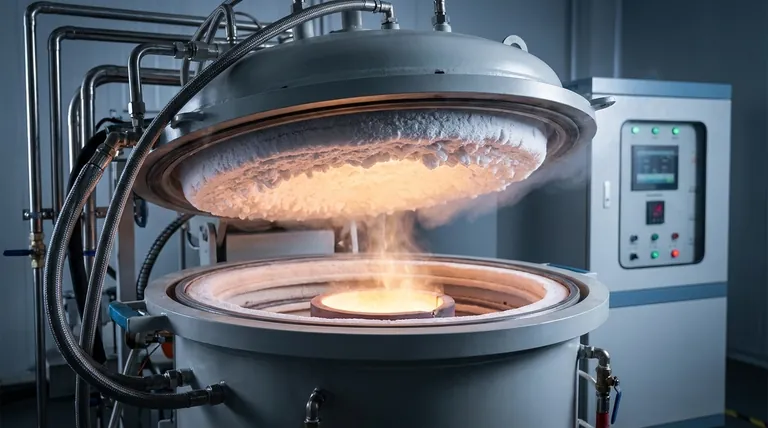
The Core Principle: A Controlled Temperature Gradient
To understand the function of the cooling system, you must first understand the process it enables. The entire operation relies on creating two distinct temperature zones within the same vacuum chamber.
The Hot Zone: Vaporization
The process begins in a crucible at the bottom of the furnace, which is heated to a high temperature under vacuum. This heat causes the crude magnesium to evaporate, turning into a vapor and leaving heavier impurities behind.
The Cold Zone: Condensation and Collection
As this hot, pure magnesium vapor rises, it contacts the much colder internal surfaces of the furnace lid and upper body. These surfaces are actively cooled by a circulating water system.
The Physics of Desublimation
Because the temperature of the cooled surfaces is well below the freezing point of magnesium, the vapor does not turn back into a liquid. Instead, it undergoes desublimation—transforming directly from a gas to a solid. This results in the formation of solid, refined magnesium crystals on the cooled surfaces.
Why This Integrated Design is Essential
The choice to integrate the condenser directly into the furnace body is not arbitrary; it is central to the efficiency and success of the process.
Maximizing Purity and Yield
By keeping the entire process within a single, sealed vacuum chamber, the risk of the pure magnesium vapor becoming contaminated by atmospheric gases is eliminated. This design also ensures that virtually all the vapor is collected, maximizing the final product yield.
Enhancing Process Efficiency
Combining the evaporation and condensation stages into one piece of equipment streamlines the entire workflow. It removes the need for a separate condenser unit and complex piping, simplifying the operation and reducing potential points of failure.
Ensuring Structural Integrity and Longevity
Beyond its role in condensation, the water cooling system serves a fundamental purpose common to all vacuum furnaces. It actively removes waste heat from the furnace shell, preventing it from overheating, warping, or failing under the intense thermal load, thereby ensuring the equipment's long service life.
Understanding the Operational Trade-offs
While effective, this process requires precise control. Mismanagement of the cooling system can lead to significant problems.
The Need for Precise Temperature Control
The efficiency of condensation is directly tied to the surface temperature of the lid and body. If the cooling is insufficient, condensation will be incomplete, reducing yield. The water cooling system must be correctly sized for the furnace to manage the heat load effectively.
The Risk of Thermal Stress
The large temperature difference between the hot crucible area and the cold condensation zone can induce thermal stress on the furnace components. Proper furnace design and controlled cooling rates are essential to prevent material fatigue or the formation of cracks over time.
The Importance of Vacuum Purity
The entire process depends on a clean, deep vacuum. Any leaks or outgassing from internal components can introduce contaminants that react with the highly reactive magnesium vapor, compromising the purity of the final product.
Making the Right Choice for Your Goal
Optimizing the magnesium distillation process requires balancing different priorities, all of which hinge on the proper function of the water cooling system.
- If your primary focus is maximizing purity: Ensure a deep, clean vacuum and maintain a sufficiently low temperature on the condensation surfaces to promote efficient and complete desublimation.
- If your primary focus is process throughput: Verify that the water cooling system is correctly sized and operating at full capacity to remove heat quickly, allowing for shorter and more consistent cycle times.
- If your primary focus is equipment longevity: Implement a strict maintenance schedule for the cooling system to prevent blockages or failures that could lead to catastrophic overheating of the furnace shell.
Ultimately, mastering the function of the water-cooled surfaces is the key to controlling the final quality, yield, and safety of the entire magnesium refinement process.
Summary Table:
| Function | Purpose | Key Benefit |
|---|---|---|
| Heat Protection | Cools furnace shell | Prevents structural damage from extreme heat |
| Condensation Surface | Provides a cold zone for vapor | Enables direct gas-to-solid desublimation of pure Mg |
| Process Integration | Combines evaporation and collection | Maximizes yield and purity in a single chamber |
| Efficiency | Creates necessary temperature gradient | Streamlines the entire distillation workflow |
Optimize Your High-Temperature Processes with KINTEK
Mastering precise thermal management, like the critical cooling in magnesium distillation, is essential for purity, yield, and safety. Backed by expert R&D and manufacturing, KINTEK offers Muffle, Tube, Rotary, Vacuum, and CVD systems, and other lab high-temp furnaces, all customizable for unique needs.
Let us help you achieve superior results. Contact our experts today to discuss how our robust and reliable furnace solutions can enhance your specific application.
Visual Guide

Related Products
- Vacuum Hot Press Furnace Machine Heated Vacuum Press Tube Furnace
- Vacuum Hot Press Furnace Machine Heated Vacuum Press
- 2200 ℃ Tungsten Vacuum Heat Treat and Sintering Furnace
- 600T Vacuum Induction Hot Press Vacuum Heat Treat and Sintering Furnace
- Vacuum Heat Treat Sintering Furnace with Pressure for Vacuum Sintering
People Also Ask
- Why use Vacuum Hot Press (VHP) for ZnS Ceramics? Achieve Superior IR Transparency and Mechanical Strength
- What are the benefits of the vacuum environment system in a vacuum hot press furnace? Unlock High-Density Sintering
- What safety features are incorporated in vacuum hot press furnaces? Ensure Operator and Equipment Protection
- What considerations guide the selection of heating elements and pressurization methods for a vacuum hot press furnace?
- How does the uniaxial pressure applied by a vacuum hot press furnace affect the microstructure of ZrC-SiC materials?



















