
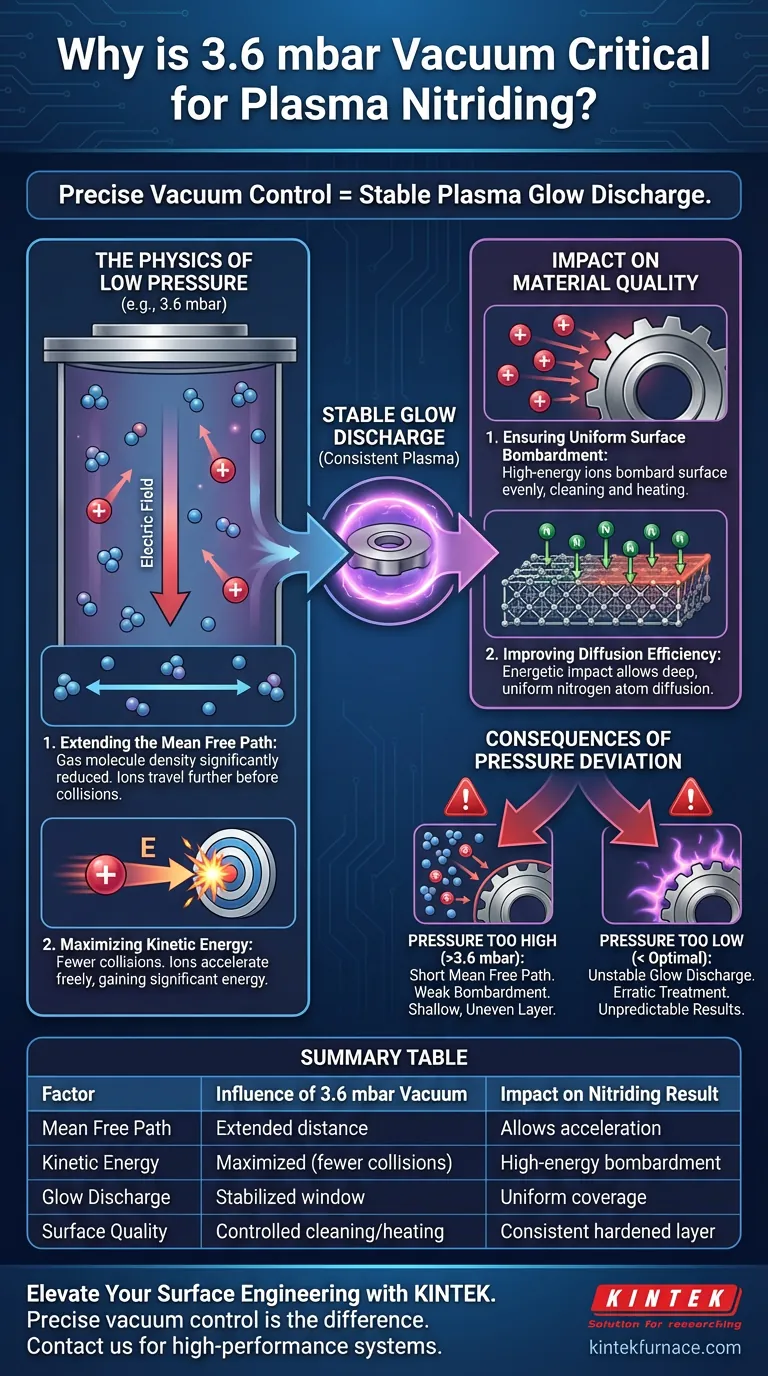
Precise vacuum control is the fundamental enabler of the plasma nitriding process. A specific low pressure, such as 3.6 mbar, is required to maintain a stable plasma glow discharge. This specific environment allows gas ions to gain the necessary speed and energy to bombard the workpiece effectively, which is impossible at higher pressures.
The specific vacuum level extends the "mean free path" of gas molecules, allowing ions to accelerate to high kinetic energies. This energy is critical for ensuring nitrogen atoms penetrate the material surface uniformly and efficiently.
The Physics of Low Pressure
Extending the Mean Free Path
To understand why 3.6 mbar is critical, you must understand the behavior of gas molecules. At this specific low pressure, the density of gas molecules in the chamber is significantly reduced.
This reduction increases the "mean free path"—the average distance a molecule travels before colliding with another. By clearing the path, ions encounter fewer obstacles as they move through the vacuum chamber.
Maximizing Kinetic Energy
Because the ions collide with fewer gas molecules, they are not slowed down by resistance. Under the influence of the electric field, these positive ions can accelerate freely.
This allows them to gain significant kinetic energy. If the pressure were higher, frequent collisions would dissipate this energy, rendering the ions too weak to effectively interact with the workpiece.
Impact on Material Quality
Facilitating Stable Glow Discharge
A specific pressure window is required to ignite and sustain a stable glow discharge. This discharge is the visible manifestation of the plasma state.
Maintaining 3.6 mbar ensures the plasma remains consistent and covers the workpiece evenly. Without this stability, the treatment becomes erratic, leading to unpredictable results.
Ensuring Uniform Surface Bombardment
The high-energy ions created by this low-pressure environment bombard the surface of the workpiece with significant force. This bombardment is the mechanism that cleans the surface and heats it locally.
More importantly, this energetic impact is what allows nitrogen atoms to diffuse into the material's lattice. The uniformity of this bombardment directly correlates to the uniformity of the final hardened layer.
Improving Diffusion Efficiency
The ultimate goal of plasma nitriding is to diffuse nitrogen into the metal to harden it. The conditions created by the 3.6 mbar vacuum significantly improve this diffusion efficiency.
By ensuring ions hit the surface with the right energy, the process maximizes the depth and quality of the nitrided layer.
Understanding the Constraints
The Consequence of Pressure Deviation
The requirement for a "specific" pressure indicates that this is a precise operating window, not a general suggestion.
If the pressure rises significantly above 3.6 mbar, the mean free path shortens. Ions lose energy to collisions, resulting in weak bombardment and a shallow, uneven nitriding layer. Conversely, deviating too far below the optimal range can destabilize the glow discharge entirely.
Making the Right Choice for Your Goal
If your primary focus is Layer Uniformity: Maintain strict adherence to the 3.6 mbar setpoint to ensure the plasma glow surrounds complex geometries evenly.
If your primary focus is Process Efficiency: Monitor vacuum stability to maximize the kinetic energy of ions, ensuring the fastest possible nitrogen diffusion rates.
Control the pressure, and you control the energy that transforms your material.
Summary Table:
| Factor | Influence of 3.6 mbar Vacuum | Impact on Nitriding Result |
|---|---|---|
| Mean Free Path | Significantly extended distance between molecules | Allows ions to accelerate without interference |
| Kinetic Energy | Maximized due to fewer particle collisions | High-energy bombardment for deep nitrogen diffusion |
| Glow Discharge | Stabilized within a precise pressure window | Ensures uniform plasma coverage over complex parts |
| Surface Quality | Controlled ion bombardment cleaning/heating | Creates a consistent, high-quality hardened layer |
Elevate Your Surface Engineering with KINTEK
Precise vacuum control is the difference between a failed run and a superior hardened product. Backed by expert R&D and manufacturing, KINTEK offers high-performance vacuum systems, including CVD, Muffle, and customizable high-temperature furnaces designed to meet the rigorous demands of plasma nitriding and heat treatment.
Whether you need to maintain a strict 3.6 mbar environment or require a custom solution for complex geometries, our systems provide the stability and reliability your lab needs. Contact KINTEK today to discuss your vacuum furnace requirements and see how our expertise can optimize your material diffusion efficiency.
Visual Guide
References
- Magdalena Mokrzycka, Maciej Pytel. The influence of plasma nitriding process conditions on the microstructure of coatings obtained on the substrate of selected tool steels. DOI: 10.7862/rm.2024.1
This article is also based on technical information from Kintek Furnace Knowledge Base .
Related Products
- Vacuum Hot Press Furnace Machine Heated Vacuum Press Tube Furnace
- Vacuum Hot Press Furnace Machine Heated Vacuum Press
- 600T Vacuum Induction Hot Press Vacuum Heat Treat and Sintering Furnace
- 2200 ℃ Tungsten Vacuum Heat Treat and Sintering Furnace
- Vacuum Heat Treat Sintering Furnace with Pressure for Vacuum Sintering
People Also Ask
- Why use Vacuum Hot Press (VHP) for ZnS Ceramics? Achieve Superior IR Transparency and Mechanical Strength
- What are the benefits of the vacuum environment system in a vacuum hot press furnace? Unlock High-Density Sintering
- What safety features are incorporated in vacuum hot press furnaces? Ensure Operator and Equipment Protection
- What is a vacuum hot press furnace? Unlock Superior Material Performance
- What control features does a vacuum hot press furnace offer? Precision Control for Advanced Materials Processing



















