A rapid vacuum chamber serves as a precision synchronization tool. By reducing environmental pressure from atmospheric levels to a low-pressure state (such as 0.133 kPa) in approximately one second, it eliminates the variable lag time associated with standard depressurization. This near-instantaneous shift is critical for establishing an exact starting point ($t=0$) to accurately measure the reaction kinetics of volatile elements.
Accurate measurement of initial evaporation rates relies on defining a precise start time. The rapid vacuum chamber minimizes depressurization time to ensure that data collection begins exactly when the target vacuum conditions are met.
The Challenge of Volatility Measurement
The Problem with Slow Depressurization
In standard vacuum systems, reaching the target pressure is often a gradual process. For highly volatile elements, significant evaporation can occur during this "pump-down" phase before the target vacuum is reached. This uncontrolled evaporation creates a data blind spot, making it difficult to quantify how much material is lost before the official measurement begins.
Defining the Reaction Start Time ($t=0$)
To calculate an accurate rate, you must know exactly when the reaction environment was established. If pressure drops slowly, the "start" becomes a blurry window rather than a specific moment. A rapid vacuum chamber solves this by compressing that transition window into a negligible timeframe.
Mechanics of the Rapid Chamber
Achieving Near-Instantaneous Vacuum
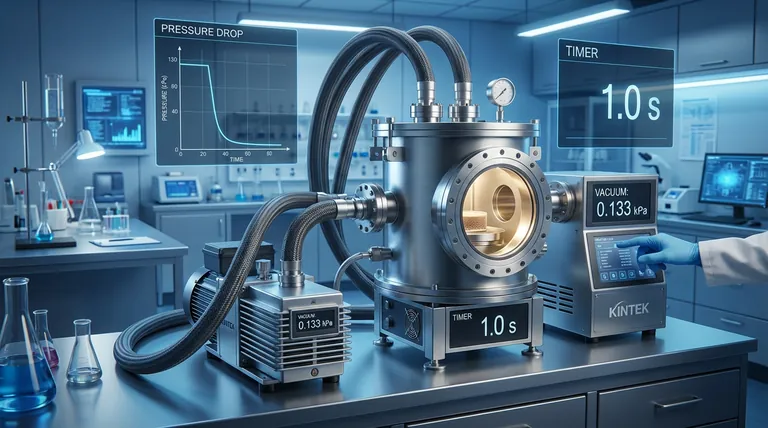
The defining characteristic of this chamber is its decompression speed. It is capable of dropping pressure from atmospheric levels to 0.133 kPa in approximately one second. This speed effectively renders the transition time irrelevant to the overall duration of the experiment.
Pneumatic Control Integration
Achieving this speed requires precise mechanical actuation. The system relies on pneumatic valves to control the reaction environment. These valves allow for the rapid opening and sealing necessary to achieve the sudden pressure drop without mechanical failure.
Operational Prerequisites
System Integration Requirements
A rapid vacuum chamber is not a standalone passive vessel; it functions as an integrated part of a reaction system. It requires a synchronized control loop using pneumatic valves to manage the decompression shock. Without this specialized integration, the 1-second decompression target cannot be consistently or safely achieved.
Making the Right Choice for Your Goal
When configuring your experimental setup for volatile elements, consider your specific analytical needs:
- If your primary focus is Initial Rate Calculation: You must use a rapid vacuum chamber to establish a valid $t=0$ point and prevent data corruption from pre-vacuum evaporation.
- If your primary focus is System Design: Prioritize the integration of high-response pneumatic valves to handle the mechanical demands of near-instantaneous decompression.
Precision in timing is just as critical as precision in pressure control.
Summary Table:
| Feature | Standard Vacuum Chamber | Rapid Vacuum Chamber |
|---|---|---|
| Depressurization Time | Gradual (Minutes) | ~1 Second |
| Starting Point (t=0) | Vague/Blurry | Precise & Defined |
| Pre-test Evaporation | High/Uncontrolled | Negligible |
| Control Mechanism | Manual/Standard Valves | Integrated Pneumatic Valves |
| Primary Application | General Heat Treatment | Volatile Reaction Kinetics |
Optimize Your Volatile Element Analysis with KINTEK
Don't let slow depressurization compromise your data accuracy. KINTEK provides high-precision laboratory solutions backed by expert R&D and manufacturing. Our customizable systems, including Vacuum, CVD, Muffle, Tube, and Rotary furnaces, are designed to meet your unique experimental needs with unmatched reliability.
Whether you require rapid decompression for kinetic studies or a specialized thermal environment, our team is ready to help you build the perfect setup. Contact KINTEK today to discuss your project requirements!
References
- Hyunjae Kim, Youn‐Bae Kang. Evaporation of Sn from Molten Fe–C–S Alloy Under Reduced Pressure at 1650 $$^\circ $$C for Developing Sustainable Ferrous Scrap Recycling Process. DOI: 10.1007/s11663-025-03579-8
This article is also based on technical information from Kintek Furnace Knowledge Base .
Related Products
- Split Chamber CVD Tube Furnace with Vacuum Station CVD Machine
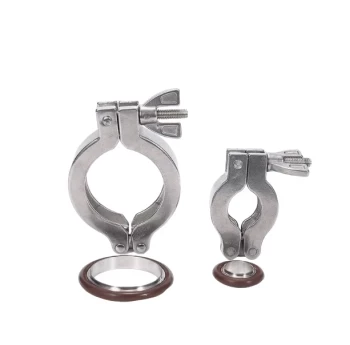
- Stainless Steel Quick Release Vacuum Chain Three Section Clamp
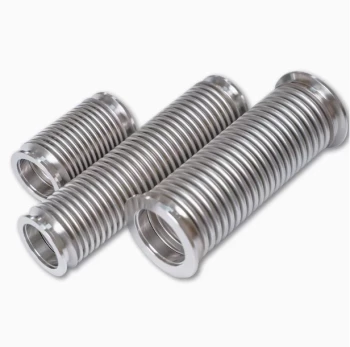
- High Performance Vacuum Bellows for Efficient Connection and Stable Vacuum in Systems
People Also Ask
- What role does a Tube Furnace play in the CVD growth of carbon nanotubes? Achieve High-Purity CNT Synthesis
- What are the operational and maintenance requirements for a CVD tube furnace? Ensure Precision for Thin Film Deposition
- What are the advantages of using a CVD tube furnace for preparing gate dielectrics? Achieve High-Quality Thin Films for Transistors
- How does a CVD tube furnace achieve high purity in gate media preparation? Master Precision Control for Flawless Films
- Why are CVD tube furnace sintering systems indispensable for 2D material research and production? Unlock Atomic-Scale Precision