
The high-temperature muffle furnace acts as the definitive isolation chamber for inorganic analysis. Specifically for agricultural by-products, it incinerates samples at a strictly controlled temperature of 550°C to ensure the total oxidation of all organic matter. This rigorous thermal treatment leaves behind only the mineral residues, allowing for the precise calculation of the material's ash content and mineral density.
By maintaining a stable 550°C environment, the furnace eliminates organic interference, isolating the non-combustible mineral components required for accurate density measurement.
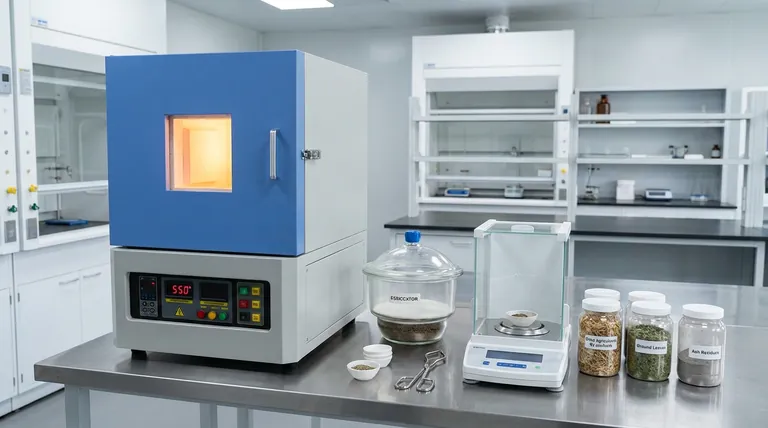
The Mechanism of Ash Determination
Controlled Thermal Oxidation
The primary function of the muffle furnace is to provide an environment of intense, constant heat.
For agricultural by-products, the target temperature is precisely 550°C.
At this temperature, the furnace drives the oxidation process, forcing organic compounds to decompose and burn off.
Isolating Inorganic Residues
The ultimate goal of this heating process is separation.
Agricultural samples consist of both organic matter (carbon-based) and inorganic matter (minerals).
The furnace effectively removes the organic structure, leaving only ash—the inorganic mineral residue—behind.
Measuring Mineral Density
Once the organic matter is removed, the remaining ash represents the sample's purity and mineral composition.
This residue allows researchers to quantify the mineral density of the agricultural by-product.
This metric is essential for understanding the quality and elemental makeup of the material.
Understanding the Constraints
The Importance of Temperature Specificity
While other materials require different temperatures (e.g., asphalt at 775°C or mushrooms at 600°C), agricultural by-products rely on the 550°C standard.
Deviating from this temperature can compromise the data.
Risks of Improper Heating
If the temperature is too low, incomplete oxidation occurs.
This leaves organic carbon in the sample, artificially inflating the weight of the ash and skewing the results.
Conversely, uncontrolled fluctuations can lead to inconsistent data regarding mineral density.
Ensuring Analytical Precision
To leverage a muffle furnace effectively for agricultural analysis, focus on the specific parameters of your protocol.
- If your primary focus is process accuracy: Ensure your furnace is calibrated to maintain exactly 550°C to guarantee complete oxidation of organic matter.
- If your primary focus is material characterization: Use the resulting ash weight to calculate precise mineral density, which serves as a proxy for the material's inorganic quality.
Precision in thermal application is the only way to transform a raw biological sample into actionable chemical data.
Summary Table:
| Parameter | Standard Requirement | Purpose in Analysis |
|---|---|---|
| Target Temperature | 550°C | Ensures complete oxidation of organic matter |
| Primary Process | Thermal Oxidation | Decomposes carbon-based compounds into gases |
| Final Residue | Inorganic Ash | Allows for mineral density calculation |
| Key Constraint | Temperature Precision | Prevents incomplete oxidation or data skewing |
Elevate Your Analytical Precision with KINTEK
Precise ash determination starts with uncompromising temperature control. KINTEK provides industry-leading high-temperature solutions, including Muffle, Tube, and Vacuum furnaces, specifically engineered for rigorous lab environments. Backed by expert R&D and manufacturing, our systems are fully customizable to meet the specific 550°C standards required for agricultural by-product analysis or any unique thermal protocol.
Ready to optimize your material characterization? Contact our specialists today to discover how KINTEK’s advanced heating technology can ensure the accuracy of your mineral density and purity data.
References
- Valorization of fruit byproducts: Proximate analysis, functional characteristics and antioxidant activity of beetroot, chestnut peel and bael pulp. DOI: 10.22271/phyto.2025.v14.i4d.15473
This article is also based on technical information from Kintek Furnace Knowledge Base .
Related Products
- 1700℃ High Temperature Muffle Oven Furnace for Laboratory
- 1800℃ High Temperature Muffle Oven Furnace for Laboratory
- 1200℃ Muffle Oven Furnace for Laboratory
- 1400℃ Muffle Oven Furnace for Laboratory
- Laboratory Muffle Oven Furnace with Bottom Lifting
People Also Ask
- What is the primary function of a high-temperature laboratory muffle furnace in chemical synthesis? Achieve Precision.
- How does a high-temperature laboratory muffle furnace affect material properties? Transform Anodic Oxide Films Fast
- What role does a muffle furnace play in BCZY712 electrolyte powder production? Achieve Perfect Phase Purity
- How does a muffle furnace impact Ni/MgAl2O4 catalysts? Optimize Stability and Catalytic Performance
- What is the role of a high-temperature muffle furnace in guava leaf carbonization? Master Precise Pyrolysis Control


















