
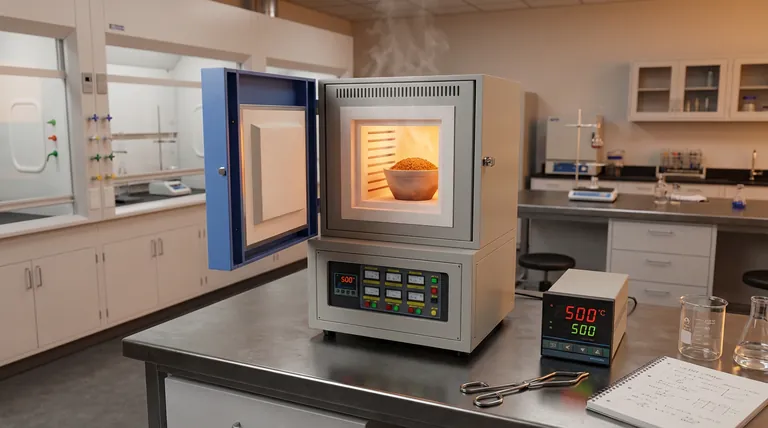
Secondary calcination functions as a thermal reset for Calcined Layered Double Hydroxide (CLDH) clay. By heating the saturated material to 500 °C in a laboratory high-temperature furnace, the process achieves two critical goals: it physically eliminates organic pollutants via combustion and chemically reactivates the clay. This triggers a specific structural restoration known as the "memory effect," which returns the adsorbent to a usable state.
Thermal regeneration transforms saturated waste back into a functional resource by leveraging the material's "memory effect" to restore its original structure. This process is essential for maintaining high adsorption efficiency across multiple usage cycles in wastewater treatment.
The Mechanics of Thermal Regeneration
Eliminating Adsorbed Contaminants
The primary function of the high-temperature furnace is the thermal destruction of pollutants.
When the clay is saturated, its pores and active sites are clogged with organic compounds collected during water treatment.
Subjecting the clay to 500 °C burns off these organic adsorbates, effectively clearing the physical blockages that prevent further adsorption.
Triggering the Memory Effect
Beyond simple cleaning, the heat treatment activates a unique property of CLDH clay called the "memory effect."
This phenomenon allows the material to reconstruct its original layered structure after being calcined.
By triggering this effect, the furnace ensures the clay does not just return to a clean state, but to a structurally active state capable of ion exchange.
Restoring Adsorption Efficiency
The combination of pollutant removal and structural reconstruction results in fully regenerated material.
The clay regains its capacity to bind contaminants, often performing with high efficiency comparable to fresh material.
This restoration enables the adsorbent to be reused for multiple cycles, significantly extending its operational lifespan.
Understanding the Trade-offs
Energy Consumption vs. Material Reuse
While regeneration reduces solid waste, it requires significant energy input to maintain a furnace at 500 °C.
Operators must balance the cost of electricity or fuel for the furnace against the cost of purchasing raw clay materials.
Structural Fatigue Over Time
The reference notes that the material maintains efficiency over "multiple cycles," implying it is not infinite.
Repeated thermal stress may eventually degrade the material's structure, reducing the efficacy of the memory effect over time.
Optimizing the Regeneration Process
To maximize the utility of CLDH clay in wastewater treatment, consider your specific operational goals.
- If your primary focus is cost-efficiency: Calculate the break-even point where the energy cost of heating to 500 °C exceeds the cost of acquiring new adsorbent material.
- If your primary focus is sustainability: Prioritize the regeneration cycle to minimize the volume of spent clay sent to landfills, even if energy costs are marginally higher.
By controlling the thermal environment, you turn a single-use waste product into a sustainable, multi-cycle asset.
Summary Table:
| Process Phase | Action in Furnace | Outcome for CLDH Clay |
|---|---|---|
| Contaminant Removal | Heating to 500 °C | Combustion of organic pollutants and pore clearing |
| Structural Activation | Thermal Reset | Triggers 'Memory Effect' for structural restoration |
| Efficiency Recovery | Controlled Cooling | Restores ion-exchange capacity for multiple reuse cycles |
Maximize Your Material Lifecycle with KINTEK Precision
Is your lab looking to reduce waste and optimize material regeneration? Backed by expert R&D and manufacturing, KINTEK offers high-performance Muffle, Tube, Rotary, and Vacuum systems specifically designed to handle the rigorous 500 °C requirements for CLDH clay reactivation and other advanced thermal processes.
Whether you need a standard solution or a system customized for your unique research needs, our laboratory high-temp furnaces provide the uniform heating and precise control necessary to harness the 'memory effect' and maintain high adsorption efficiency.
Ready to enhance your lab's sustainability and efficiency? Contact us today to find the perfect furnace solution for your application.
References
- Lehlogonolo Tabana, Shepherd M. Tichapondwa. Integrated study of antiretroviral drug adsorption onto calcined layered double hydroxide clay: experimental and computational analysis. DOI: 10.1007/s11356-024-33406-7
This article is also based on technical information from Kintek Furnace Knowledge Base .
Related Products
- 1200℃ Muffle Oven Furnace for Laboratory
- High Temperature Muffle Oven Furnace for Laboratory Debinding and Pre Sintering
- 1800℃ High Temperature Muffle Oven Furnace for Laboratory
- 1700℃ High Temperature Muffle Oven Furnace for Laboratory
- 1400℃ High Temperature Laboratory Tube Furnace with Alumina Tube
People Also Ask
- How does a high-temperature laboratory muffle furnace affect material properties? Transform Anodic Oxide Films Fast
- What is the primary function of a high-temperature laboratory muffle furnace in chemical synthesis? Achieve Precision.
- How is a laboratory muffle furnace used in 3D-printed PP-CF cross-linking? Achieve Thermal Stability at 150 °C
- What is the role of a laboratory high-temperature muffle furnace in iron analysis? Key to Precise Sample Mineralization
- What is the critical role of a laboratory high-temperature muffle furnace in TiO2/LDH? Unlock Superior Crystallization



















