
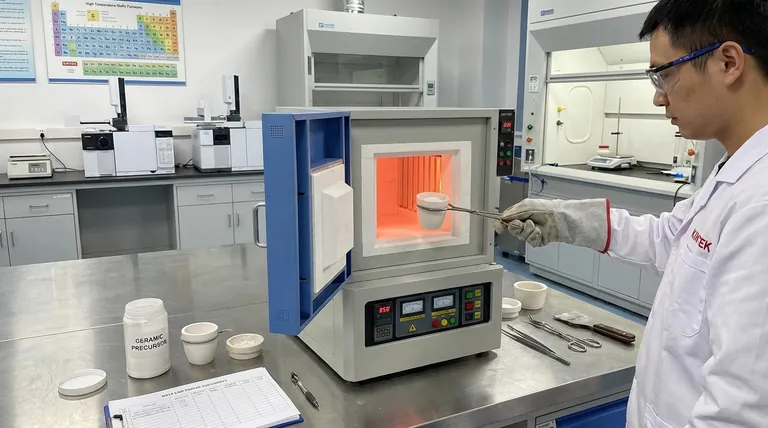
A high-precision high-temperature muffle furnace serves as the critical thermal reactor for the chemical and structural evolution of ceramic powders. By providing a stable and uniform thermal field, it facilitates solid-phase reactions, drives the decomposition of volatile components like carbonates or organic binders, and initiates the formation of the target crystal phase. This foundational step ensures that the resulting powder is chemically pure and structurally prepared, directly reducing volume shrinkage and internal stress during the final sintering process.
The muffle furnace acts as a controlled environment that transforms raw precursors into stable, crystalline powders. Its primary role is to ensure chemical homogeneity and phase stability, which are the prerequisites for achieving high-density, crack-free ceramic components.
Driving Chemical and Phase Transformations
Initiating Solid-Phase Reactions
The muffle furnace provides the precise thermal energy required to trigger solid-state reactions between constituent oxides. At specific temperature thresholds—often between 750°C and 900°C—raw materials begin to interact at the molecular level to form complex structures, such as the perovskite phase in PZT ceramics.
Facilitating Phase Transformation and Nucleation
A stable thermal environment allows for the complete nucleation and growth of desired crystalline phases. By maintaining constant temperatures for extended periods (sometimes up to 10 hours), the furnace ensures that the powder transitions from a disordered precursor into a highly crystalline oxide phase.
Controlling Grain Growth and Morphology
Through superior temperature control precision, the furnace regulates grain boundary migration rates. This control allows engineers to influence the physical evolution of particles, ensuring they achieve specific sizes—often less than 1 micrometer—and shapes required for optimal densification.
Purification and Volatile Management
Complete Decomposition of Precursors
High temperatures within the furnace drive the thermal decomposition of precipitates, such as oxalates or carbonates. This process forces the escape of volatile components, ensuring that the remaining material is a high-purity oxide powder free from residual gases that could cause defects.
Execution of Complex Debinding Programs
Modern high-precision furnaces are capable of running complex debinding programs that can last up to 48 hours. By configuring precise heating rates and isothermal holds (e.g., at 150°C or 410°C), the furnace ensures the slow and uniform discharge of organic surfactants and solvents without compromising the structure of the powder.
Elimination of Internal Impurities
The continuous air environment provided by the furnace facilitates the thermal oxidation of residual organic components. This process is essential for removing surfactants like oleylamine, ensuring that the final powder is chemically clean and ready for industrial application.
Enhancing Structural Integrity and Performance
Reducing Volume Shrinkage
By completing the majority of chemical reactions and phase changes during the pre-calcination stage, the furnace significantly reduces volume shrinkage during final sintering. This "pre-shrinking" of the powder is vital for maintaining the dimensional accuracy of the finished ceramic part.
Minimizing Internal Stress and Cracking
Precise temperature regulation minimizes thermal gradients within the material. This uniformity prevents the buildup of internal stresses that typically lead to cracks or delamination, particularly in large-scale or thick-walled ceramic structures.
Improving Final Material Density
A well-calcined powder, produced in a uniform thermal field, leads to higher mechanical strength and a superior microstructure. By inhibiting abnormal grain growth during the early stages, the muffle furnace sets the stage for a fully densified finished product.
Understanding the Trade-offs
Precision versus Throughput
While high-precision furnaces offer unmatched control, they often require slower heating rates (e.g., 5°C per minute) and long holding times to ensure uniformity. This focus on quality can limit the volume of material processed compared to less precise industrial kilns, creating a trade-off between material excellence and production speed.
Energy Consumption and Insulation
Maintaining high temperatures for 24 to 48 hours is energy-intensive. While high-quality glass wool insulation and muffle designs help retain heat, the operational costs of maintaining such a precise environment must be balanced against the performance requirements of the final ceramic.
Atmospheric Limitations
Standard muffle furnaces operate in an air atmosphere, which is ideal for oxidation but may not be suitable for powders requiring inert or reducing environments. Using the wrong atmospheric setting during pre-calcination can result in incomplete phase transformation or unwanted oxidation states in the metal ions.
How to Apply This to Your Project
Choosing the Right Approach
- If your primary focus is high chemical purity: Prioritize a furnace with excellent airflow and long isothermal hold capabilities to ensure the complete removal of organic surfactants.
- If your primary focus is dimensional stability: Focus on a furnace with the highest thermal field uniformity to ensure that all powder particles undergo consistent volume shrinkage.
- If your primary focus is microstructure control: Invest in a system with programmable heating curves to precisely manage grain boundary migration and inhibit abnormal grain growth.
The high-precision muffle furnace is not merely a heating tool, but the definitive instrument for engineering the fundamental chemical and structural properties of advanced ceramics.
Summary Table:
| Feature | Role in Pre-Calcination | Impact on Ceramic Quality |
|---|---|---|
| Precise Thermal Energy | Triggers solid-phase reactions (750°C - 900°C) | Ensures target crystal phase formation (e.g., Perovskite) |
| Phase Nucleation Control | Maintains stable isothermal holds | Achieves high crystallinity and phase homogeneity |
| Volatile Decomposition | Drives out carbonates, oxalates, and binders | Produces high-purity oxide powders without gas defects |
| Grain Growth Regulation | Controls grain boundary migration rates | Influences particle size (≤1 μm) and morphology |
| Pre-Shrinkage Treatment | Completes chemical evolution before sintering | Reduces volume shrinkage and prevents cracking |
Elevate Your Material Research with KINTEK Precision Solutions
Don't settle for inconsistent results in your pre-calcination process. KINTEK provides high-precision Muffle, Tube, Rotary, Vacuum, and CVD systems specifically engineered to meet the rigorous demands of advanced ceramic manufacturing.
Why choose KINTEK?
- Expert R&D & Manufacturing: Our furnaces are designed for ultimate thermal field uniformity, ensuring every batch meets your exact purity and crystallinity specs.
- Fully Customizable: Whether you need complex debinding programs or specific atmospheric controls, we tailor our high-temp systems to your unique research needs.
- Enhanced Structural Integrity: Our technology helps you minimize internal stress and maximize mechanical strength in your finished components.
Contact our technical specialists today to discuss your project!" )"
References
- Beatriz Monteiro, Sónia Simões. Microstructure and Mechanical Properties of Ti6Al4V to Al2O3 Brazed Joints Using Ti-Ag/Cu-Ti Thin Films. DOI: 10.3390/met14020146
This article is also based on technical information from Kintek Furnace Knowledge Base .
Related Products
- 1700℃ High Temperature Muffle Oven Furnace for Laboratory
- 1800℃ High Temperature Muffle Oven Furnace for Laboratory
- 1200℃ Muffle Oven Furnace for Laboratory
- 1400℃ Muffle Oven Furnace for Laboratory
- High Temperature Muffle Oven Furnace for Laboratory Debinding and Pre Sintering
People Also Ask
- What is the primary function of a high-temperature laboratory muffle furnace in chemical synthesis? Achieve Precision.
- How does a high-temperature laboratory muffle furnace affect material properties? Transform Anodic Oxide Films Fast
- What role does a muffle furnace play in BCZY712 electrolyte powder production? Achieve Perfect Phase Purity
- What role does a muffle furnace play in sintering photocathodes? Enhance Electrode Conductivity & Catalytic Activity
- What is the role of a high-temperature muffle furnace in guava leaf carbonization? Master Precise Pyrolysis Control



















