
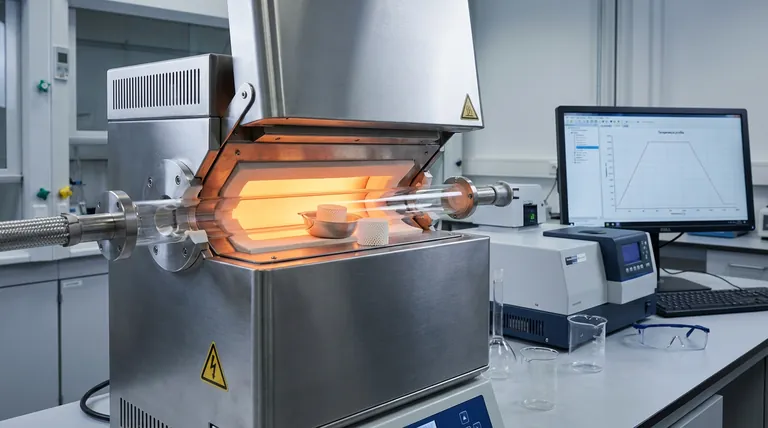
High-temperature furnaces function as precision instruments for chemical separation during the pyrolysis and debinding of 3D-printed glass. Rather than simply applying heat, these furnaces execute strictly controlled thermal profiles to slowly decompose the temporary polymer binders used during printing. This process leaves behind the essential silica material, transitioning the object from a composite print to a pure, porous glass precursor.
The furnace's primary role during this stage is to establish the physical foundation of the final glass component. By facilitating controlled carbonization, it removes organic matter to reveal a stable silica skeleton without damaging the part's geometry.
The Mechanics of Thermal Decomposition
The central challenge in 3D printing glass is removing the "glue" (polymer matrix) without destroying the "sand" (silica particles). The furnace manages this delicate operation.
Precise Heating Profiles
The furnace does not simply ramp up to a maximum temperature. Instead, it follows a specifically engineered heating curve.
This profile ensures that the temperature rises slowly enough to manage the chemical changes occurring within the part.
Decomposition of the Polymer Matrix
As the temperature climbs, the furnace environment causes the polymer matrix to break down.
This acts as a "cleaning" phase where the organic binders that held the 3D-printed layers together are systematically eliminated.
Carbonization
Part of this elimination involves carbonization.
The furnace heat converts organic compounds into carbon residues, which are then evacuated or oxidized, effectively stripping the non-glass elements from the component.
Establishing the Silica Structure
Once the binders are removed, what remains is the critical pre-form of the final glass object.
Revealing the Silica Skeleton
The primary outcome of the furnace's work during this stage is the creation of a porous silica skeleton.
This structure maintains the shape of the original 3D print but is now composed almost entirely of silica.
Creating the Foundation for Densification
This skeleton is not yet transparent glass; it is the physical framework required for the next stage.
By successfully removing the binder, the furnace prepares the porous structure to be collapsed into a dense, transparent glass solid during subsequent sintering (which occurs at even higher temperatures).
Understanding the Trade-offs
While the furnace is essential, the debinding process carries inherent risks that require careful management.
The Risk of Thermal Shock
If the furnace heats the component too quickly, the rapid gas generation from the decomposing polymer can rupture the part.
"Slowly decompose" is the operative phrase; patience in the thermal profile is required to prevent cracking or distortion.
Incomplete Debinding
If the temperature profile is insufficient or the duration too short, organic residues may remain trapped inside the part.
This leads to defects in the final glass, such as cloudiness or black carbon inclusions, compromising the goal of a transparent glass structure.
Making the Right Choice for Your Goal
When configuring your furnace for the pyrolysis and debinding of glass components, prioritize control over raw power.
- If your primary focus is Geometric Fidelity: Ensure your heating ramp is extremely slow to allow gas escape without warping the delicate silica skeleton.
- If your primary focus is Optical Clarity: Verify that your maximum temperature and dwell time are sufficient to achieve complete carbonization and elimination of all organic matter.
The success of the final glass product is determined by how gently and thoroughly the furnace removes the binder in this critical intermediate stage.
Summary Table:
| Stage | Function | Outcome |
|---|---|---|
| Heating Profile | Controlled thermal ramping | Prevents thermal shock and ruptures |
| Polymer Decomposition | Systematic elimination of binders | Removal of the temporary organic matrix |
| Carbonization | Oxidation of organic compounds | Strips non-glass elements from the part |
| Skeleton Formation | Structural stabilization | Creates a porous silica pre-form for sintering |
Transform Your 3D-Printed Glass Production with KINTEK
Achieving perfect optical clarity and geometric precision requires more than just heat; it requires absolute thermal control. Backed by expert R&D and manufacturing, KINTEK offers high-performance Muffle, Tube, Rotary, Vacuum, and CVD systems designed to handle the most delicate pyrolysis and debinding stages. Whether you are a research lab or an industrial manufacturer, our customizable high-temp furnaces ensure complete binder removal without compromising your part's integrity.
Ready to elevate your material processing? Contact our specialists today to find the perfect furnace for your unique needs.
References
- Ziyong Li, Xiewen Wen. One-photon three-dimensional printed fused silica glass with sub-micron features. DOI: 10.1038/s41467-024-46929-x
This article is also based on technical information from Kintek Furnace Knowledge Base .
Related Products
- High Temperature Muffle Oven Furnace for Laboratory Debinding and Pre Sintering
- 1400℃ High Temperature Laboratory Tube Furnace with Alumina Tube
- 1200℃ Muffle Oven Furnace for Laboratory
- 1700℃ High Temperature Laboratory Tube Furnace with Alumina Tube
- 1800℃ High Temperature Muffle Oven Furnace for Laboratory
People Also Ask
- What thermal phenomena occur during polymer binder burnout in ceramic green bodies? Lab Furnace Guide
- What role does a high-temperature muffle furnace play in STFO synthesis? Achieve Pure Perovskite Results
- Why is controlled heat treatment in a muffle furnace necessary for calcined clay? Achieve Optimal Pozzolanic Activity
- How does a high-temperature muffle furnace facilitate the formation of LaNbxAl1−xO3+δ perovskite structures? Key Roles
- What role does a high-temperature muffle furnace play in the formation of biochar catalysts? Master Catalyst Synthesis



















