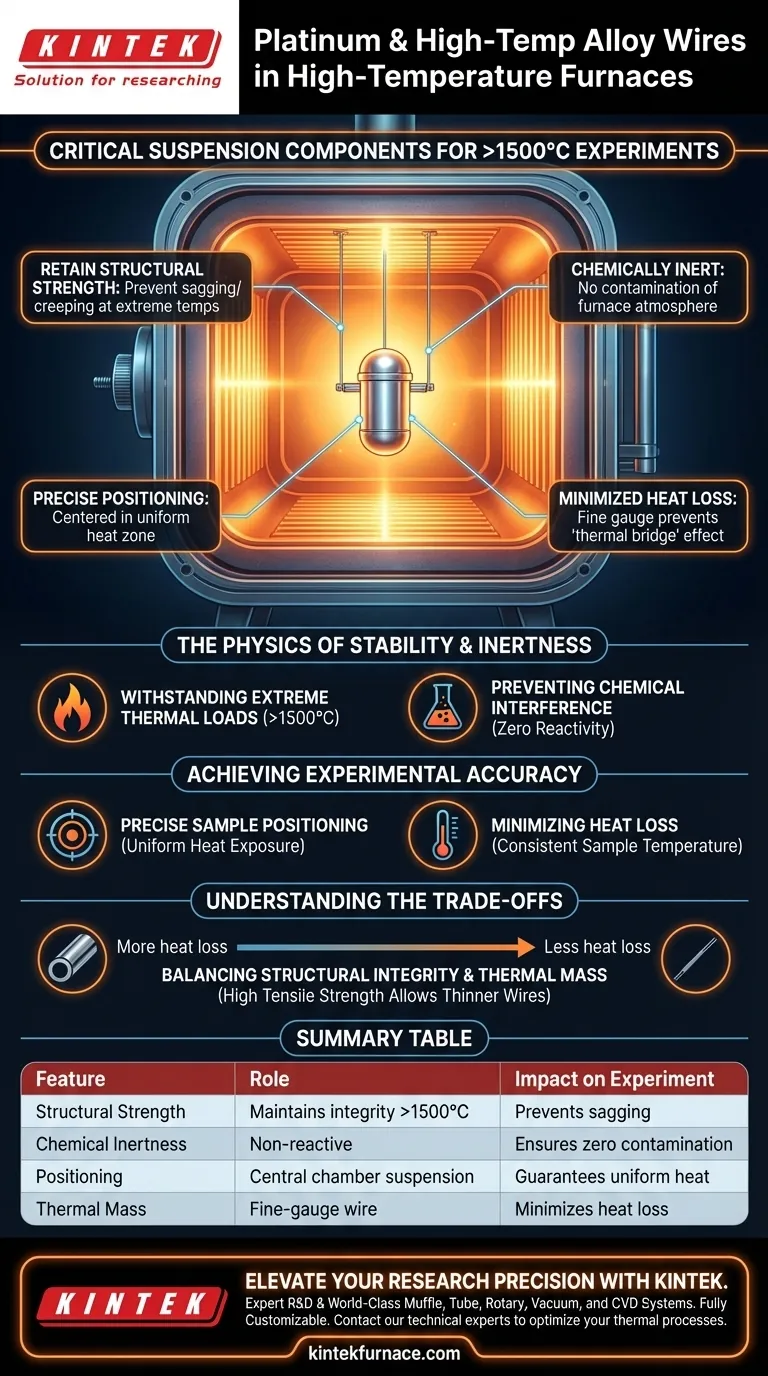
Platinum and high-temperature alloy wires act as critical suspension components designed to maintain structural integrity in experiments exceeding 1500 degrees Celsius. They physically secure encapsulated samples in the precise center of the furnace chamber while preventing chemical contamination and minimizing thermal interference.
The core value of using these specific alloys lies in their ability to decouple the sample from the furnace environment. By combining extreme heat resistance with a fine form factor, they ensure the sample’s internal temperature remains consistent with the furnace's thermocouple readings.
The Physics of Stability and Inertness
Withstanding Extreme Thermal Loads
Standard suspension materials fail when subjected to the extreme conditions of high-temperature furnaces. Platinum and high-temperature alloys are specifically selected because they retain structural strength at temperatures above 1500°C.
This capability prevents the suspension system from sagging, creeping, or breaking during prolonged heating cycles.
Preventing Chemical Interference
In addition to thermal resilience, these wires must not alter the experiment's chemistry. They are designed to remain chemically inert relative to the furnace atmosphere.
This ensures that the suspension mechanism does not introduce contaminants or react with the environment, preserving the purity of the experimental conditions.
Achieving Experimental Accuracy
Precise Sample Positioning
The geometry of a furnace creates specific thermal gradients, making the physical location of the sample critical. These wires allow for the stable positioning of encapsulated samples directly in the center of the furnace chamber.
Central placement ensures the sample is exposed to the most uniform heat zone, reducing variables caused by uneven heating.
Minimizing Heat Loss
The gauge (thickness) of the suspension wire plays a pivotal role in thermal data accuracy. These specific wires utilize a fine gauge to reduce the physical mass connecting the sample to the outside environment.
A thicker wire would act as a "thermal bridge," conducting heat away from the sample. By using a fine gauge, heat loss is minimized, ensuring the sample temperature stays highly consistent with the temperature measured by the furnace thermocouples.
Understanding the Trade-offs
Balancing Structural Integrity and Thermal Mass
The primary challenge in suspension design is the relationship between the wire's thickness and experimental accuracy. While a thicker wire offers more security, it increases the risk of conductive heat loss, which causes a discrepancy between the set temperature and the actual sample temperature.
Therefore, the system relies on the high tensile strength of platinum/alloys to allow for the thinnest possible wire gauge. You are trading raw mechanical bulk for thermal precision, relying on material quality rather than material volume to hold the weight.
Making the Right Choice for Your Goal
To ensure the validity of your high-temperature experiments, select your suspension material based on your specific precision requirements.
- If your primary focus is Thermal Accuracy: Prioritize wires with the finest possible gauge to minimize heat loss and ensure the sample matches the thermocouple reading.
- If your primary focus is Structural Security: Ensure the alloy selected is rated for structural retention specifically above your target temperature (e.g., >1500°C) to prevent creep.
Success in high-temperature experiments depends on minimizing the suspension system's physical and thermal footprint while maintaining absolute position.
Summary Table:
| Feature | Platinum/High-Temp Alloy Role | Impact on Experiment |
|---|---|---|
| Structural Strength | Maintains integrity above 1500°C | Prevents sagging or sample displacement |
| Chemical Inertness | Non-reactive material properties | Ensures zero contamination of the furnace atmosphere |
| Positioning | Enables central chamber suspension | Guarantees exposure to the uniform heat zone |
| Thermal Mass | Fine-gauge wire construction | Minimizes heat loss to maintain thermocouple accuracy |
Elevate Your Research Precision with KINTEK
Don't let subpar suspension components compromise your high-temperature data. At KINTEK, we understand that every degree matters. Backed by expert R&D and world-class manufacturing, we provide high-performance Muffle, Tube, Rotary, Vacuum, and CVD systems, all fully customizable to meet your unique experimental challenges.
Whether you are working with delicate alloys or require extreme thermal stability, our lab high-temp furnaces are designed to work in harmony with your specialized materials. Ready to optimize your thermal processes? Contact our technical experts today to find the perfect solution for your lab.
Visual Guide
References
- Hamed Abdeyazdan, Evgueni Jak. Phase equilibria in the CuO <sub>0.5</sub> –SbO <sub>1.5</sub> –SiO <sub>2</sub> system. DOI: 10.1111/jace.70123
This article is also based on technical information from Kintek Furnace Knowledge Base .
Related Products
- 1700℃ High Temperature Laboratory Tube Furnace with Alumina Tube
- 1400℃ High Temperature Laboratory Tube Furnace with Alumina Tube
- Vacuum Heat Treat Sintering Furnace Molybdenum Wire Vacuum Sintering Furnace
- Small Vacuum Heat Treat and Tungsten Wire Sintering Furnace
- 1700℃ Controlled Inert Nitrogen Atmosphere Furnace
People Also Ask
- How are high-temperature laboratory tube furnaces applied in long-term vacuum homogenization heat treatments for intermetallic samples?
- How do high-temperature laboratory tube furnaces ensure environmental stability? Precision Thermal Reduction Tips
- In what scenarios are laboratory high-temperature tube furnaces or muffle furnaces utilized? Study MgTiO3-CaTiO3 Ceramics
- How does a laboratory high-temperature tube furnace contribute to the conversion of electrospun fibers? Expert Insights
- What is the mechanism of a high-temperature furnace in Bi-2223 sintering? Achieve Precision Phase Transformation